This guide explains how Bluetooth 6 works in real-world headphones and earbuds.
It serves as a reference page for all Bluetooth 6 headset reviews on BestTechRadar.
What Is Bluetooth 6?
Bluetooth 6 is the next generation of Bluetooth technology and builds on previous versions such as Bluetooth 5.0, Bluetooth 5.3, and Bluetooth 5.4.
Like earlier versions, Bluetooth 6 is used to transmit data wirelessly between devices.
In everyday use, this most often means sending music from a phone to headphones or earbuds through Bluetooth.
For this transmission to work properly, both devices must use the same language to compress and decode audio data.
That language is called a Bluetooth audio codec.
To keep this article focused and practical, the phone is used as the audio source and the headphones as the receiving device.
This setup represents the most common Bluetooth audio use case on smartphones today.
Bluetooth codecs are not just technical details.
They directly affect how music sounds, how much delay you experience, and how stable the wireless connection is.
In real-world use, this is the exact scenario tested across modern smartphones and wireless headphones.
Bluetooth 6 Release Date
Bluetooth 6 was officially announced when the Bluetooth 6.0 specification was finalized in September 2024 by the Bluetooth SIG.
In practice, new Bluetooth versions only reach users after manufacturers integrate the standard into hardware and software.
Because of this, Bluetooth 6 devices appear gradually, starting with early smartphones and audio products, while wider adoption takes more time.
Bluetooth 6 Features (What’s New?)
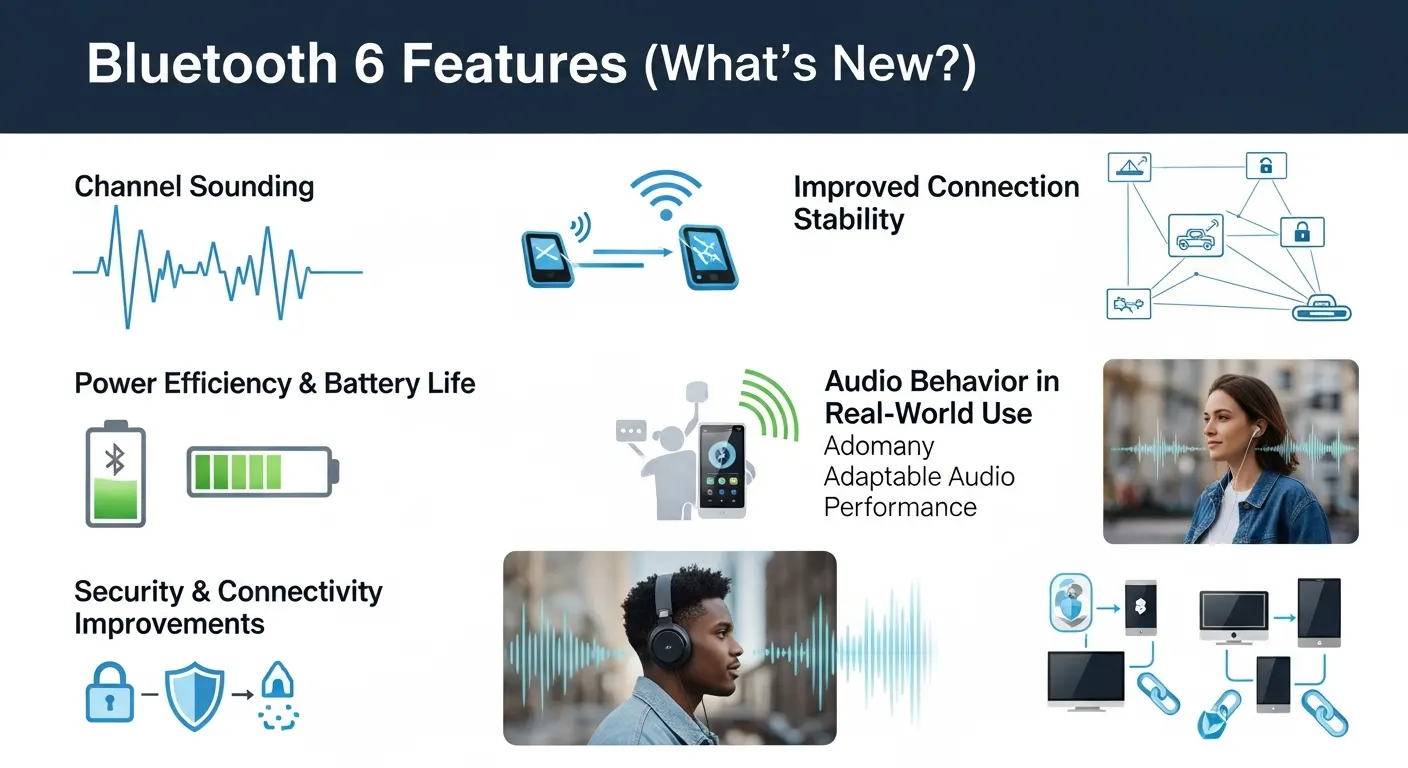
Channel Sounding
Bluetooth 6 Channel Sounding is designed to improve how devices measure distance and positioning in real-world use.
This feature is mainly useful for device tracking and “find my” scenarios, where higher distance accuracy makes locating devices more reliable.
Below is a detailed video on how Bluetooth 6 makes your earbuds better:
Improved Connection Stability
Distance, signal interference, antenna quality, and surrounding wireless devices all affect Bluetooth performance.
This new version improves how devices manage and interpret radio signals, resulting in more stable behavior in challenging environments.
Power Efficiency & Battery Life
Power efficiency improvements in Bluetooth audio are closely linked to audio codecs.
SBC provides basic sound quality with low power consumption.
LC3 offers better sound quality at lower bitrates compared to older codecs.
It also uses less power and provides much lower latency.
Audio Behavior in Real-World Use
In real-world use, many Bluetooth 6 improvements are experienced through Bluetooth audio behavior.
These improvements depend not only on the Bluetooth version itself, but also on audio codecs and overall device implementation.
In simple terms, higher bitrate usually means better sound quality.
In theory, codec specifications are often very high.
However, real wireless transmission always has limitations such as distance, antenna quality, and crowded radio environments.
When conditions worsen, the system lowers bitrate to maintain a stable connection.
Security & Connectivity Improvements
For Bluetooth audio to work correctly, both the source device (phone, music player) and the receiving device (headphones, speakers) must support the same codec.
Bluetooth 6 vs Bluetooth 5 (Full Comparison)
Bluetooth 6 vs Bluetooth 5.4
| Aspect | Bluetooth 5.4 | Bluetooth 6 |
| Bluetooth core version | 5.4 | 6.0 |
| Max LE PHY data rate | 2 Mbps | 2 Mbps |
| Audio quality | Codec dependent | Codec dependent |
| Audio latency | Codec dependent | Codec dependent |
| Device positioning | Not supported | Channel Sounding |
| Distance accuracy | Not available | Centimeter-level |
| Compatibility | Wide device support | Backward compatible |
Check out our detailed comparison of Bluetooth 5.4 vs 6.0.
Bluetooth 6 vs Bluetooth 5.3
| Audio parameter | Bluetooth 5.3 | Bluetooth 6 |
| LE Audio support | Yes | Yes |
| Sample rate | Codec dependent | Codec dependent |
| Bit depth | Codec dependent | Codec dependent |
| Bitrate | Codec dependent | Codec dependent |
| Audio transport | Isochronous Channels | Enhanced isochronous handling |
| Positioning support | No | Channel Sounding |
Bluetooth 6 vs Bluetooth 5.0
| Real-world factor | Bluetooth 5.0 | Bluetooth 6 |
| Bluetooth core version | 5.0 | 6.0 |
| Max LE PHY data rate | 2 Mbps | 2 Mbps |
| Frequency band | 2.4 GHz ISM | 2.4 GHz ISM |
| Connection stability | Environment dependent | More stable behavior |
| Interference handling | Adaptive hopping | Improved scanning and filtering |
| Device positioning | RSSI-based estimation | Channel Sounding |
| Distance accuracy | Meter-level | Centimeter-level |
Bluetooth Audio Specifications (Codec-Level)
For headphones and earbuds, audio codecs have a bigger impact on sound quality and latency than the Bluetooth version itself.
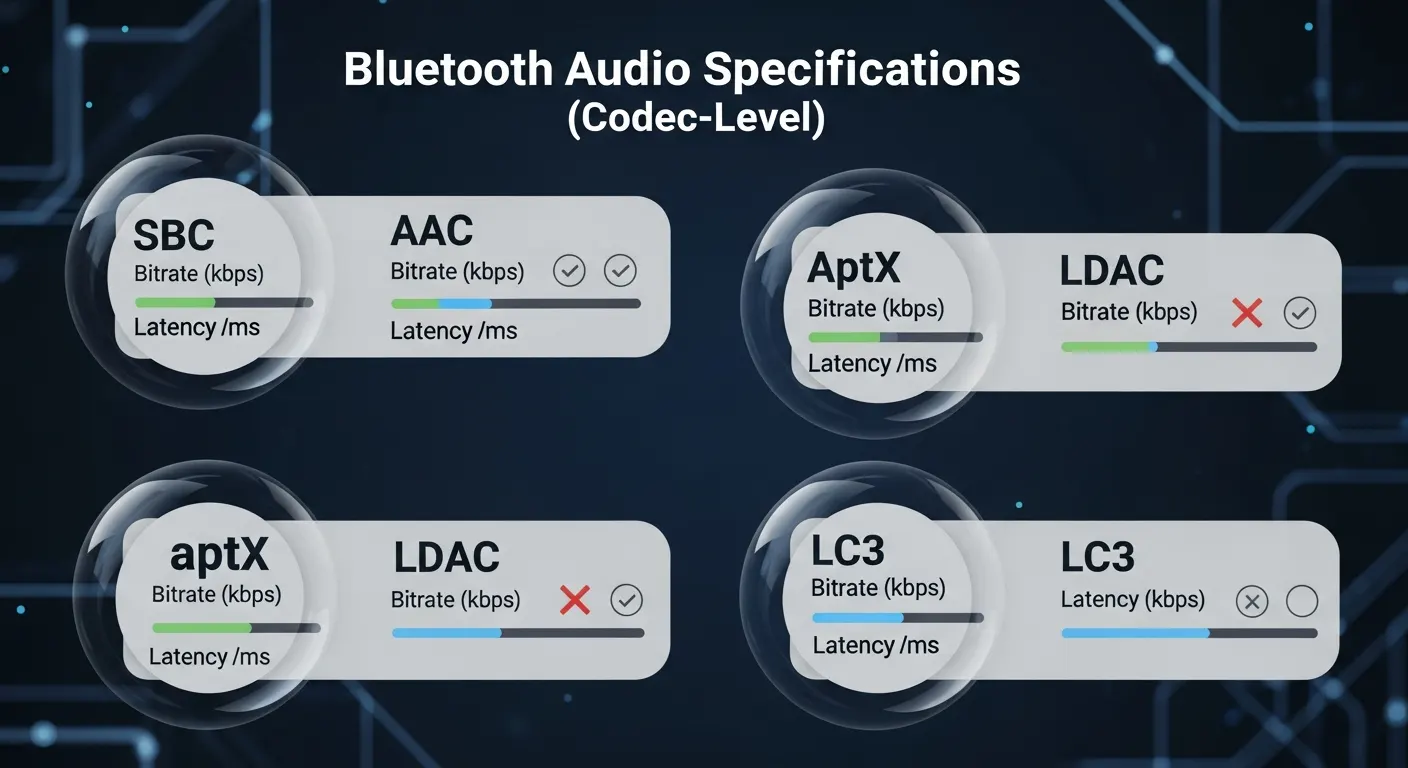
Bluetooth audio specifications describe how sound is compressed, transmitted, and decoded in real-world use.
These technical values affect Bluetooth sound quality and performance rather than Bluetooth version or protocol-level behavior.
To understand Bluetooth audio, you need to understand three core values used by audio codecs.
Sample rate is the number of times audio is sampled per second.
CD-quality audio uses 44.1 kHz, while high-resolution audio can reach up to 192 kHz.
Bit depth describes how much audio information is captured in each sample.
Higher bit depth means more detail and better sound quality.
Bitrate is the amount of audio data transmitted per second.
In simple terms, higher bitrate usually results in better sound quality.
Sample rate, bit depth, and bitrate are the core elements of Bluetooth audio compression and sound quality.
Bluetooth 6 for Headphones & Earbuds
Latency is the time between the phone sending audio and the headphones playing it.
Lower latency improves audio and video synchronization when watching movies or playing games.
With modern codecs and optimized implementations, latency can drop to around 30-40 milliseconds. With current wireless headphones, latency improvements depend far more on codec support and tuning than on Bluetooth version alone.
Bluetooth 6 for Bluetooth Speakers
Besides phones and headphones, Bluetooth audio is widely used with Bluetooth speakers, home audio systems, and car audio systems.
Bluetooth 6 Devices (What Will Support It?)
Bluetooth 6 devices are appearing gradually, with early adoption focused on smartphones and audio products.
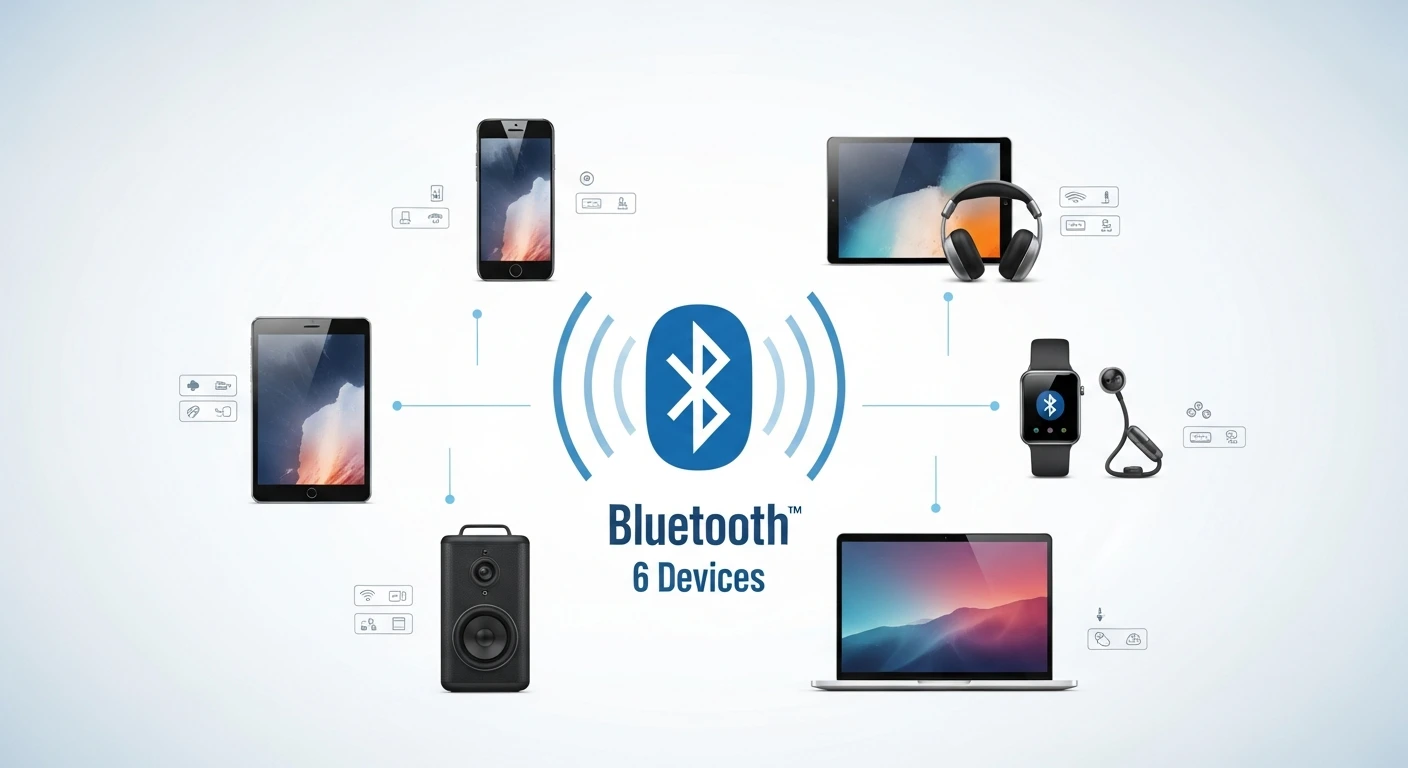
Support for Bluetooth 6 depends on both hardware and software implementation, and broader availability takes time.
Wearables & Smartwatches
Lower power consumption improves battery life and real-world usability in compact devices.
Bluetooth 6 Backward Compatibility
Bluetooth 6 remains backward compatible with older Bluetooth versions.
However, to use advanced audio features, both the source device and the receiving device must support the same Bluetooth version and audio codec.
Is Bluetooth 6 Worth Waiting For?
Understanding codec differences helps you choose headphones or phones that match your real-world usage.
Choosing the wrong codec can lead to poor sound quality or noticeable delay, even on expensive devices. Its value comes from smarter connection handling, improved positioning accuracy, and better power efficiency.
For most users, the benefits of Bluetooth 6 will become noticeable gradually as devices and codecs evolve.
In practice, most Bluetooth 6 benefits become noticeable only when both devices and audio codecs fully support the new standard.
FAQ
What Is Bluetooth 6?
Bluetooth 6 is the next generation of the Bluetooth standard. It builds on earlier versions and introduces new core features such as Channel Sounding while remaining compatible with older devices.
Is Bluetooth 6 Faster Than Bluetooth 5.3?
Bluetooth 6 does not increase raw Bluetooth data speed. Real-world performance still depends on radio limits, device hardware, and implementation.
Does Bluetooth 6 Improve Audio Quality?
Audio quality is still defined by the Bluetooth audio codec. Bluetooth 6 itself does not improve sound quality without codec support.
Will Bluetooth 6 Reduce Latency?
Bluetooth 6 can improve latency behavior through newer Bluetooth mechanisms. Actual latency still depends on codec choice and device implementation.
Do You Need New Hardware for Bluetooth 6?
Yes. To use Bluetooth 6 features, both devices must support Bluetooth 6 at the hardware and software level.