AI ENC stands for artificial intelligence environmental noise cancellation. It is a call feature that uses microphones and software to pick out your voice and remove background noise before the sound reaches the person on the other end. Product pages usually list it next to phrases like clear calls or call noise reduction. Below you will find what the term means, how it works, how it differs from ENC and ANC, and how to test it on your own pair.
The feature is also appearing on new releases. The SOUNDPEATS CC3 Pro, announced for October 28, 2026, lists AI ENC in its specifications, and it is covered further down as an example.
What Does AI ENC Mean?
AI ENC is a call noise reduction feature that adds machine learning to standard environmental noise cancellation. The two parts of the name are easier to understand one at a time.
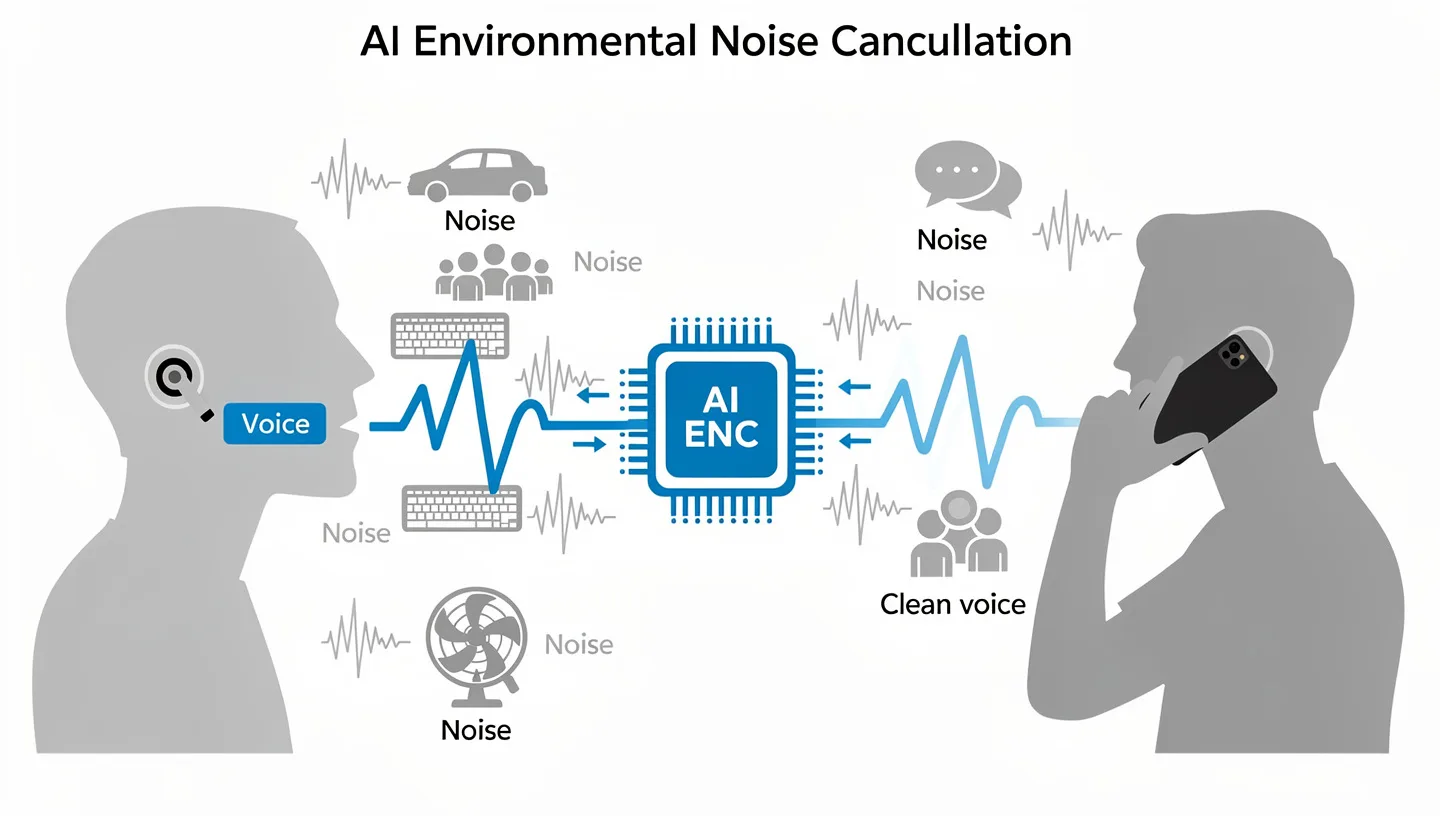
ENC Stands for Environmental Noise Cancellation
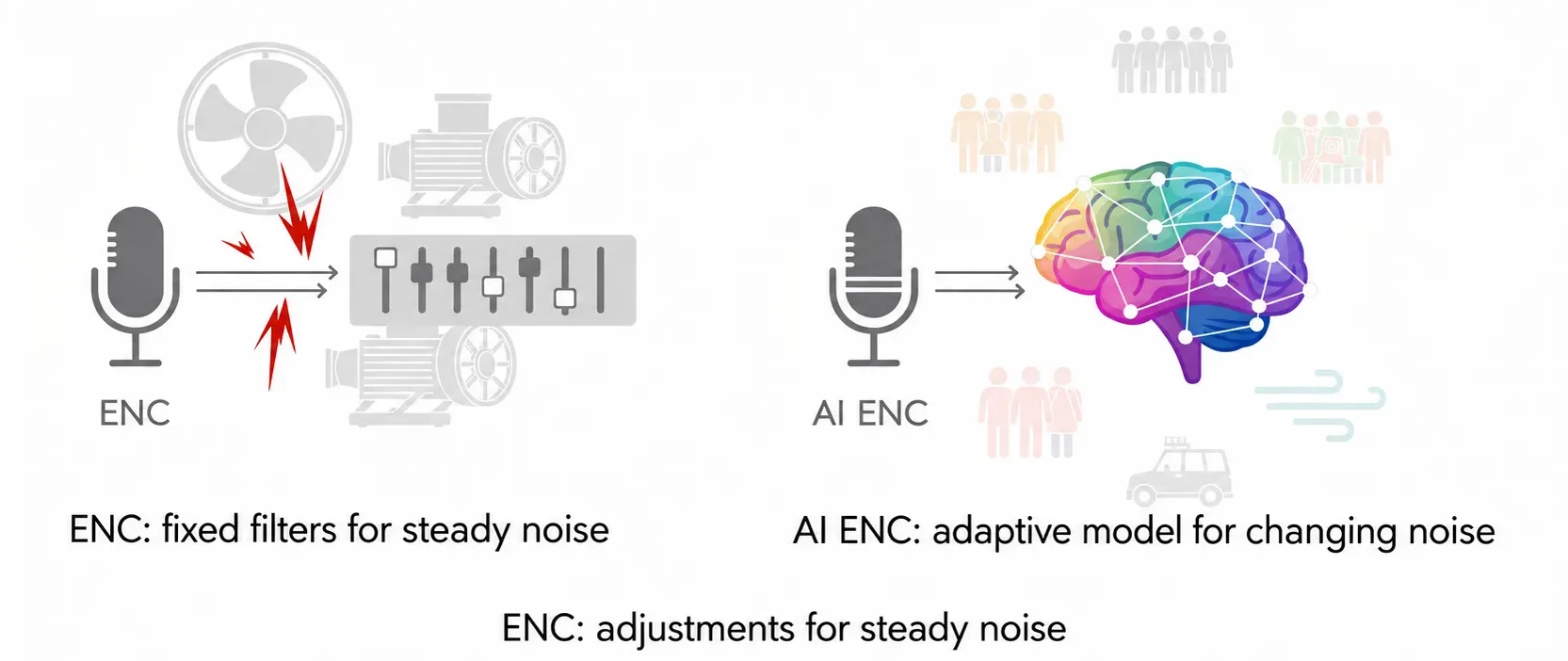
ENC reduces sounds around you, such as traffic, wind, chatter and fans, on the microphone side of a call. It works on the signal your earbuds send out, so it changes what the caller hears and leaves what you hear untouched. Older ENC relies on digital signal processing (DSP) filters, which deal well with steady sounds like an engine hum but can miss sudden ones.
What the AI Part Adds
The AI part refers to algorithms trained on samples of speech and noise. Instead of one fixed filter, the software learns to tell a human voice from traffic, keyboard clatter or other people talking, and it adjusts as the surroundings change. When you walk from a quiet room onto a busy street, the processing shifts with you. Brands use the label loosely, as explained further down.
How Does AI ENC Work?
AI ENC captures sound with the built-in microphones, separates your voice from everything else, and sends only the cleaned voice to the caller. The process runs in real time in four steps.
- The microphones pick up your voice together with the sounds around you.
- A processing chip runs the algorithm, which marks what is speech and what is noise.
- The noise is reduced or removed from the outgoing signal.
- The cleaned voice travels over Bluetooth to your phone and then to the caller.
The exact setup differs between products, and it is one part of the wider set of earbud technologies that decide how a pair performs on calls.
Single Mic vs Multiple Mics
Many explanations describe one microphone near the mouth and another facing outward, so the system can compare the two signals. Earbuds with four or six microphones have even more data to work with. A model with one microphone per earbud has less to compare, which puts more of the work on the software. Brands rarely publish how the microphones are used during a call, so the number on the spec sheet tells only part of the story.
Where the Processing Happens
Some pairs run the noise reduction on the chip inside the earbuds, while others depend more on the phone, and brands seldom say which. The chip matters because heavier processing needs more computing power, which is why the feature shows up mostly on mid-range and newer models. The article on wireless earbud chips covers this side in more detail.
AI ENC vs ENC: What Is the Difference?
The main difference is the method: ENC applies fixed filtering, while AI ENC uses a trained model that adapts to the situation.
| Feature | ENC | AI ENC |
|---|---|---|
| Method | DSP filtering with set rules | Machine learning model trained on speech and noise |
| Works best with | Steady noise such as fans and engines | Changing noise such as traffic, crowds and wind |
| Sudden sounds | Often get through | Handled better, depending on the model |
| Adapts to surroundings | Limited | Yes, in real time |
| Price range | Budget and up | Often a bit higher |
Results depend on the microphones and the tuning as much as on the label, so a well-tuned ENC can still beat a weak AI ENC.
AI ENC vs ANC: Two Different Jobs
ANC changes what you hear, and AI ENC changes what the other person hears.
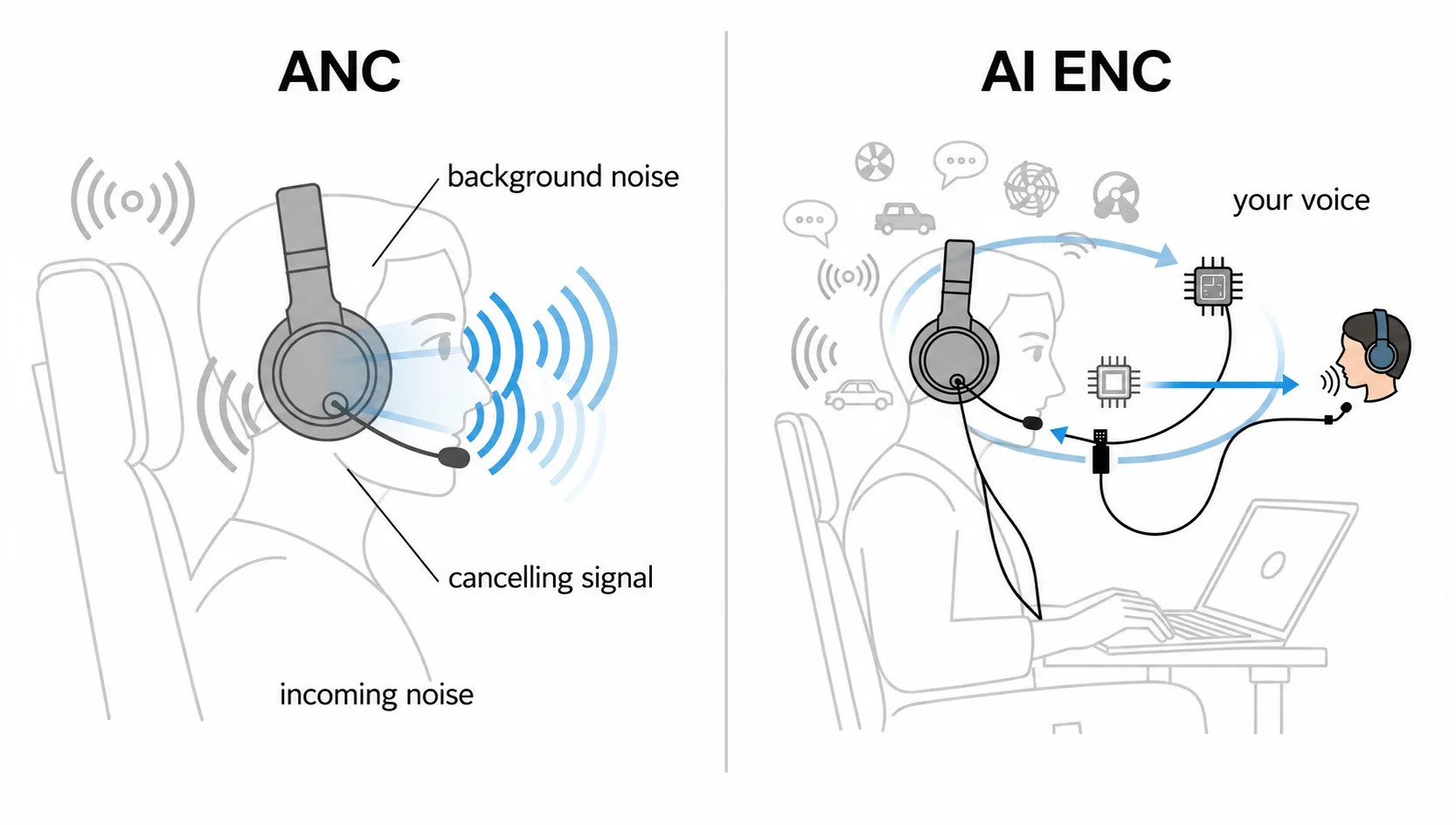
Active noise cancellation uses microphones to detect ambient noise and plays an opposite signal in your ears, which lowers the sound reaching you. Wikipedia has an overview of active noise control for the technical side.
| Feature | ANC | AI ENC |
|---|---|---|
| Who benefits | You, the listener | The person you are talking to |
| Works on | Sound coming into your ears | Your voice going out |
| Best use | Music, flights, commutes, focus | Calls, meetings, voice chat |
| Where it runs | Speaker side, with outward microphones | Microphone side, during calls |
Many earbuds carry both, and they do not conflict, since one handles incoming sound and the other handles outgoing sound. Open-ear models usually skip ANC because there is no seal in the ear canal, yet they can still offer AI ENC for calls.
Is AI ENC a Standard Feature?
No. I could not find an industry standard or shared definition behind the name. Each brand applies it to its own hardware and software, so two products with the same label can perform very differently. Some brands add details like the number of microphones or a decibel figure, and others only print the three letters.
AI ENC vs Qualcomm cVc
Qualcomm cVc is a named set of call algorithms that Qualcomm describes as covering noise suppression, echo cancellation, automatic gain control and packet loss concealment, on both the sending and receiving side of a call. Product pages list it as cVc 8.0 or AI CVC. It comes from a chip maker, while AI ENC is a generic label, and products built on Qualcomm chips often list cVc separately. The wider platform is covered in the article on Snapdragon Sound.
What AI ENC Can and Cannot Do
AI ENC reduces background noise on calls, but it cannot remove every sound and it depends on the hardware around it.
Wind, Traffic and Crowd Noise
It handles steady traffic and moving crowd noise better than older ENC. Wind is the hardest case, because gusts hit the microphone directly and the processing may pull down your voice along with the noise. Some brands add separate wind reduction, so look for it in the specifications.
Why Your Voice Can Sound Distant
Strong suppression can lower the level of your voice, so callers may hear you slightly further away in loud places. If a caller keeps asking you to repeat yourself, the tuning is too aggressive for that environment. Moving to a quieter spot for a minute usually fixes it.
Open-Ear Earbuds and AI ENC
Clip-on earbuds and other open-ear designs leave the ear canal open, so surrounding noise reaches both your ears and the microphones freely. AI ENC still cleans the outgoing voice for the caller, but you keep hearing the street yourself. Reviewers testing open-ear models generally report acceptable call quality at home and in the office, with more compromise outdoors. The open design limits what any noise reduction can do, and the results vary from one model to the next.
Bluetooth Call Quality Limits
Music codecs such as LDAC or AAC apply to playback only. Calls run over a separate voice link with far less bandwidth, so even a clean voice gets compressed on the way to your phone. That limit caps how natural your voice can sound on the other end, whatever the noise reduction does. Newer devices with LE Audio and the LC3 codec improve this when both the phone and the earbuds support it.
Does AI ENC Affect Battery Life?
Sources disagree. Some describe a small drop in battery life, while others call the effect minimal because the feature only runs during calls and voice chat. The result depends on the chip and how much processing the model needs. If you mostly listen to music you will barely notice it, and frequent callers should check battery figures in independent reviews.
How to Test AI ENC Yourself
The easiest test is to record your own voice in a noisy place and listen back. Use the same sentence every time so the results are easy to compare.
- Read a sentence for about 30 seconds and record it in a quiet room as a baseline, using a voice memo or a call to yourself.
- Repeat next to a running fan or a white noise app.
- Repeat outside near traffic, and once more in the wind.
- If the companion app lets you switch the feature off, record with it on and off.
- Play the recordings back and check the level of your voice, the amount of background noise and any robotic tone.
- Make a real call and ask the other person what they hear.
Which Earbuds and Headphones Have AI ENC?
AI ENC appears mostly on budget and mid-range wireless earbuds, and the list keeps growing.
- SOUNDPEATS Clip1, an open-ear clip-on model with AI ENC listed for calls
- Soundcore Aerofit 2 Pro, an open-ear design with four microphones and an AI algorithm for calls
- ACwO DwOTS 515, a budget true wireless pair with AI-powered ENC
Availability and specifications change often, so confirm the details on the product page before you buy.
SOUNDPEATS CC3 Pro (Announced)
The SOUNDPEATS CC3 Pro is an open-ear clip-on model announced for October 28, 2026, with a list price of 69.99 USD on the US Amazon store. The specification sheet lists AI ENC for call noise reduction and one microphone per earbud. The brand has not published a noise reduction figure or details on how the processing works. I have a review unit, so results from real calls and recordings will be added after launch. For background on the brand, see whether SOUNDPEATS is a good brand.
Do You Need AI ENC?
You need AI ENC if you take calls, join meetings or use voice chat in places that are not quiet. Remote workers, commuters and gamers on team chat get the most from it.
- Worth it if you call from the street, a cafe or public transport, or you talk a lot during the workday.
- Skip it if you rarely talk on your earbuds and mostly listen to music, where ANC and fit matter more.
For a wider selection of models across price ranges, see the list of best wireless earbuds.
Conclusion
AI ENC cleans up your voice on calls, and it does nothing for the sound you hear while listening. The label has no shared standard, so the microphones, the chip and the tuning decide the result more than the name does. Test it with your own recordings in a noisy place before you trust it for work calls.
Frequently Asked Questions
What is AI ENC in earbuds?
AI ENC is a call feature that uses microphones and a trained algorithm to remove background noise from your voice. The person on the other end hears you more clearly, even in a noisy place.
Is AI ENC the same as ANC?
No. ANC lowers the noise you hear, while AI ENC cleans the voice you send during calls. One helps the listener and the other helps the caller.
Is AI noise cancellation good?
It usually works well against steady traffic and crowd noise when the microphones and tuning are decent. Wind and sudden loud sounds are harder, and results differ a lot between brands.
Can ENC and ANC work at the same time?
Yes. They run on different audio paths, one for incoming sound and one for your outgoing voice, so earbuds can offer both without a conflict.
Does AI ENC need more than one microphone?
Not strictly. More microphones give the system more information, but a model with one microphone per earbud can still run noise reduction, with more of the work done by the software. Check reviews for real call results.
Does AI ENC work in open-ear earbuds?
Yes, it can clean your outgoing voice for the caller. You will still hear the surroundings yourself, and outdoor calls are harder than calls at home or in the office.
Will AI ENC make my voice sound robotic?
A well-tuned system keeps your voice natural. Weaker tuning can add artifacts or lower your volume, especially in loud places.
Does every pair of earbuds have AI ENC?
No. It is more common on mid-range and newer models, and many entry-level pairs only have a basic microphone with little or no noise reduction.
How can I test if AI ENC works?
Record the same sentence in a quiet room, near a fan and outside, then compare the recordings. If the app has a switch for the feature, record with it on and off, and finish with a real call.