Every time a new Bluetooth version launches, the same question follows: do you need to upgrade your headphones? With Bluetooth 6.0 arriving in September 2024 and Bluetooth 5.4 still shipping in most mid-range and premium headphones through 2026, the question is worth answering properly. The short version is that the version number printed on a spec sheet tells you less about audio performance than the codec and chipset inside the device. But there are real differences between 5.4 and 6.0, and some of them matter depending on what you are using the headphones for.
This covers what each version actually introduced, what changed between them, and what the difference means for wireless audio in practice.
The short answer: the version number matters less than you think
Both Bluetooth 5.4 and Bluetooth 6.0 use the same 2 Mbps maximum LE PHY data rate. Neither version changed the raw speed of the wireless link. Audio quality over Bluetooth is determined by the codec, not the Bluetooth version. Latency is determined by the codec and the audio profile. A pair of headphones running LC3 over Bluetooth 5.4 will sound identical to the same headphones running LC3 over Bluetooth 6.0, because the audio pipeline is the same in both cases.
What changed between 5.4 and 6.0 are the feature sets surrounding the connection: how devices measure distance from each other, how they filter advertising packets, and how they handle timing-sensitive data. These features matter significantly for IoT applications, indoor positioning systems, and device tracking. For wireless headphones and earbuds, most of them are irrelevant today because headset hardware has not yet implemented the new 6.0 features in audio applications.
When each version was released and what it was designed for
Bluetooth 5.4 was finalized in February 2023 by the Bluetooth Special Interest Group. Its headline feature was Periodic Advertising with Responses, known as PAwR, which is the underlying technology that makes Auracast broadcast audio possible. PAwR allows a single source device to send audio to large numbers of receivers simultaneously without establishing individual connections to each one. Bluetooth 5.4 also introduced encrypted advertising data, closing a security gap that had existed since early Bluetooth LE versions where advertising packets were sent in plain text.
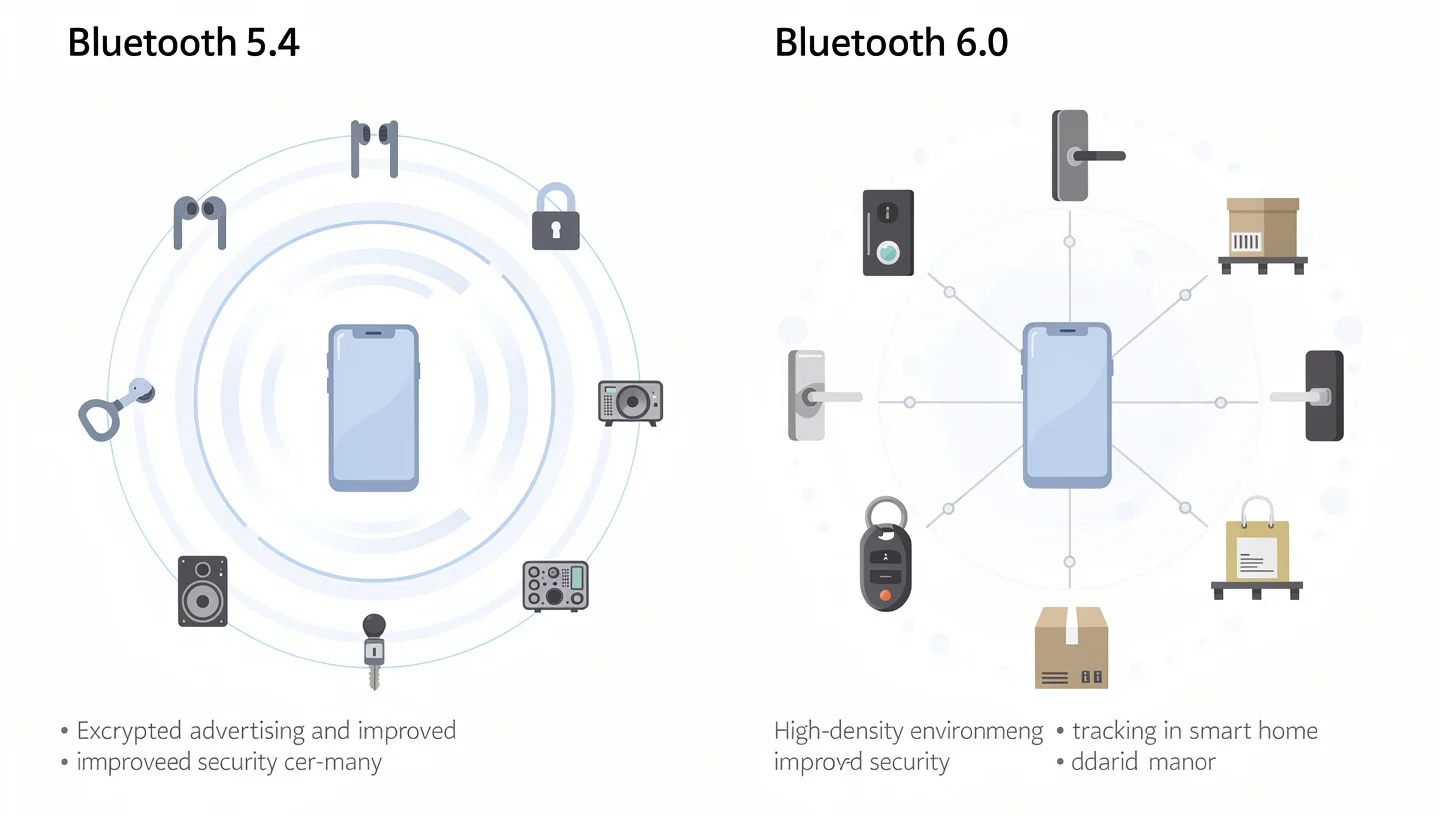
Bluetooth 6.0 was finalized in September 2024. Its headline feature is Channel Sounding, a ranging system that allows two Bluetooth devices to measure their distance from each other with centimeter-level accuracy. This is primarily designed for precision device tracking, smart lock applications, and asset monitoring in industrial and retail environments. Bluetooth 6.0 also added Decision-based Advertising Filtering and Frame Space updates that improve efficiency in high-density device environments. Consumer audio products with Bluetooth 6.0 began shipping in late 2024 and have become more common through 2025 and 2026.
Bluetooth 5.4 vs 6.0: feature comparison
| Feature | Bluetooth 5.4 | Bluetooth 6.0 |
|---|---|---|
| Release date | February 2023 | September 2024 |
| Max LE PHY data rate | 2 Mbps | 2 Mbps |
| PAwR and Auracast support | Yes | Yes |
| Encrypted advertising data | Yes | Yes |
| LE GATT Security Levels | Yes | Yes (enhanced) |
| Channel Sounding | No | Yes, centimeter-level |
| Decision-based Advertising Filtering | No | Yes |
| Frame Space Update | No | Yes |
| Audio quality | Codec dependent | Codec dependent |
| Latency | Codec dependent | Codec dependent |
| Backward compatible | Yes | Yes |
What Bluetooth 6.0 adds that 5.4 does not have
Three features in Bluetooth 6.0 are genuinely new and not present in 5.4. Understanding what each one does makes it clear which use cases benefit from the upgrade and which ones do not.
Channel Sounding: centimeter-level distance measurement
Channel Sounding is the most significant addition in Bluetooth 6.0. Earlier Bluetooth versions estimated distance between devices using Received Signal Strength Indication, known as RSSI, which gave meter-level accuracy at best and was unreliable in environments with obstacles and multipath interference. Channel Sounding uses a combination of phase-based ranging and round-trip timing across multiple radio channels to measure the physical distance between two Bluetooth 6.0 devices with centimeter-level accuracy.
The practical applications are in device tracking (a more accurate version of Find My), smart locks that can determine whether you are at the door or further away, and industrial asset management where precise location matters. For headphones and earbuds, Channel Sounding has no audio-specific application in current products. No headset on the market in 2026 uses Channel Sounding for any audio function. It is a feature for future positioning-aware applications that headphone manufacturers have not yet built.
Decision-based Advertising Filtering
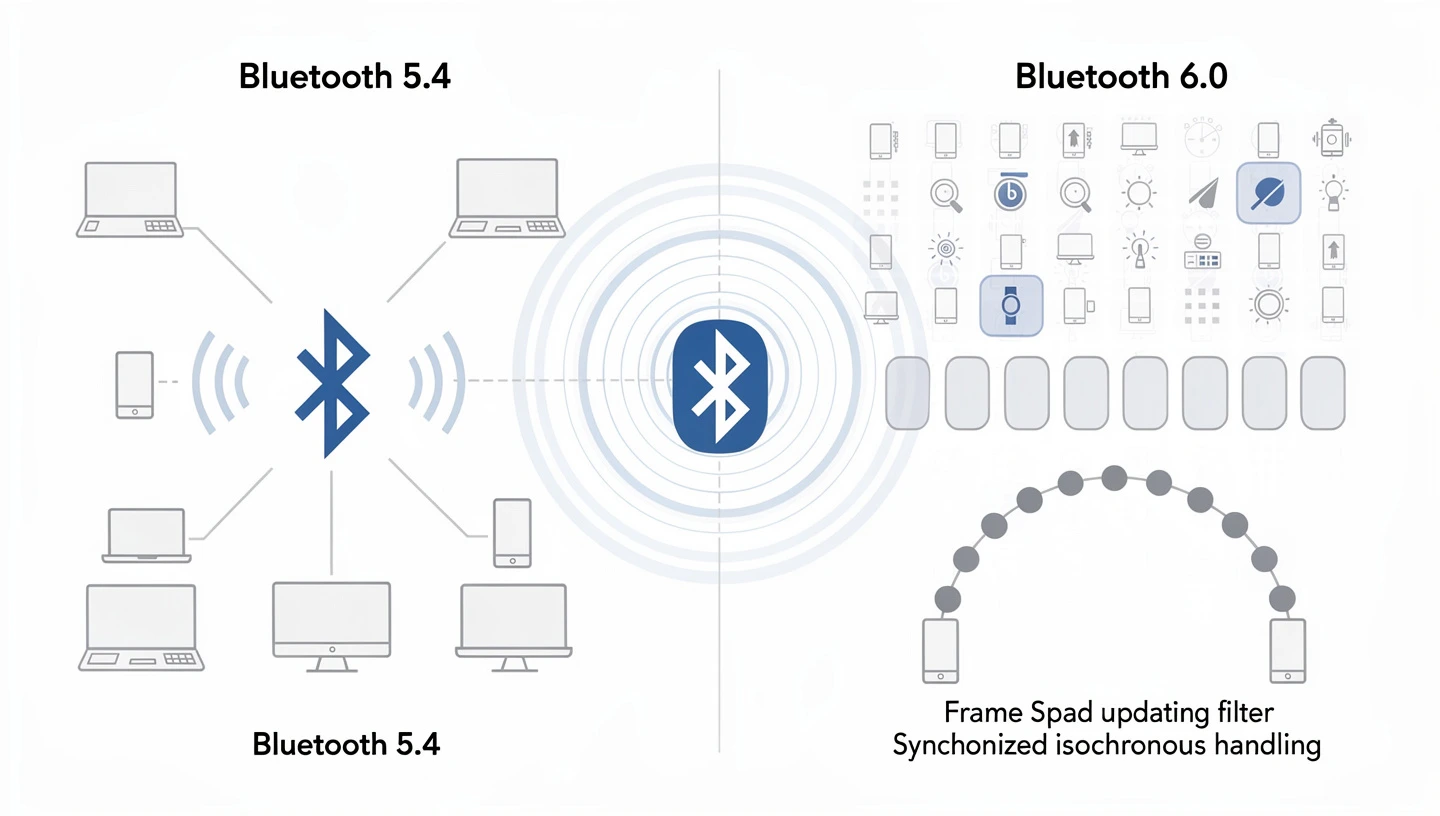
Decision-based Advertising Filtering, shortened to DBAF, allows a Bluetooth 6.0 device to offload advertising packet filtering decisions to the controller hardware rather than the host processor. In environments with many Bluetooth devices broadcasting simultaneously, the host processor on a phone or headphone chip was previously woken up to evaluate every incoming advertising packet, even ones from irrelevant devices. DBAF lets the controller chip handle that filtering without waking the host, which reduces power consumption and processing overhead in dense device environments.
For wireless earbuds, the benefit is a small reduction in the energy cost of maintaining a Bluetooth connection in busy environments like offices, gyms, or public transport. The improvement is incremental rather than dramatic, but it contributes to slightly better battery efficiency in the conditions where earbuds are used most.
Frame Space Update and isochronous handling
The Frame Space Update in Bluetooth 6.0 reduces the mandatory time gap between consecutive data packets in certain transmission scenarios. Shorter frame spacing means the radio can complete a transmission exchange faster and return to a low-power idle state sooner. For isochronous audio channels, the ones used by LE Audio for time-synchronized audio delivery, tighter frame spacing contributes to lower processing overhead and marginally better timing precision. The practical effect on listening is not audible as a sound quality improvement, but it contributes to the connection stability and power efficiency gains that Bluetooth 6.0 headphones advertise.
What Bluetooth 5.4 already covers
Before treating Bluetooth 6.0 as a mandatory upgrade, it helps to understand that most of the features relevant to wireless audio were already present in Bluetooth 5.4. The jump from 5.3 to 5.4 was larger for audio applications than the jump from 5.4 to 6.0.
PAwR and Auracast multi-speaker support
Periodic Advertising with Responses is the protocol layer that enables Auracast, and it was introduced in Bluetooth 5.4. Auracast lets one audio source broadcast to an unlimited number of Bluetooth receivers simultaneously, without each receiver needing a dedicated connection. This is the technology behind multi-speaker setups where you pair two, four, or more speakers together, and behind public audio broadcasts in venues like airports or cinemas. For consumers, PAwR in 5.4 is what makes Auracast-compatible speaker and headphone setups possible today. A full breakdown of how Auracast works is in the Auracast Bluetooth guide.
Encrypted advertising data
Before Bluetooth 5.4, the advertising packets that devices broadcast to announce their presence and capabilities were transmitted in plain text. Any Bluetooth scanner in range could read the device name, service UUIDs, and other identifying information. Bluetooth 5.4 introduced encryption for advertising data, which means device identifiers and connection details are no longer visible to third parties. For headphones, this closes the theoretical tracking vector where your earbuds’ Bluetooth broadcast could be used to identify and follow your location across a public space.
Latency with LE Audio and LC3
The latency improvements that made wireless audio viable for gaming and video arrived with LE Audio in Bluetooth 5.2, not with 5.4 or 6.0. The LC3 codec that runs over LE Audio achieves latency below 20 ms under good conditions, which is comparable to wired audio for most practical purposes. Bluetooth 5.4 inherits all LE Audio capabilities from 5.2 and adds the connection stability improvements from 5.3. A device running Bluetooth 5.4 with LE Audio and LC3 already achieves the latency performance that gamers and video watchers need, without requiring Bluetooth 6.0. The full latency benchmarks across Bluetooth versions are in the Bluetooth 5.4 guide.
What Bluetooth 5.4 vs 6.0 means specifically for headphones and earbuds
The version comparison above covers features across all Bluetooth applications. For headphones and earbuds specifically, the picture is more focused.
Audio quality: codec decides, not Bluetooth version
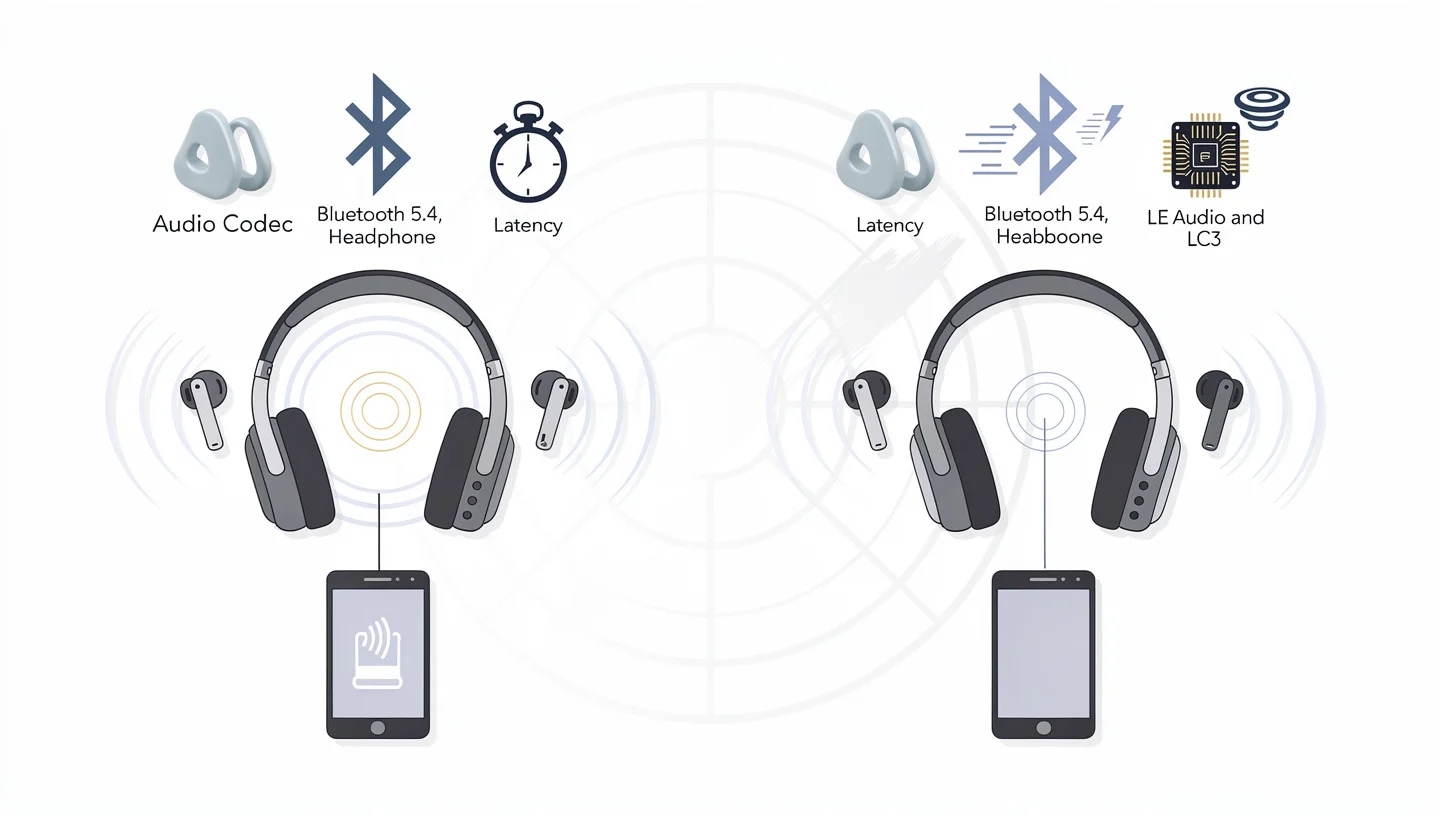
The codec is the compression format used to carry audio from your phone to your headphones. LDAC, aptX Adaptive, LC3 and AAC all run over the same Bluetooth radio regardless of whether the device uses Bluetooth 5.4 or 6.0. Switching from 5.4 headphones to 6.0 headphones while keeping the same codec produces no measurable difference in audio quality. The codec determines the bitrate, the frequency response ceiling, the noise floor, and the compression artifacts. Bluetooth version affects none of those. For anyone trying to decide between two pairs of headphones where one uses 5.4 and the other uses 6.0, the codec specification and driver quality are far more important than the Bluetooth version number. A deeper look at how codecs interact with audio quality is in the Bluetooth codec comparison guide.
Latency: LE Audio and LC3 matter more than 5.4 or 6.0
Latency in wireless headphones is governed by the audio codec and the audio profile, not by the Bluetooth version. Devices running LE Audio with LC3 achieve under 20 ms latency over both Bluetooth 5.4 and 6.0 because the latency improvement came with the isochronous channel architecture in Bluetooth 5.2, which both later versions inherit. What Bluetooth 6.0 adds through the Frame Space Update is a small reduction in overhead during isochronous transmissions, but this is not audible as reduced latency in current headphones. The latency you experience is almost entirely a function of whether the headphones use LE Audio or the older A2DP profile, not whether they use 5.4 or 6.0.
Channel Sounding and headphones: not relevant yet in 2026
Channel Sounding requires both devices in a connection to support Bluetooth 6.0 and to have implemented the Channel Sounding feature in their firmware. No consumer headphones or earbuds released through early 2026 use Channel Sounding for any audio function. The feature exists in Bluetooth 6.0 chipsets but headphone manufacturers have not yet built audio-specific applications around it. The most plausible future use case is automatic device detection and handoff when you move between rooms or devices, but that requires both the phone and the headphones to implement the feature, and neither side has done so yet at scale.
Connection stability improvements in practice
Bluetooth 6.0’s DBAF and Frame Space changes do contribute to more stable connections in dense device environments, and this is the one area where the 6.0 upgrade has a tangible benefit for headphone users in daily use. In offices, gyms, crowded public transport, and other spaces with dozens or hundreds of active Bluetooth devices, the filtering improvements reduce the processing load on the headphone chip during connection maintenance. The result is marginally fewer dropouts and slightly better battery efficiency in those environments. The improvement is real but not dramatic, and Bluetooth 5.4 already handles dense environments better than Bluetooth 5.3 did.
Backward compatibility: will Bluetooth 6.0 headphones work with older phones
Yes. Bluetooth is backward compatible across versions. A pair of Bluetooth 6.0 headphones connecting to a phone with Bluetooth 5.0 will negotiate the highest shared feature set and operate normally. The 6.0-specific features, Channel Sounding, DBAF, and Frame Space, only activate when both devices support Bluetooth 6.0. Everything else, audio streaming, codec selection, multipoint pairing, volume control, and playback control, works regardless of version mismatch.
The same applies in reverse. Bluetooth 5.4 headphones work normally with a Bluetooth 6.0 phone. The phone does not force the connection down to a lower quality. Both devices use the best mutually supported features available. For audio applications, this means the connection experience is essentially identical whether your phone is ahead of or behind your headphones in Bluetooth version, as long as both support the same codecs.
The one exception is Auracast. Auracast requires PAwR support, which starts at Bluetooth 5.4. A phone or speaker running only Bluetooth 5.3 or earlier cannot participate in an Auracast broadcast setup. This is the version compatibility line that matters most for multi-speaker audio setups in 2026. For more on what Bluetooth 6 features look like in practice across different devices, that guide covers the version from the headphone and earbud perspective.
Which headphones and earbuds ship with Bluetooth 6.0 in 2026
Bluetooth 6.0 in consumer audio products became more common through 2025. On the earbud side, the SoundPEATS Air6 HS is one of the early budget models to ship with Bluetooth 6.0, pairing it with a 13mm triple magnet driver and LDAC support at a $39.99 price point. At the premium end, flagship TWS earbuds from Sony, Samsung, and Apple are expected to adopt Bluetooth 6.0 through their 2025 and 2026 product cycles.
On the chipset side, Qualcomm’s S7 and S7 Pro Gen 1 audio chips support Bluetooth 6.0 and are shipping in premium earbuds and headphones from multiple brands. MediaTek’s Dimensity W series also supports Bluetooth 6.0 in the hearing-aid and TWS segments. The adoption curve for Bluetooth 6.0 in consumer audio is following a similar pattern to Bluetooth 5.4: mid-range and premium products first, then broader availability as chipset costs normalize.
For anyone currently using Bluetooth 5.4 headphones, there is no compelling audio-specific reason to upgrade just for Bluetooth 6.0. The audio quality and latency improvements come from codec upgrades, not from the Bluetooth version. If you are buying new headphones and the choice comes down to two otherwise comparable models where one uses 5.4 and the other uses 6.0, the 6.0 model offers slightly better connection efficiency in dense environments and will benefit from future firmware features as they arrive. But buying specifically for the Bluetooth version number, while ignoring codec support, driver quality, and ANC performance, is the wrong prioritization. For budget earbuds that currently use Bluetooth 6.0 with LDAC, the SoundPEATS Air6 HS review covers what the combination delivers in practice.
Bluetooth 5.4 vs 6.0: which matters for your next headphone purchase
If your current headphones use Bluetooth 5.3 or earlier and do not support LE Audio, the relevant upgrade question is whether new headphones support LE Audio and a modern codec like LC3 or aptX Adaptive, not whether they use 5.4 or 6.0. That codec and profile upgrade delivers real, audible improvements in latency and audio quality that the version number does not.
If your current headphones already use Bluetooth 5.4 with LE Audio, upgrading to Bluetooth 6.0 headphones gives you marginally better connection stability in dense environments, future readiness for Channel Sounding applications, and the DBAF efficiency improvements. None of these translate to better sound from your current audio sources today.
The version that matters for audio is Bluetooth 5.2, because that is where LE Audio and LC3 arrived. Everything from 5.3 onward is incremental improvement rather than a fundamental change in what wireless audio can do. Both Bluetooth 5.4 and 6.0 are good versions to have in a headphone. Neither one is a reason to buy or avoid a specific pair on its own. For a full look at where LE Audio fits into the Bluetooth version history and what it changed for wireless audio, that guide covers the audio-specific side of the standard. If you are also weighing up codec choices for your next headphone purchase, the comparison between Bluetooth LE Audio and LDAC covers the practical difference between the two approaches to high-quality wireless audio.
Frequently asked questions
Is Bluetooth 6.0 better than 5.4 for audio quality?
No. Audio quality over Bluetooth is determined by the codec, not the Bluetooth version. Both 5.4 and 6.0 use the same 2 Mbps LE PHY data rate. Headphones running the same codec on either version produce identical audio quality. The codec specification and driver quality matter far more than whether the device uses Bluetooth 5.4 or 6.0.
What is Channel Sounding in Bluetooth 6.0?
Channel Sounding is a ranging system that allows two Bluetooth 6.0 devices to measure the physical distance between them with centimeter-level accuracy. It works using phase-based ranging and round-trip timing across multiple radio channels. It is designed for device tracking, smart locks, and asset monitoring. No consumer headphones in 2026 use Channel Sounding for audio functions.
Are Bluetooth 6.0 headphones backward compatible with older phones?
Yes. Bluetooth is backward compatible across all versions. Bluetooth 6.0 headphones work with any phone running Bluetooth 4.0 or higher. The devices negotiate the highest shared feature set. The Bluetooth 6.0 specific features only activate when both devices support Bluetooth 6.0. Audio streaming, codec selection, and playback control work normally regardless of version mismatch.
What is the difference between Bluetooth 5.4 and 6.0 for gaming?
For gaming latency, neither version matters as much as whether the headphones support LE Audio with the LC3 codec. LE Audio arrived with Bluetooth 5.2 and achieves under 20 ms latency. Both 5.4 and 6.0 headphones with LE Audio deliver the same low-latency gaming performance. Bluetooth 6.0 adds a small Frame Space improvement that reduces overhead slightly, but this is not measurable as lower latency in current headphones.
Do I need Bluetooth 6.0 headphones if I already have Bluetooth 5.4?
Not for any current audio-specific reason. If your Bluetooth 5.4 headphones support LE Audio or a modern codec like LDAC or aptX Adaptive, the audio performance difference against Bluetooth 6.0 headphones with the same codecs is not audible. The practical improvements in 6.0, better connection efficiency in dense environments and Channel Sounding readiness, are real but not compelling reasons to upgrade headphones that otherwise meet your needs.
What is PAwR and which Bluetooth version introduced it?
Periodic Advertising with Responses, PAwR, is the protocol that enables Auracast broadcast audio. It was introduced in Bluetooth 5.4. PAwR allows a single source device to send audio simultaneously to large numbers of receivers without individual connections. Bluetooth 6.0 inherits PAwR from 5.4. Any Auracast-compatible device requires at least Bluetooth 5.4.
Which earbuds and headphones ship with Bluetooth 6.0?
Bluetooth 6.0 consumer audio products became more common through 2025 and 2026. The SoundPEATS Air6 HS is one of the early budget models with Bluetooth 6.0. Premium TWS earbuds from Sony, Samsung, and Apple are adopting Bluetooth 6.0 through their 2025 and 2026 product cycles. On the chipset side, Qualcomm S7 and S7 Pro Gen 1 chips support Bluetooth 6.0 and are shipping in multiple premium headphone models.