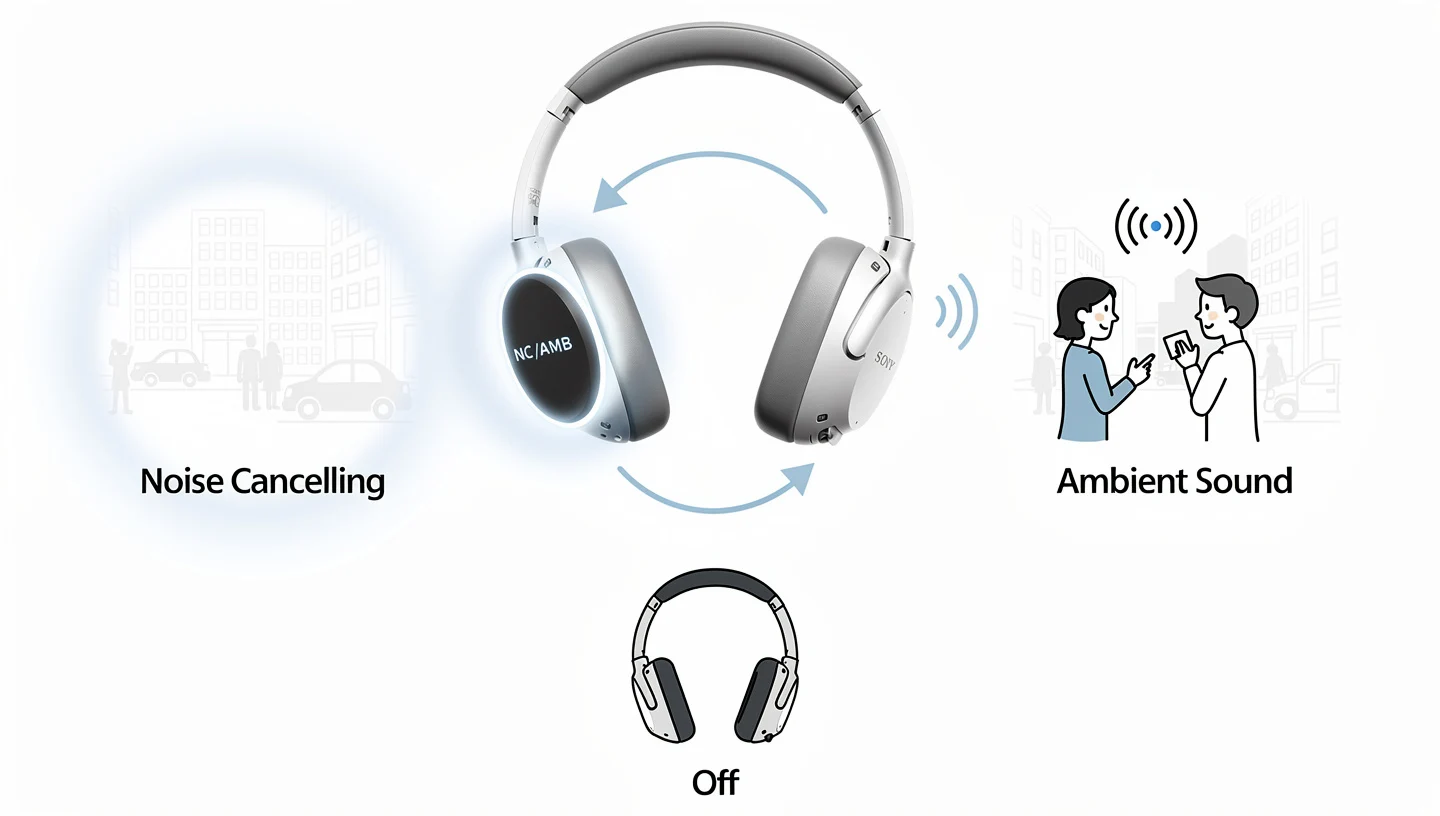
You press a button on your Sony headphones and a voice says “Noise cancelling” or “Ambient sound.” The label on the button reads NC/AMB. Neither of those abbreviations tells you much at first glance, but the feature they control is one of the most useful things a pair of headphones can have. NC stands for Noise Cancelling and AMB stands for Ambient Sound. Pressing the button cycles through three states: noise cancelling on, ambient sound on, and both off. That simple three-position cycle gives you control over how much of the world around you reaches your ears while wearing the headphones.
NC/AMB is a Sony-specific label. Every other major headphone brand has the same two modes under different names, which this guide covers further down. The underlying technology is identical across all of them.
NC/AMB meaning: the short answer
NC blocks the sounds around you by generating anti-noise signals through the headphone drivers. AMB does the opposite: the same microphones that capture noise for cancellation instead relay that sound into your ears, so you can hear your surroundings while still wearing the headphones and listening to audio. You cannot use both at the same time because they use the same microphones for opposite purposes. One press of the NC/AMB button moves you from one mode to the next in a fixed sequence, with a voice prompt confirming which state the headphones have entered.
What NC mode does and how it works
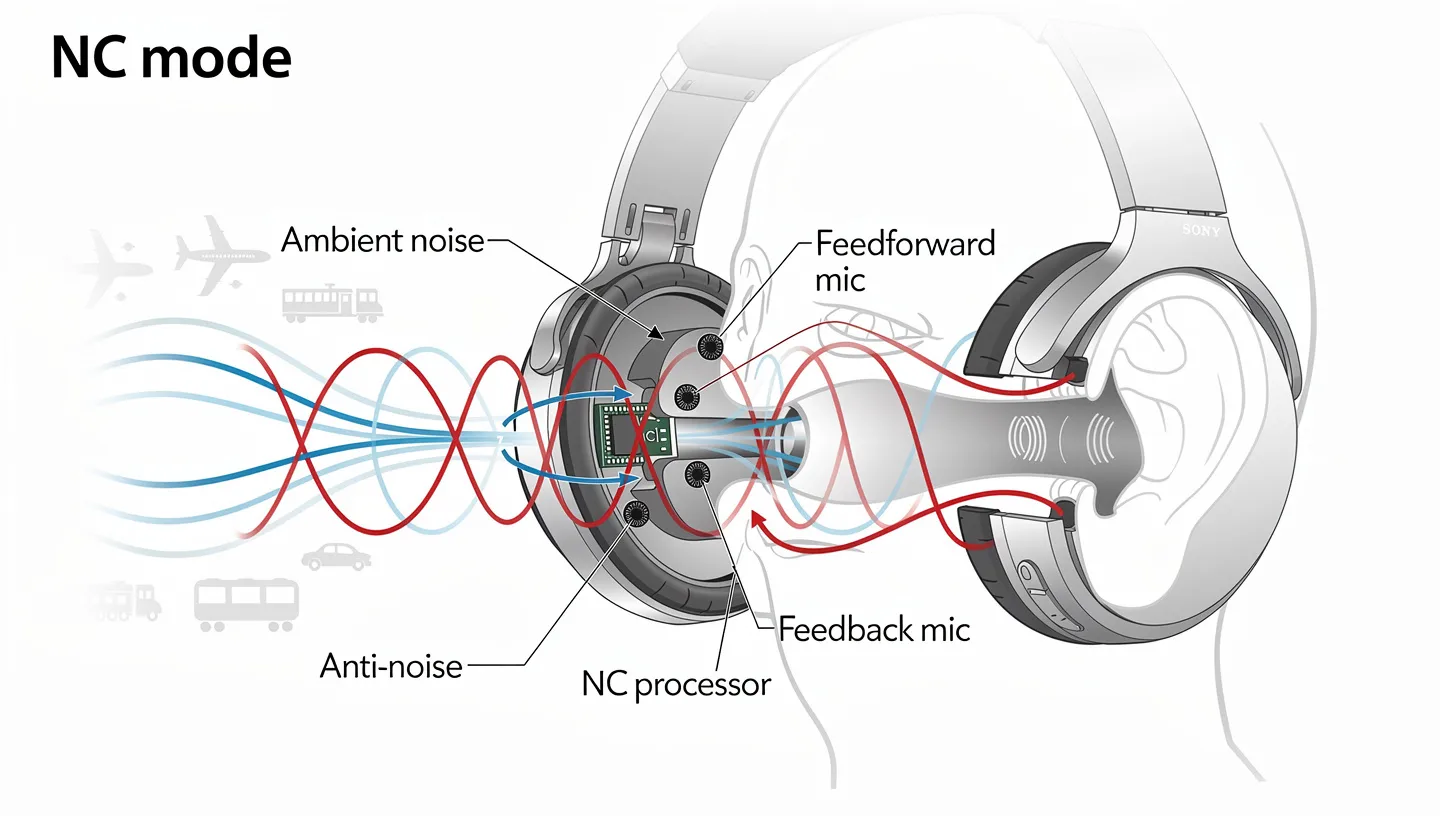
Active noise cancellation, the technology behind the NC in NC/AMB, does not physically block sound the way thick earcup padding does. It generates a sound wave that is the inverse of the ambient noise signal, and when those two waves meet at the ear, they cancel each other out. The result is a reduction in perceived ambient noise, not complete silence, but a significant drop in the volume and presence of the sounds around you.
How the microphones capture and cancel noise
Most premium Sony headphones use a hybrid ANC system with two sets of microphones. Feedforward microphones sit on the outside of each earcup facing outward. They pick up ambient sound before it reaches the ear and give the processor a head start on generating the anti-noise signal. Feedback microphones sit on the inside of each earcup, facing the ear. They measure what is actually reaching the ear canal after the initial cancellation pass and make corrections in real time.
The processing chip, which runs continuously while NC is active, generates the anti-noise waveform and delivers it through the headphone drivers at the same time as your audio. The two signals, anti-noise and ambient noise, arrive at the ear simultaneously and cancel each other out. The speed at which this happens is measured in microseconds. Any processing delay would cause the anti-noise signal to arrive out of phase and make ambient noise louder rather than quieter.
What NC blocks well and what it does not
NC is most effective on low-frequency, constant sounds: engine rumble on a plane, the hum of a train, air conditioning units, and road noise in a car. These are steady, predictable sounds that the processor can model and cancel accurately. Sony and Bose flagship headphones block between 80 and 90% of ambient noise in these conditions.
NC is less effective on high-frequency, unpredictable sounds: human speech, keyboard clicks, sneezing, and sudden sharp sounds. These change too fast and too randomly for the processor to generate an accurate anti-noise signal in time. Mid-range headphones typically achieve 60 to 70% ambient noise reduction across the full spectrum, with the gap most visible in voice frequencies. Budget ANC models under $50 manage around 30 to 40% reduction and are largely ineffective above 500 Hz.
Does NC mode affect sound quality
NC does have a small effect on audio quality. The DSP processor running the noise cancellation algorithm shares processing resources with the audio pipeline, and on some headphones this introduces a faint high-frequency hiss when NC is active in a quiet room with no audio playing. This is most noticeable on older or budget ANC headphones. On the Sony WH-1000XM5 and newer models, the hiss is minimal and disappears entirely during playback.
Some listeners also notice a slight pressure sensation when NC is active, particularly in quiet environments. This is caused by the anti-noise signal interacting with the sealed earcup environment and is a known characteristic of active noise cancellation rather than a defect. Turning both NC and AMB off in a quiet room eliminates both the hiss and the pressure sensation, and passive isolation from the earcup seal handles whatever ambient noise is present.
What AMB mode does and how it differs from NC
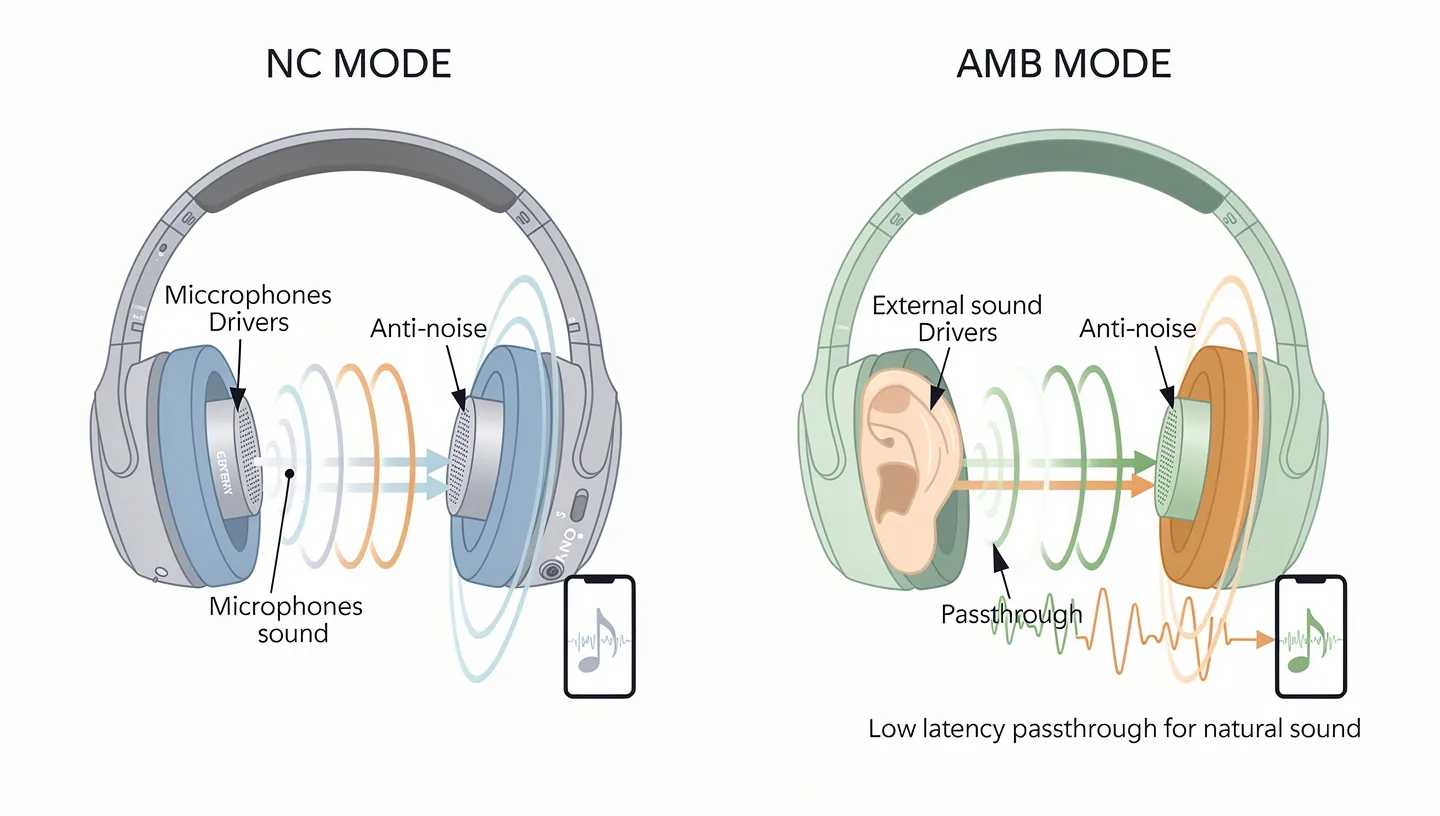
Ambient Sound mode, the AMB in NC/AMB, uses the same external microphones that NC relies on, but instead of using their input to generate an anti-noise signal, it routes that input directly into the headphone drivers. You hear your surroundings through the headphones as if the earcups were partially open. The processing adds a small amount of equalization to make the sound more natural, since a raw microphone feed played back through drivers can sound thin or metallic without correction.
How ambient sound passthrough works technically
The external microphones capture the surrounding environment continuously. In NC mode, that signal feeds into the anti-noise algorithm. In AMB mode, the same signal bypasses the cancellation algorithm and is mixed into the audio output at an adjustable level. The processing delay between sound entering the microphone and that sound reaching your ear is typically under 1 to 2 milliseconds on current Sony models. At that latency, the passthrough audio feels natural and synchronized with the physical sounds around you. Longer processing delays, which appear on some budget passthrough implementations, make the ambient sound feel slightly artificial or out of sync with what you see.
Adjusting ambient sound level in the Sony Headphones Connect app
Through the Sony Headphones Connect app, you can adjust how much ambient sound passes through on a scale from 0 to 20. At the lower end of the scale, only a faint amount of environmental sound enters. At the maximum level, the surrounding environment comes through clearly and at close to its natural volume. The app also offers a Voice Only option that filters ambient sound to pass through human speech while reducing non-voice ambient noise, which is useful in environments where you want to hear announcements or conversations but not background rumble. A detailed breakdown of what the Sony Headphones Connect app can do beyond NC/AMB control is in the Sony Headphones Connect app guide.
How to activate and switch NC/AMB on Sony headphones
Sony headphones offer three distinct ways to move between NC and AMB modes depending on the model. All three methods change the same setting and trigger the same voice confirmation.
Physical button: the pressing sequence
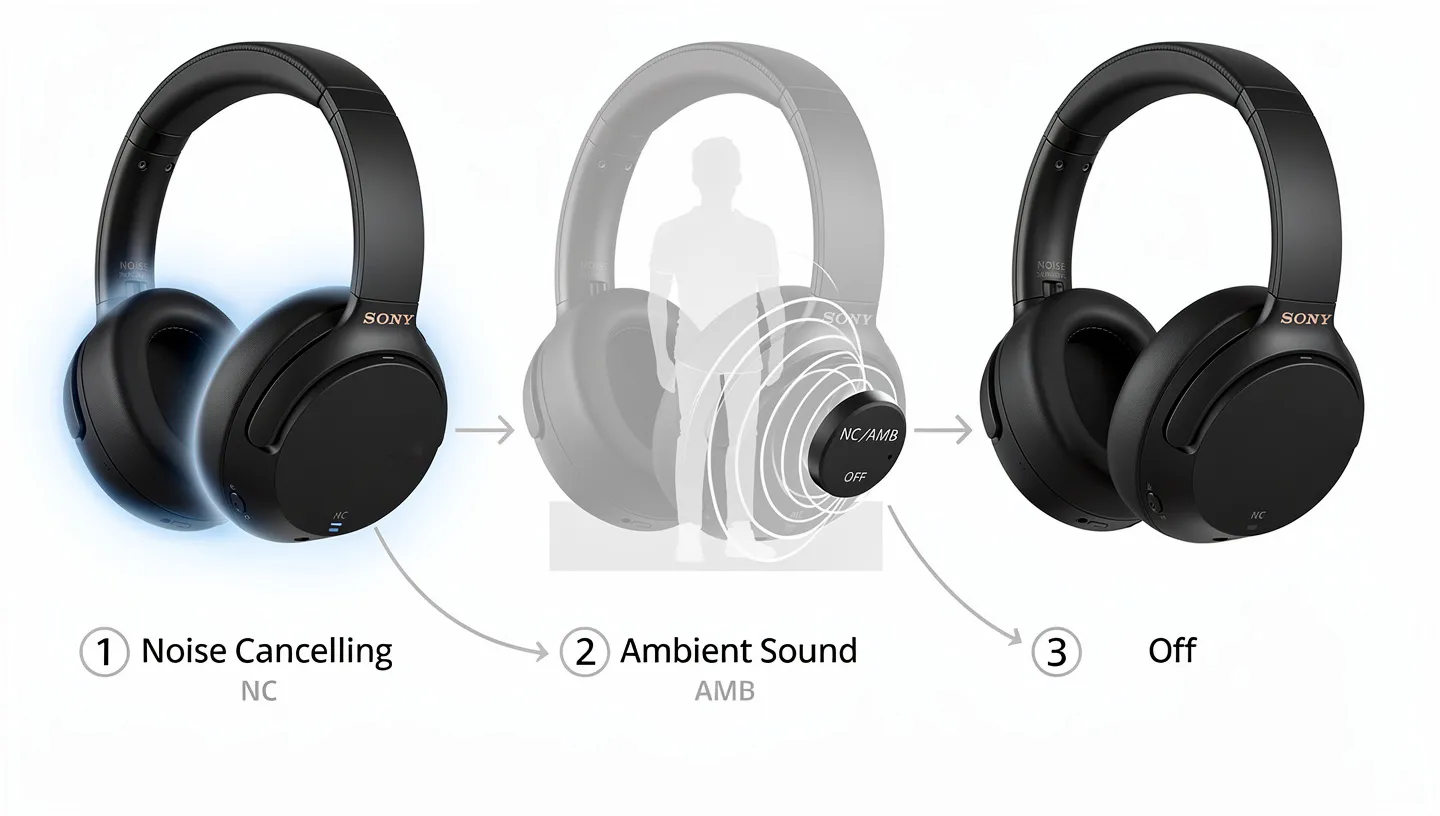
Most Sony over-ear headphones have a dedicated NC/AMB button on the left earcup. Each press moves through the cycle in this order:
- First press: Noise Cancelling on (voice says “Noise cancelling”)
- Second press: Ambient Sound on (voice says “Ambient sound”)
- Third press: Both off (voice says “Ambient sound control off”)
Older Sony models like the WH-CH710N use a slightly different label on the button and may have a different default cycle order, but the three states remain the same across the lineup. The voice guidance makes it easy to confirm the current mode without looking at the headphones.
Sony Headphones Connect app: fine-tuning and location presets
The app lets you change which states the NC/AMB button cycles through. If you never use ambient sound, you can set the button to toggle only between NC on and NC off, skipping the AMB state entirely. You can also set location-based presets so the headphones automatically switch to NC when you arrive at a train station or switch to AMB when you start walking. Adaptive Sound Control, covered in the section below, does this automatically without manual location setup.
Palm gesture on XM4 and XM5: quick AMB without pressing anything
The WH-1000XM4 and WH-1000XM5 support a quick attention mode activated by placing your palm over the right earcup. Music pauses, AMB activates, and the surrounding environment comes through clearly. Remove your hand and the music resumes at the mode the headphones were in before. This is designed for brief conversations or listening to announcements without pressing any buttons. The sensitivity of the palm detection can be adjusted in the app.
Why you cannot use NC and AMB at the same time
NC and AMB are mutually exclusive because they use the same hardware for opposite purposes. The external microphones on each earcup have one audio feed. NC uses that feed to generate an anti-noise signal that cancels ambient sound. AMB uses that same feed to relay ambient sound into the drivers. The processor cannot simultaneously cancel a signal and reproduce it. Running both algorithms on the same microphone input at the same time would result in each one partially undermining the other, producing neither effective noise cancellation nor clean ambient passthrough.
This is not a Sony-specific limitation. Every ANC headphone from every brand operates the same way. Apple’s AirPods Pro, Bose QuietComfort Ultra, and Jabra Evolve2 all have the same constraint. The button, toggle, or app control that switches between modes is always selecting one algorithm or the other, never both.
Which Sony headphones have the NC/AMB button
Not every Sony headphone has active noise cancellation or an NC/AMB button. The feature is present on models that include ANC hardware. Below is the current status across the main Sony headphone lineup:
| Model | NC/AMB button | Notes |
|---|---|---|
| WH-1000XM3 | Yes | Physical button, labeled NC/AMB |
| WH-1000XM4 | Yes | Button + palm gesture + app |
| WH-1000XM5 | Yes | Button + palm gesture + app |
| WH-1000XM6 | Yes | Button + app |
| WH-CH710N | Yes | Physical button, labeled NC/AMB |
| WH-CH720N | Yes | Physical button + app |
| WF-1000XM4 | App only | No physical button on earbud; controlled via app or touch gestures |
| WF-1000XM5 | App only | No physical button on earbud; controlled via app or touch gestures |
| Sony models without ANC | No | No NC/AMB hardware present |
NC and AMB by other names: how every brand labels the same two modes
NC/AMB is Sony’s label for a feature that every major ANC headphone brand includes under a different name. The underlying technology is the same: microphones feed a processor, which either cancels ambient sound or relays it to the drivers. Only the marketing term changes.
| Brand | Noise cancelling name | Ambient passthrough name |
|---|---|---|
| Sony | NC (Noise Cancelling) | AMB (Ambient Sound) |
| Apple | ANC (Active Noise Cancellation) | Transparency |
| Bose | ANC | Aware mode |
| JBL | ANC | Ambient Aware |
| Jabra | ANC | HearThrough |
| Anker Soundcore | ANC | Transparency |
| Samsung | ANC | Ambient sound |
| Sennheiser | ANC | Transparent Hearing |
Apple’s Transparency mode on AirPods Pro is the most discussed alternative name, in part because Apple’s processing is widely considered the most natural-sounding ambient passthrough currently available. Bose’s Aware mode is close behind. Sony’s AMB at its higher adjustment levels is competitive with both. For a broader look at how active noise cancellation works across different headphone types and price tiers, that guide covers the hardware and performance differences in detail.
Adaptive Sound Control: when NC/AMB switches automatically
Adaptive Sound Control is a Sony feature, available through the Sony Headphones Connect app, that detects your current activity and automatically selects the appropriate NC or AMB setting without you pressing the button. The headphones analyze motion data and GPS location to determine whether you are sitting, walking, running, or on public transport.
In practice: the headphones switch to NC automatically when you board a train. They switch to AMB when you start walking. If you set up location memory, the headphones can associate specific places with specific modes and switch as soon as you arrive. You can override the automatic selection at any time with a button press, and the manual selection holds until the next automatic trigger fires. Adaptive Sound Control is available on WH-1000XM4, XM5, and XM6, and is set up entirely through the app.
Speak to Chat: AMB that activates when you start talking
Speak to Chat is a Sony-specific feature on the XM4, XM5, and XM6 that detects when you start speaking and automatically activates AMB mode without any button press. Music pauses, ambient sound passes through, and you hear the person in front of you clearly. When you stop talking, a short timer counts down and the headphones return to whatever mode they were in before, typically NC, and music resumes.
The timeout duration and the microphone sensitivity for voice detection are both adjustable in the Sony Headphones Connect app. Speak to Chat is designed for the situation where you need to briefly interact with someone, a cashier, a colleague, a flight attendant, without taking the headphones off or hunting for the button. The sensitivity setting matters: too high and background speech triggers it unintentionally, too low and it misses your voice in noisy environments.
NC Optimizer: calibrating noise cancellation to your head
NC Optimizer is a calibration tool built into Sony headphones that measures the physical characteristics of how the headphones sit on your specific head and adjusts the noise cancellation algorithm accordingly. Hold the NC/AMB button for approximately two seconds. The voice says “Optimizer start.” The internal microphones play a brief test signal and measure how it reflects off your face, your glasses if you wear them, and your hairstyle. It also detects the ambient pressure level, which is particularly useful on aircraft where cabin pressure changes affect how the earcup seals against the head.
The calibration takes around three to four seconds. After completion, the headphones apply a tuned NC profile specific to your current wearing conditions. Running NC Optimizer when you first put the headphones on, especially on a flight, typically produces noticeably better low-frequency noise reduction than the default profile. NC Optimizer is available on WH-1000XM3, XM4, and XM5.
When to use NC and when to switch to AMB
The right mode depends entirely on where you are and what you need from your environment. There is no universally correct default.
When NC is the right choice
Flights: engine noise from aircraft is almost entirely low-frequency, which is exactly what NC handles best. This is where the performance difference between a good ANC headphone and a standard one is most obvious. Trains and buses: engine and track rumble fall in the same low-frequency range. Open-plan offices: keyboard noise and distant conversations drop significantly, though individual nearby voices still come through. Studying or focused work: even partial noise reduction in a moderately noisy environment produces a measurable improvement in concentration.
When to switch to AMB
Walking near traffic: you need to hear approaching cars, cyclists, and signals. NC removes those cues along with everything else. Waiting for announcements: at an airport or train station, AMB lets you hear gate changes and delays without taking the headphones off. Brief conversations: Speak to Chat handles this automatically on XM4 and newer, but manually switching to AMB also works. Running outdoors: situational awareness reduces the risk of missing approaching vehicles or other hazards.
When to turn both off
In a quiet room at home, running NC with no audio playing makes the faint hiss of the noise cancellation system audible. The passive seal of the earcups provides enough isolation for home listening without requiring active processing. Turning both NC and AMB off in that context saves battery, eliminates the pressure sensation, and removes the hiss.
NC vs AMB: quick comparison
| NC | AMB | |
|---|---|---|
| Blocks ambient sound | Yes | No |
| Passes ambient sound through | No | Yes |
| Best for | Flights, commuting, office focus | Walking, brief conversations, public spaces |
| Battery drain vs passive | Moderate increase | Moderate increase |
| Hiss in silent rooms | Possible on some models | Not typical |
| Can run simultaneously | No | No |
Does NC/AMB drain battery faster
Both NC and AMB consume more battery than passive listening because both modes require the external microphones and the DSP processor to run continuously. The difference is measurable but not dramatic. Sony publishes battery figures for both states. The WH-1000XM5 is rated at 30 hours with NC active and around 40 hours with NC off. That is roughly a 25% reduction in battery life from running NC continuously.
AMB uses similar power to NC because the same hardware is active in both modes. The microphones and processor draw comparable current regardless of whether they are running the cancellation algorithm or the passthrough routing. Turning both NC and AMB off and relying on passive isolation extends battery life to the maximum rated figure. For a full breakdown of how ANC modes affect battery life across headphone types and how codec choice interacts with power consumption, the does LDAC use more battery guide covers the power side of wireless audio in detail.
NC/AMB in daily use: which mode to default to
For most users, NC on by default makes sense during any form of commuting or travel. The noise reduction during those periods is substantial and the battery cost is acceptable across a typical day. Switching to AMB for outdoor walking and brief interactions, then turning both off at home, covers the three main scenarios most people encounter without overthinking the button.
If you use Sony headphones and have not yet tried Adaptive Sound Control in the app, it is worth setting up. It handles the NC to AMB transition automatically based on what you are doing and removes the need to press the button at all in most situations. The app also gives you the ambient sound level slider, Speak to Chat, and NC Optimizer, all of which improve the NC/AMB experience beyond what the button alone provides.
For a direct comparison of how Sony’s NC/AMB system performs against the specific models on the WH-1000XM4 and later headphones with full implementation details, the NC/AMB on Sony headphones guide covers the Sony-specific side in full. For how NC compares across brands and price points from budget to flagship, the NC on headphones guide covers the broader picture.
Frequently asked questions
What does NC/AMB mean on headphones?
NC stands for Noise Cancelling and AMB stands for Ambient Sound. NC/AMB is Sony’s label for the button that switches between these two modes. Pressing it cycles through three states: noise cancelling on, ambient sound on, and both off. Other brands use different names for the same two modes, such as Transparency on Apple AirPods or Aware mode on Bose headphones.
How do I activate NC/AMB mode on Sony headphones?
Press the NC/AMB button on the left earcup once to activate noise cancelling. Press it again to switch to ambient sound. Press it a third time to turn both off. On WH-1000XM4 and XM5, you can also place your palm over the right earcup to temporarily activate ambient sound without pressing the button. All three modes can also be changed through the Sony Headphones Connect app.
Can I use NC and AMB at the same time?
No. NC and AMB use the same external microphones for opposite purposes. NC uses the microphone signal to generate an anti-noise waveform that cancels ambient sound. AMB uses the same signal to relay ambient sound into the drivers. The processor cannot run both algorithms on the same input simultaneously. This applies to every ANC headphone brand, not just Sony.
Does ambient sound mode drain battery faster?
Yes, slightly. Both NC and AMB require the external microphones and the DSP processor to run continuously, which draws more current than passive listening. The battery reduction is similar for both modes. The Sony WH-1000XM5 drops from around 40 hours of passive battery life to 30 hours with NC active. AMB produces a comparable reduction. Turning both off in a quiet home environment maximizes battery life.
Is NC safe for outdoor use?
NC reduces your awareness of surrounding sounds, which can be a safety concern in outdoor environments with traffic, cyclists, or other hazards. For walking, running, or cycling outdoors, switching to AMB mode is the safer choice. AMB lets environmental sounds through while you continue listening to audio. Speak to Chat on XM4 and newer temporarily activates AMB when you start speaking, but for sustained outdoor activity AMB as the default mode is the practical option.
Do all Sony headphones have NC/AMB?
No. NC/AMB is only present on Sony headphones that include ANC hardware. The WH-1000XM series, WH-CH710N, WH-CH720N, and WF-1000XM earbuds all have NC and AMB. Lower-cost Sony headphones without ANC have neither mode and no NC/AMB button. Check the product specification for “Active Noise Cancellation” to confirm whether a specific model supports it.
Can I adjust how much ambient sound comes through in AMB mode?
Yes. Through the Sony Headphones Connect app, the ambient sound level is adjustable from 0 to 20. At higher levels the surrounding environment comes through at close to its natural volume. At lower levels only faint environmental sound passes through. The app also includes a Voice Only setting that filters ambient sound to prioritize human speech over background noise, which is useful for hearing announcements or conversations in noisy environments.