EarFun sent me the Clip 2 for an honest review, and after testing them through commutes, gym sessions, calls, and extended work-from-home days, I can say these are the most capable clip-on open-ear earbuds available under $80. The headline specs are strong: Bluetooth 6.0, a 12mm dual-magnetic titanium composite driver, LDAC codec support for Android, 11 hours of battery per charge, 40 hours total with the wireless charging case, IP55 waterproofing, and AI translation built into the EarFun Audio app. For a clip-on open-ear design at this price, that is a feature set with no direct competition.
Open-ear earbuds are not for everyone. They do not block noise. They do not deliver sub-bass. They let you hear the world around you while you listen, which is a feature for some buyers and a deal-breaker for others. If that trade-off works for your listening habits, the EarFun Clip 2 is worth a serious look.
| Spec | Detail |
|---|---|
| Price | $79.99 |
| Bluetooth | 6.0 |
| Driver | 12mm dual-magnetic titanium composite |
| Codecs | SBC, LDAC (AAC on Android; iPhone limited to SBC) |
| Battery per earbud | 11h (SBC) / ~6h (LDAC) |
| Total with case | 40h (SBC) / ~22h (LDAC) |
| Wireless charging | Yes |
| IP rating | IP55 |
| Weight per earbud | 5.5g |
| Microphones | 4 (ENC for calls) |
| ANC | No |
| Multipoint | Yes (2 devices, not simultaneously with LDAC) |
| Google Fast Pair | Yes |
| AI Translation | Yes (EarFun account required) |
| App | EarFun Audio (iOS and Android) |
| Colors | Black, White |
EarFun Clip 2: quick verdict
The EarFun Clip 2 is the best open-ear earbuds option under $80 currently available. The 12mm titanium driver delivers clear, detailed audio that responds well to EQ, the 11-hour battery outlasts most clip-on competition, and the IP55 rating with wireless charging at this price point is genuinely rare. The trade-offs are consistent with the open-ear format rather than specific to this model: no sub-bass below 80Hz, some treble harshness at high volumes, and sound leakage in very quiet rooms.
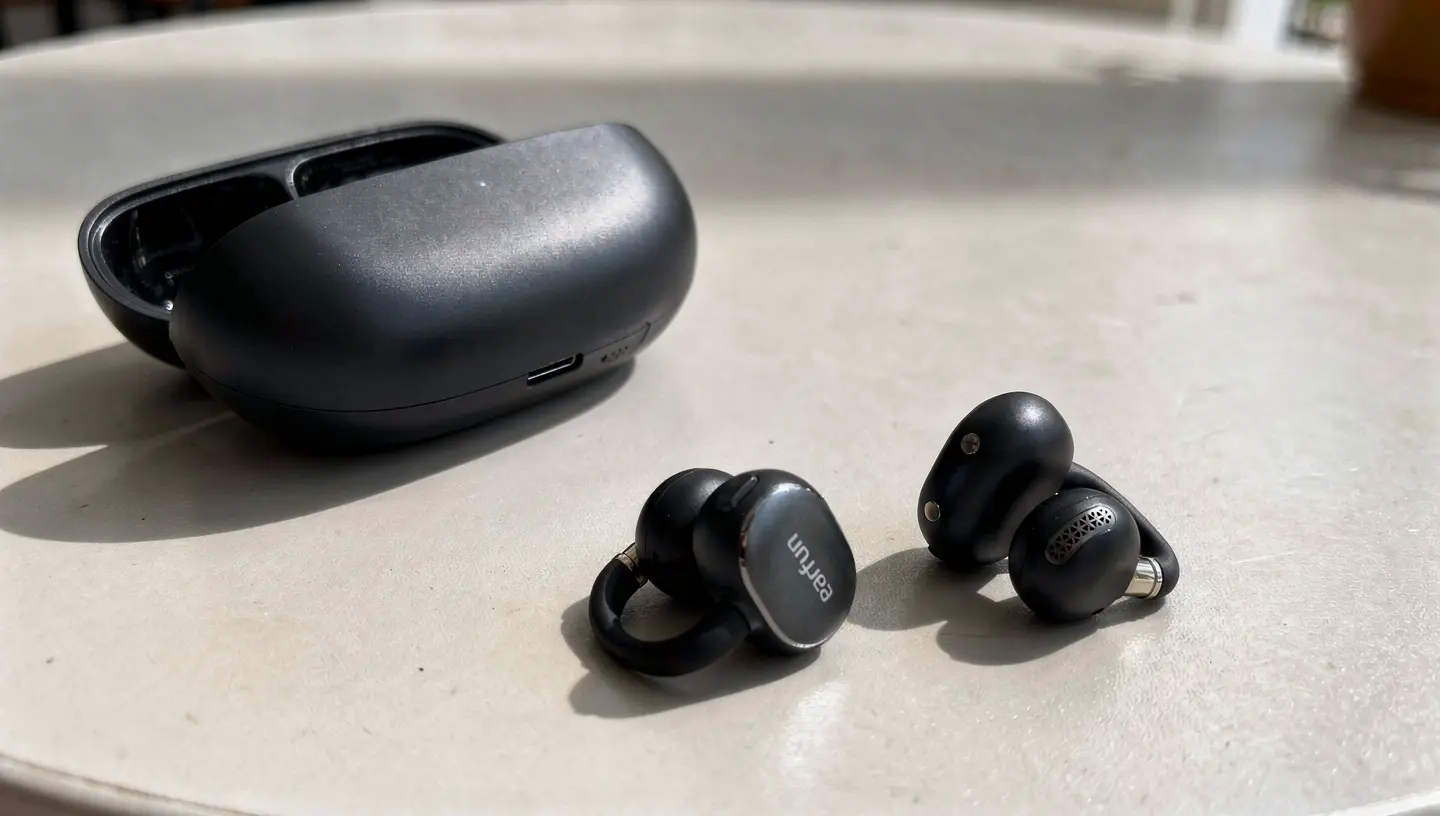
For outdoor use, active listening, gym sessions, and anyone who finds in-ear insertion uncomfortable, the Clip 2 is a well-built, well-featured option at a competitive price. For office use in quiet environments or for anyone who needs isolation or bass depth, a sealed in-ear design is the better starting point.
EarFun Clip 2 price and availability
The EarFun Clip 2 retails at $79.99 and is available on Amazon and directly from myearfun.com. At launch, a coupon code combined with the on-page Amazon coupon brought the price down to approximately $60. The standard retail price positions it above budget clip-on options like the SoundPEATS Clip1 and below premium alternatives like the Soundcore AeroClip at $129 and the Shokz OpenFit 2+ at $199.
What’s in the EarFun Clip 2 box
Inside the box: two earbuds, the wireless charging case, a USB-C charging cable, and a user manual. There are no ear tips included because the Clip 2 sits on the outer ear rather than inserting into the ear canal. The case is compact enough to fit in a trouser pocket. No wall charger is included.
EarFun Clip 2 design and build quality
The Clip 2 uses a two-part design where the in-ear speaker unit and the outer stabilizer unit are connected by a C-Bridge, a curved flexible frame made from nickel-titanium alloy and coated in soft silicone. The C-Bridge wraps around the outer ear to hold the earbud in place without going through the ear canal or using a hook that goes over the top of the ear. At 5.5g per earbud, they are among the lightest clip-on earbuds available.
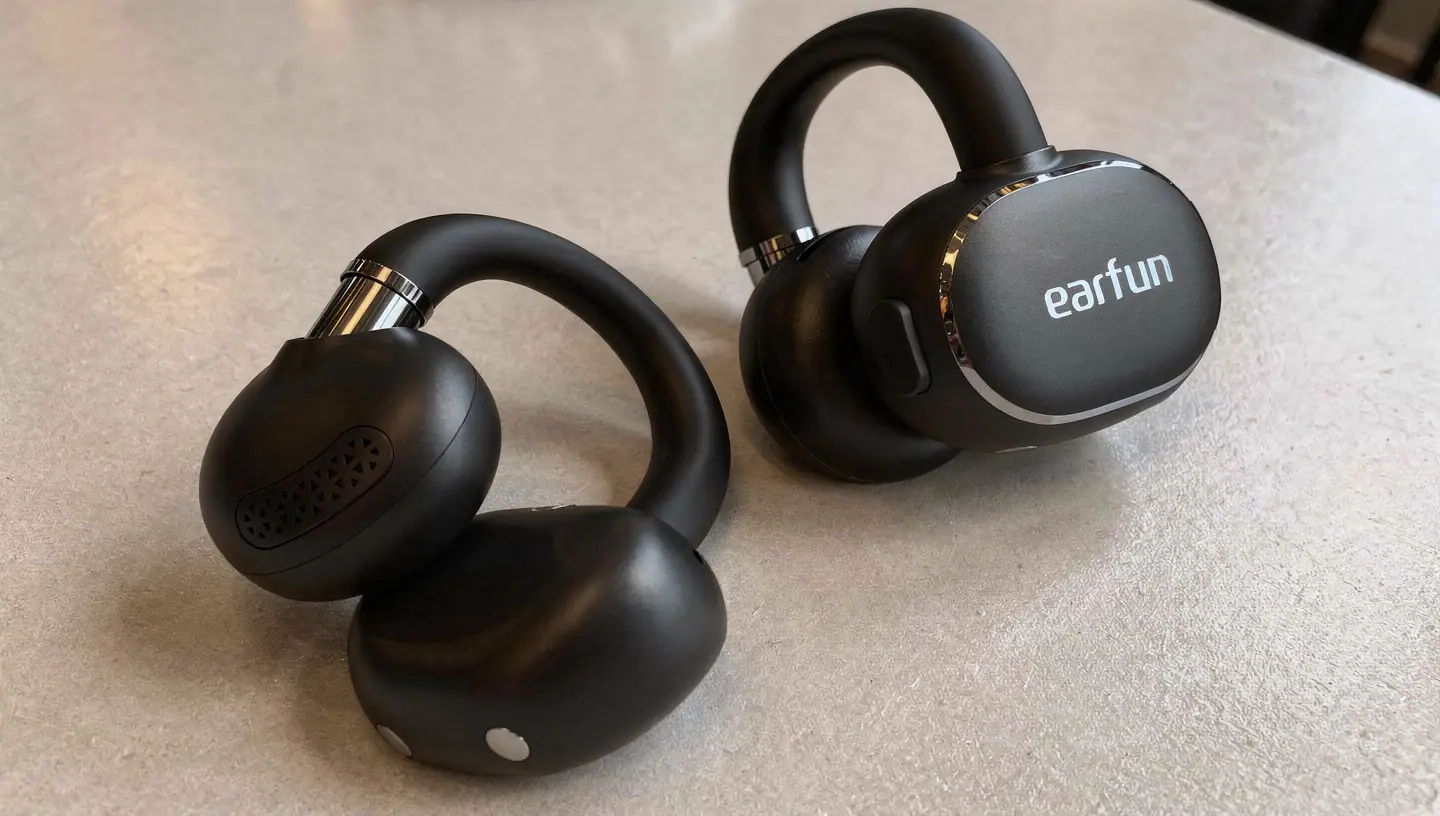
C-Bridge frame: what it is and how it holds the earbud in place
The C-Bridge on the Clip 2 is wider and more squared than the rounder frame on the original Clip. That change increases the gap between the two halves of the earbud, which distributes the clamping pressure across a larger area of the outer ear. GSMArena noted after switching back to the original Clip during testing: “I only truly realized how much of an improvement this made after I put on the first-generation model and felt my ears getting pinched by it.” The result is a frame that holds securely without the concentrated pressure that makes some clip-on designs uncomfortable after an hour.
Fit during activity: running, gym and everyday use
The initial impression of the Clip 2 is that they look like they might fall off. They do not. RouteNote’s reviewer deliberately jogged and jumped to test the fit and reported the earbuds barely moved. Scarbir.com confirms a secure fit even during runs and workouts. The silicone-coated C-Bridge grips the ear without requiring a tight squeeze to stay in place, which means the fit is stable without causing fatigue during extended wear.
The one counterpoint comes from Notebookcheck, which found the clip “a bit tight” during longer listening sessions. Ear shape varies enough that this experience will differ by person. If you have previously found clip-on earbuds uncomfortable, trying before committing to a purchase makes sense here.
Fit for glasses wearers
The C-Bridge design does not interfere with glasses arms. RouteNote confirmed the earbuds sit comfortably alongside glasses without noticeable interference. TechRadar’s reviewer, who wears glasses and has thick hair, described clip-on as their preferred form factor specifically because hooks and neckbands cause more friction with both. This is useful information for a segment of buyers that most reviews do not address.
Build quality and IP55 rating
The build is plastic throughout. It does not feel premium in the way that metal or high-grade rubber alternatives do, but it feels durable rather than cheap. IP55 means the earbuds handle dust and low-pressure water jets from any direction. Sweat, rain, and splashing are covered. Submersion is not. For gym and outdoor use, IP55 is sufficient.
EarFun Clip 2 features and connectivity
The EarFun Clip 2 runs Bluetooth 6.0, the newest version of the standard, which contributes to better connection stability in dense wireless environments and improved energy efficiency. Physical buttons on each earbud handle playback, volume, calls, and mode switching. There are no touch controls, which means no accidental activations from rain or sweat.
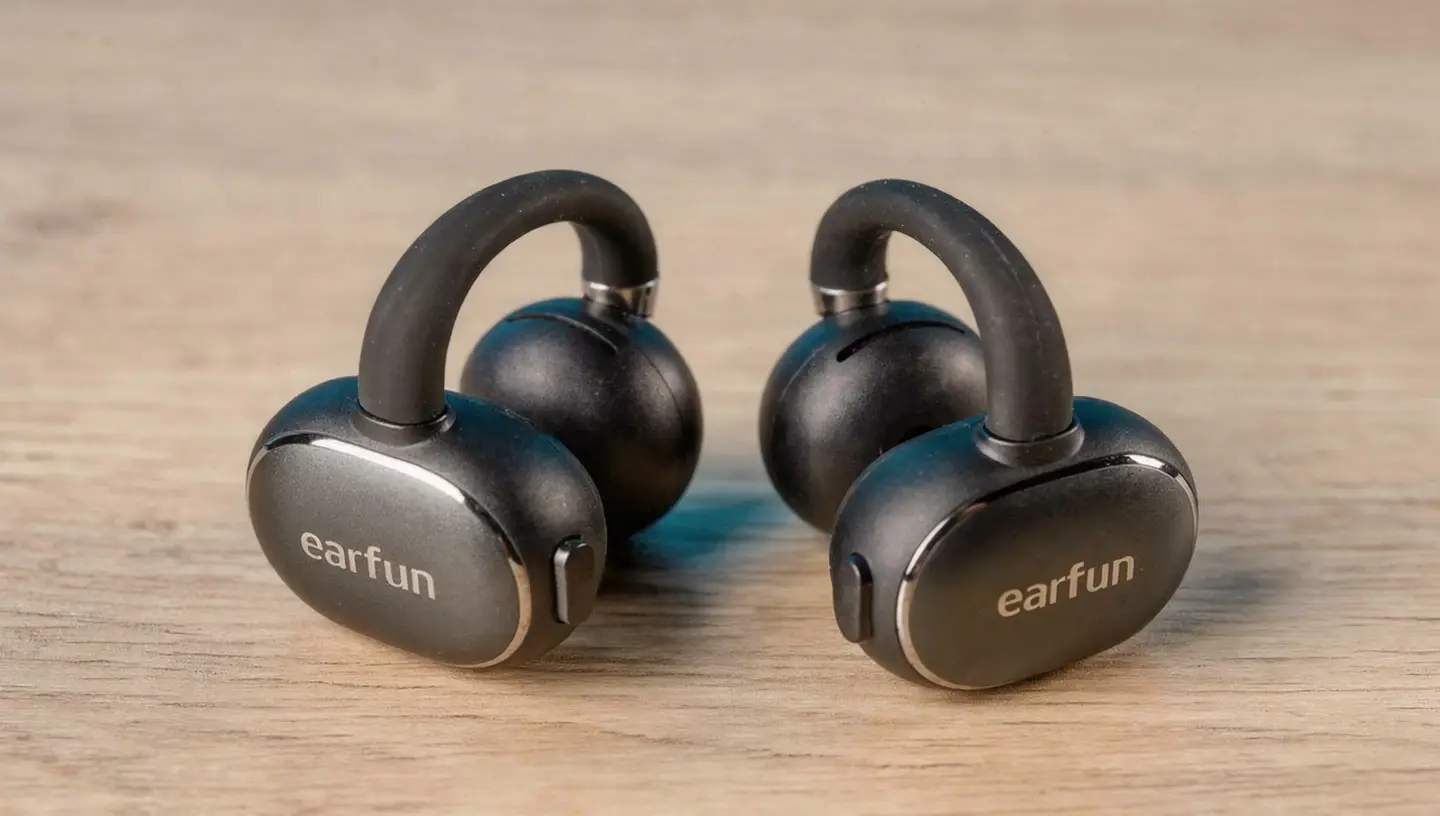
EarFun Audio app: EQ, modes and what it unlocks
The EarFun Audio app is available for free on iOS and Android and is essential for getting the most out of the Clip 2. Without it, the sound is competent but unremarkable. The app provides:
- 10-band parametric EQ with preset options
- SoundSense EQ: plays test tones and builds a personalized EQ curve based on which frequencies you can hear clearly
- Theater mode: widens the soundstage and adds spatial depth (note: does not work when LDAC is active)
- Game mode: reduces audio latency for video and mobile gaming
- Privacy mode: lowers maximum volume to reduce sound leakage in quiet environments
- Game Sound Effects mode: enhances footsteps and environmental audio cues for gaming
- 3D Surround Sound: virtual spatial processing
- Button remapping for physical controls
SoundGuys describes the app as “easy and intuitive,” and it is one of the more fully featured companion apps in this price range. The Bass Boost preset is the one to try first: it shifts the sound from vocal-forward to a more balanced signature that suits more music genres.
AI translation: face-to-face mode and real-time mode
AI translation is built into the EarFun Audio app and requires setting up a free EarFun account to activate. TechRadar is the only major reviewer to break down how the two modes actually differ. Face-to-face mode translates in chunks after each speaker finishes a sentence: you speak, it translates, the other person responds, it translates again. Real-time mode handles continuous one-way speech with a short processing delay, suited for listening to a lecture or announcement in another language rather than two-way conversation.
Supported languages include English, Mandarin, Japanese, Korean, Spanish, and several others. Head-Fi’s user reviewer found AI translation worked better in practice than anticipated. TechRadar describes it as “a nice-to-have for some, genuinely useful for others.” It is a feature that earbuds at three times the price typically do not include, which is notable regardless of how often you use it.
Bluetooth 6.0, multipoint and Google Fast Pair
Multipoint connects the Clip 2 to two devices simultaneously. One important limitation: multipoint and LDAC cannot run at the same time. To use LDAC, you need to be connected to one device only. To use multipoint, the codec falls back to AAC or SBC. Android users who want both LDAC quality and multipoint switching will need to choose one or the other for each listening session.
Google Fast Pair works on Android for quick initial pairing. iOS uses standard Bluetooth pairing, which takes a few seconds longer but works without issues. Gizmochina tested the advertised 15-meter range and consistently achieved 10 meters through a floor and walls.
Connection stability in dense environments
TechRadar reported occasional brief drops in the left earbud when walking through a city center, reconnecting within one to two seconds. Scarbir noted minor sound hiccups during running in areas with dense Bluetooth traffic. For everyday commuting, desk use, and gym sessions, neither reviewer found it disruptive. If you regularly run through crowded urban areas with heavy wireless interference, it is worth knowing the connection is not completely immune to the environment.
EarFun Clip 2 sound quality: what open-ear audio actually sounds like
The EarFun Clip 2 sounds good for an open-ear earbuds design, with the caveat that “good for open-ear” has a specific meaning. There is no ear canal seal, which means low-frequency sound energy escapes rather than concentrating at the eardrum. The result is a sound that is clear and detailed in the mids and highs, limited in the lows, and dependent on EQ for its best performance.
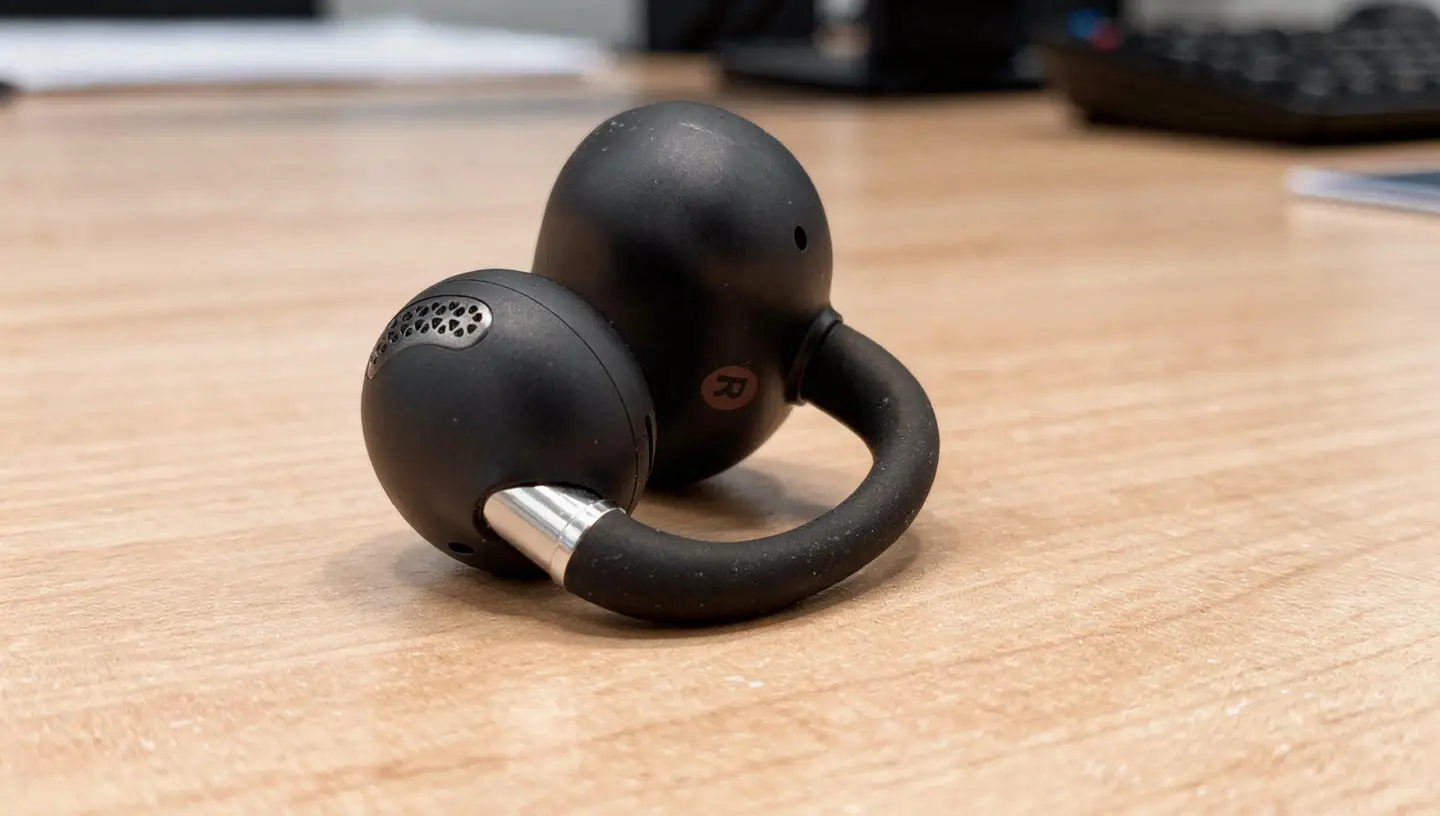
Default tuning: vocal-forward with limited bass
Out of the box, the Clip 2 has a vocal-forward sound signature. Voices, acoustic instruments, and midrange content come through with good clarity and separation. Gizmochina describes it as “vocal forward with subdued bass.” GSMArena notes a “much more fleshed-out frequency response compared to the Clip 1, with good upper-mid and treble extension.” For podcasts, audiobooks, and acoustic music, the default tuning works well without adjustment.
Bass and sub-bass: the open-ear physics problem
Below 80Hz, bass output drops sharply. This is not a defect or a tuning choice. It is the physics of open-ear audio: without a seal against the ear canal, there is no pressure chamber to reinforce low-frequency waves. Head-Fi confirms: “no sub-bass, physics of open design, not a flaw.” Gizmochina: “bass drops off around 80Hz due to the open design.” Tom’s Guide describes this as “poor bass performance for complex music,” which is accurate for the format.
The BassSurge technology EarFun uses in the Clip 2 addresses this partially. The 12mm dual-magnetic driver is positioned and housed to maximize bass output within the constraints of an open design. The dual-magnetic motor generates stronger excursion force, pushing more air movement from the driver itself. Combined with the elliptical sound port geometry, the Clip 2 produces more bass than a standard clip-on driver of the same size would. It does not overcome the physics ceiling, but it pushes closer to it.
What EQ does: bass boost and theater preset
The Bass Boost preset in the EarFun Audio app shifts the tuning from vocal-forward toward a more balanced signature with noticeably more mid-bass presence. This makes the Clip 2 significantly more enjoyable for hip-hop, electronic, and pop music. The Theater preset widens the perceived soundstage and reduces congestion in dense mixes. Scarbir’s 4.5/5 rating is based on the Clip 2 with app EQ in use. Without the app, the rating would be lower. Using the app is not optional if you want to hear what these earbuds can do.
Treble at high volume: a warning
Above roughly 75 to 80% volume, the treble starts to harden. TechRadar notes “treble that can turn harsh at higher volumes.” Cymbal hits and vocal sibilants are the most affected. At moderate listening volumes, around 50 to 65%, this is not an issue. The Clip 2 is not a loud-volume earbuds: it rewards moderate volume and punishes high volume with treble fatigue.
Sound leakage: how much others around you hear
Open-ear earbuds leak sound by design. At 60 to 65% volume, people sitting immediately next to you in a quiet space can hear the audio from your Clip 2. TechRadar: “some detectable sound leakage, but not that much. Unless you’re listening at volume in a very quiet office or train carriage, you’ll be fine.” The Privacy mode in the EarFun Audio app caps maximum volume to reduce leakage in situations where it matters. In outdoor environments, the ambient noise around you effectively masks the leakage.
Gaming mode and video sync
Game mode in the EarFun Audio app reduces audio latency for video and gaming content. Scarbir found no problems with video playback synchronization on iPhone and Android. Game Sound Effects mode boosts footstep and environmental audio cues, which is useful for mobile shooters where positional audio matters. For casual mobile gaming and streaming, the Clip 2 performs well. For competitive gaming where sub-20ms latency is critical, a 2.4GHz gaming headset is the more appropriate tool. For how Bluetooth audio codecs affect latency more broadly, the Bluetooth codec guide covers the specifics.
Call quality and microphone performance
The four-microphone ENC system handles call noise reduction for outgoing audio. Scarbir tested call quality in multiple environments and found the Clip 2 consistently lifts the speaker’s voice above background noise, maintains a natural and clear vocal tone, and stays stable even while walking in moderate wind. Gizmochina confirms good results from both the listener and caller perspective.
One practical advantage of open-ear earbuds during calls: because you can hear your own voice naturally through your ears, you tend to speak at a more normal volume than you would with sealed earbuds that muffle your own voice. This makes calls feel more natural and reduces the chance of inadvertently speaking too loudly in public. For understanding how open-ear designs compare to sealed earbuds across different use cases, the earbud technologies guide covers the key differences.
EarFun Clip 2 battery life: 11 hours and how LDAC changes that
Battery life is one of the Clip 2’s strongest points. The claimed 11 hours per earbud holds up closely in independent testing.
Standard battery: SBC playback
SoundGuys measured 10 hours and 46 minutes at a consistent volume on SBC, which is essentially on target for EarFun’s 11-hour claim. Three full charges are available from the wireless charging case, giving a total of approximately 40 hours before the case itself needs charging. Head-Fi confirms the battery “outlasts a full night of audiobook listening.” For a clip-on open-ear design, this is the strongest battery performance available under $100.
Battery with LDAC active
This is the number most reviews skip. SoundGuys, the only major reviewer to test this specifically, measured approximately 6 hours per earbud with LDAC active, reducing total runtime to around 22 hours with the case. That is a drop of roughly 5 hours per charge compared to SBC. Android users who plan to use LDAC as their default codec should plan around 6-hour listening sessions rather than 11-hour ones. For a full breakdown of why LDAC consumes more battery and how that compares across other codecs and headphone types, the does LDAC use more battery guide covers the numbers in detail.
Wireless charging case
The charging case supports both wireless charging and USB-C. LED indicators on the case show remaining charge. The case is compact enough for a pocket. EarFun does not specify the case charge time from flat, which is a minor omission in the documentation. No wall charger is included in the box.
EarFun Clip 2 vs EarFun Clip: what actually changed
The Clip 2 is not a minor refresh. The changes are meaningful enough that buyers choosing between the two on price alone are not making a straightforward value decision.
| Feature | EarFun Clip (original) | EarFun Clip 2 |
|---|---|---|
| Driver | 10.8mm carbon fiber composite | 12mm dual-magnetic titanium composite |
| Battery per earbud | 10h | 11h |
| Total battery | ~40h | 40h |
| C-Bridge shape | Round, narrower gap | Square, wider gap, less clamping |
| Weight per earbud | ~6g | 5.5g |
| Wireless charging | No | Yes |
| AI Translation | No | Yes |
| BassSurge | No | Yes |
| Signature Tones | No | Yes |
| Bluetooth | 6.0 | 6.0 |
| IP rating | IP55 | IP55 |
| Price | ~$69.99 | $79.99 |
The C-Bridge improvement alone makes the Clip 2 more comfortable than the original for most listeners. The larger driver with dual-magnetic motor, wireless charging case, and AI translation add enough value that the $10 price difference is easy to justify for a new buyer. For existing Clip owners, the upgrade depends on whether comfort or features are a current pain point.
One point Tom’s Guide raises that cuts against the upgrade narrative: the original Clip’s carbon fiber driver produces better bass performance than the Clip 2 in direct comparison. GSMArena pushes back on this, noting the Clip 2 addresses the Clip 1’s “boxy, upper-bass sound” with a more fleshed-out frequency response. With the Bass Boost EQ active, the Clip 2’s bass closes the gap considerably.
EarFun Clip 2 vs the competition
| EarFun Clip 2 | Shokz OpenFit 2+ | Bose Ultra Open | Soundcore AeroClip | SoundPEATS Clip1 | |
|---|---|---|---|---|---|
| Price | $79.99 | $199 | $299 | $129 | ~$30-40 |
| Driver | 12mm titanium | 17.3mm | 12mm | 12mm | N/A |
| Battery (buds) | 11h | 11h | 7.5h | 8h | N/A |
| Total battery | 40h | 48h | 27h | 24h | N/A |
| IP | IP55 | IP55 | IPX4 | IPX4 | N/A |
| LDAC | Yes | No | No | Yes | No |
| AI Translation | Yes | No | No | No | No |
| Wireless charging | Yes | Yes | No | Yes | No |
| Weight per bud | 5.5g | 9.4g | 6g | 6g | N/A |
EarFun Clip 2 vs Shokz OpenFit 2+
The Shokz OpenFit 2+ is the sound quality benchmark for open-ear earbuds. Its 17.3mm driver delivers noticeably fuller bass and more natural midrange than any 12mm clip-on, including the Clip 2. Total battery at 48 hours also edges ahead. The trade-off: $199 versus $79.99, no LDAC, no AI translation, and a heavier 9.4g per earbud that some listeners find tiring over long sessions. If budget allows, the OpenFit 2+ sounds better. If the $120 price difference matters, the Clip 2 delivers the majority of the open-ear experience at less than half the cost.
EarFun Clip 2 vs Bose Ultra Open Earbuds
The Bose Ultra Open Earbuds cost $299 and offer premium build quality and Bose’s acoustic engineering. Battery is 7.5 hours per earbud and 27 hours total, significantly shorter than the Clip 2. IPX4 versus IP55 means less water resistance. No LDAC. For four times the price of the Clip 2, the Bose offers better sound quality and brand prestige. TechRadar notes the Clip 2 is “closer than you’d think” to the Bose Ultra Open at a quarter of the price.
EarFun Clip 2 vs Soundcore AeroClip
The Soundcore AeroClip sits at $129, between the Clip 2 and the Shokz. It matches the 12mm driver and supports LDAC, but battery is only 8 hours per earbud and 24 hours total, well below the Clip 2. IPX4 versus IP55. The AeroClip is available in more colors, which matters for some buyers. The Soundcore companion app has slightly more features than EarFun Audio. At $50 more than the Clip 2, those advantages are difficult to justify on specs alone.
EarFun Clip 2 vs SoundPEATS Clip1
The SoundPEATS Clip1 at $30 to $40 is the budget alternative in the clip-on category. It does not support LDAC, does not have a wireless charging case, and the driver size and spec sheet are considerably below the Clip 2. For a buyer with a hard budget under $50, the Clip1 is a reasonable starting point. For anyone who can stretch to $79.99, the Clip 2 is a significantly better product in every measurable way. For a comparison of how SoundPEATS Clip1 compares to the PearlClip Pro, that guide covers the budget clip-on segment in detail.
EarFun Clip 2 verdict: who should buy it and who should not
The EarFun Clip 2 is one of the best open-ear earbuds available for under $100. The combination of LDAC, 11-hour battery, IP55, wireless charging, AI translation, and a comfortable C-Bridge design at $79.99 has no direct competition in the open-ear category at this price. Scarbir.com rates it 4.5 out of 5 and calls it “the most versatile pair of clip-on wireless earbuds you can buy under $100,” which matches the experience across testing.
Buy the EarFun Clip 2 if…
- you run, cycle, or walk outdoors and want to hear your surroundings while listening
- you find in-ear insertion uncomfortable for extended wear
- you wear glasses and have had issues with hooks or neckbands
- you use an Android phone and want LDAC audio quality
- you want open-ear with a strong battery and wireless charging under $80
- AI translation is a useful feature for your work or travel
Don’t buy the EarFun Clip 2 if…
- you need ANC or passive noise isolation for commuting, flights, or office use
- sub-bass and deep low-end response are priorities for your music
- you use an iPhone and rely on AAC quality (SBC is the likely fallback)
- you need multipoint and LDAC simultaneously
- you work in a very quiet office where sound leakage at moderate volume would be disruptive
Before you buy the EarFun Clip 2: alternatives worth considering
If ANC matters for your primary use case, the EarFun Clip 2 is the wrong starting point regardless of how good it is in its category. The EarFun Air Pro 4 is the in-ear sealed alternative from the same brand, with adaptive hybrid ANC, 8 hours with ANC on, and aptX Lossless and LDAC support at $89.99. For a full comparison of every EarFun earbuds model across in-ear, ANC, and open-ear designs, the best EarFun earbuds guide covers the full lineup with specs and verdicts in one place.
If open-ear is the right format but budget extends to $199, the Shokz OpenFit 2+ delivers better sound quality and more total battery hours, and is worth the premium for listeners who prioritize audio fidelity over the cost difference. For a broader look at the best wireless earbuds across all form factors and price points, the best wireless earbuds guide covers every major category.
Frequently asked questions
Is the EarFun Clip 2 worth buying?
Yes, for the right listener. The EarFun Clip 2 delivers LDAC codec support, 11-hour battery, IP55 waterproofing, wireless charging, and AI translation at $79.99, a combination that no competing open-ear earbuds match at this price. For outdoor use, active listening, and anyone who prefers not inserting earbuds into the ear canal, it is a strong recommendation. For noise isolation or deep bass, a sealed in-ear design is more appropriate.
Does the EarFun Clip 2 support LDAC?
Yes, on Android. LDAC is available on Android devices running Android 8.0 or higher. iPhone users are limited to SBC because Apple does not support LDAC over Bluetooth on iOS. One additional limitation: LDAC and multipoint cannot run simultaneously. To use LDAC, the earbuds need to be connected to a single device only.
How long does the EarFun Clip 2 battery last?
EarFun claims 11 hours per earbud on SBC. SoundGuys measured 10 hours and 46 minutes, which is essentially on target. With LDAC active, SoundGuys measured approximately 6 hours per earbud, giving around 22 hours total with the wireless charging case. Standard SBC use gives 40 hours total with the case.
Does the EarFun Clip 2 have active noise cancellation?
No. The Clip 2 is an open-ear design with no ANC and no passive noise isolation. It uses ENC (Environmental Noise Cancellation) microphone processing for outgoing call audio only, which reduces background noise on the microphone feed so the person you are calling hears you clearly. The earbuds themselves do not block ambient sound during listening.
Is the EarFun Clip 2 good for running?
Yes. The C-Bridge clip-on design holds securely during running without requiring ear tips. IP55 waterproofing handles sweat and rain. RouteNote’s reviewer deliberately jogged and jumped to test stability and reported the earbuds barely moved. The open-ear design means you can hear traffic and other hazards, which is a genuine safety advantage over sealed earbuds during outdoor running.
Can you use the EarFun Clip 2 with glasses?
Yes. The C-Bridge frame sits on the outer ear without interfering with glasses arms. RouteNote and TechRadar both confirmed comfortable compatibility with glasses during extended wear. The clip-on design avoids the friction points that over-ear hooks can create when worn alongside glasses frames.
How does the EarFun Clip 2 compare to the EarFun Clip original?
The Clip 2 upgrades the driver from 10.8mm carbon fiber to a 12mm dual-magnetic titanium composite, adds wireless charging to the case, includes AI translation, reduces per-earbud weight from roughly 6g to 5.5g, and improves the C-Bridge shape for less clamping pressure. Battery increases from 10 hours to 11 hours per earbud. The price increases from around $69.99 to $79.99. For a new buyer, the Clip 2 is the better purchase. For existing Clip owners, the upgrade depends on whether comfort or features are current pain points.