Most clip-on earbuds under $40 look the same on paper, so the Monster Open Ear AC221 has to earn its place with something else. Its angle is weight. At 4 grams per earbud, it is one of the lightest clip-ons I have come across, and it still lists Bluetooth 6.0, an IPX6 rating and up to 30 hours of playback with the case. Nothing goes into the ear canal, so traffic, voices and announcements stay audible while the music plays.
The question with any Monster open ear earbuds is whether the sound and the calls hold up at about $30, or whether you are paying for a name. This review goes through the design, controls, connectivity, sound, microphones and battery of the AC221, compares it with the Monster models around it and with the clip-ons it competes against, and ends with who should buy it.
| Spec | Monster Open Ear AC221 |
|---|---|
| Type | Open-ear, clip-on |
| Price | About $29.99 |
| Driver | 13 mm dynamic |
| Bluetooth | 6.0 |
| Weight | 4 g per earbud |
| Battery per charge | Up to 8 hours |
| Total with case | Up to 30 hours |
| Charging | USB-C, about 2 hours |
| Water resistance | IPX6 |
| Controls | Touch |
| Noise cancellation | None (open design) |
| Colors | Black, White |
| Warranty | 1 year |
Monster Open Ear AC221 quick verdict
The AC221 is a cheap, light clip-on earbud that makes sense at $30 and gets harder to defend at $60 or more. The strong points are the 4 g weight, the IPX6 rating and a battery claim of up to 30 hours with the case. The weak points are the ones that repeat across Monster’s open-ear line: thin bass, a low maximum volume, touch controls that react to every adjustment and calls that are not built for noisy places.
Open-ear earbuds do not block noise and do not deliver deep bass, so some of that comes with the format. If you want something for walks, housework or a desk while you stay aware of your surroundings, the AC221 is a fair pick at $29.99. If sound quality and reliable calls matter more, the SoundPEATS Clip1 and the EarFun Clip 2 are safer, and I compare them further down.
Who the Monster Open Ear AC221 is for
The AC221 is for people who want a pair of earbuds they can forget they are wearing. Walkers, commuters on foot, people doing housework and anyone at a desk who still needs to hear a colleague fit that description. Open-ear earbuds do not block noise and cannot match the bass of sealed designs, so they suit podcasts, audiobooks and background music better than critical listening.
It does not compete with the EarFun Clip 2 or with premium open-ear models. Its real rivals are the SoundPEATS Clip1 and Monster’s own AC225, both around the same price. In that bracket the AC221 does not have to sound great. It has to avoid the usual budget problems: thin sound, touch controls that misfire and calls that sound muffled.
Monster Open Ear AC221 price and availability
The black AC221 sells for $29.99 in the US, with a white version also on offer. You may see a much higher “from” price on some pages, up to $151.99, and a $59.99 figure on others. Both look like inflated list prices, in line with how other Monster open-ear models are sold, where a $29.99 sale price sits next to a list price of $98 or more. I would treat $30 as the real price and think twice above $40.
One more thing worth knowing is that Monster open-ear earbuds are not made by the cable and accessory company most people picture. The brand is licensed, and the products are sold by third-party sellers. Our guide on whether Monster headphones are any good explains how that works and what it means for quality across the range.
What is in the box and first look
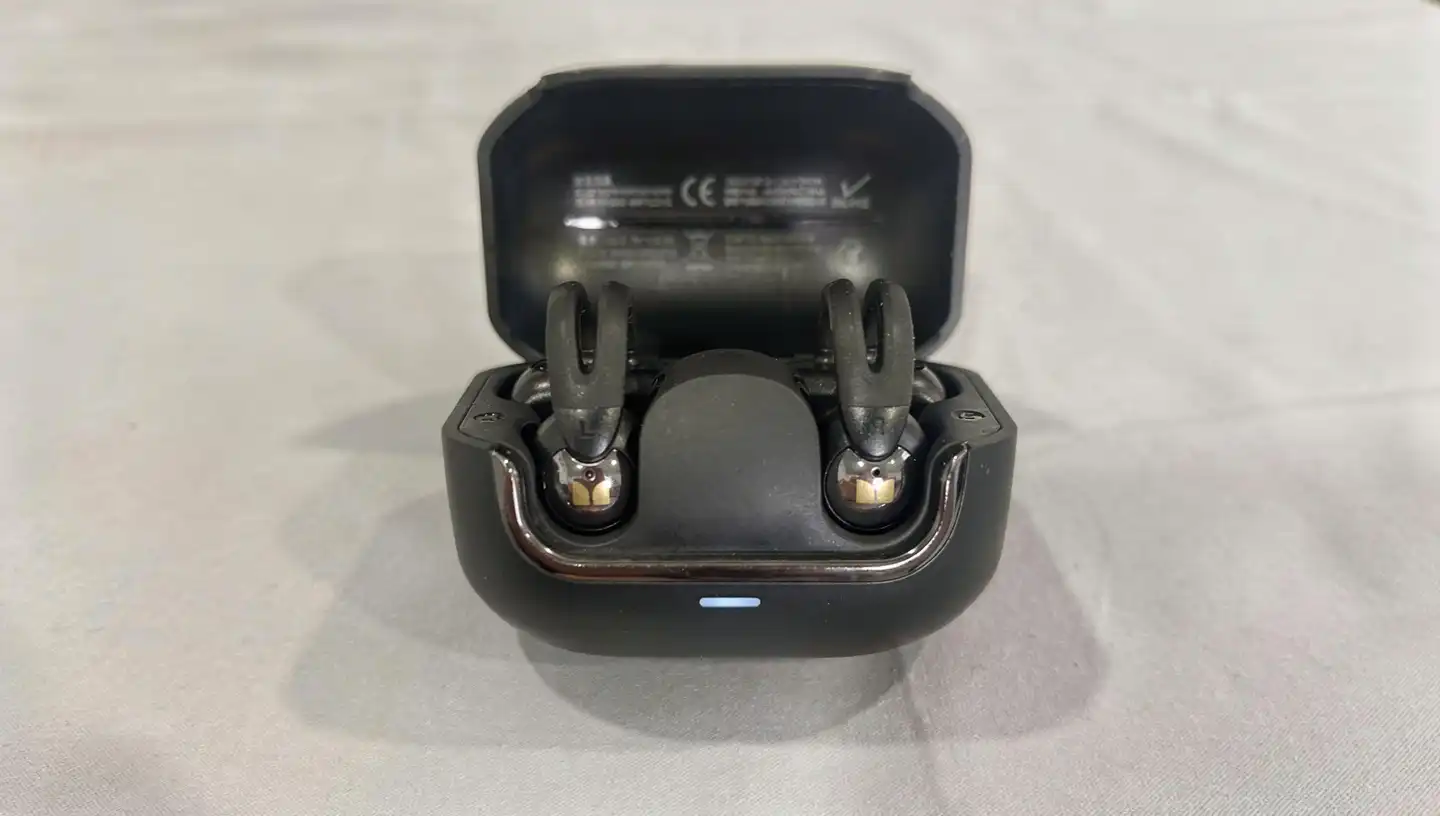
The package contains the two earbuds, a charging case, a USB-C cable and a user manual. There is no wall adapter and no spare tips, which makes sense because nothing goes in the ear canal. The earbuds pair automatically when you take them out of the case, and after the first connection they reconnect on their own. That is the standard routine for this class, and it is the part budget earbuds rarely get wrong.
The first thing you notice is how little there is to hold. The speaker unit is small, the bridge is thin and the whole earbud feels closer to a light accessory than to a gadget. That is the intent, since the AC221 is meant to disappear on the ear. Whether that translates into a secure fit is a question for the next section.
Design and build quality
Clip-on design and fit
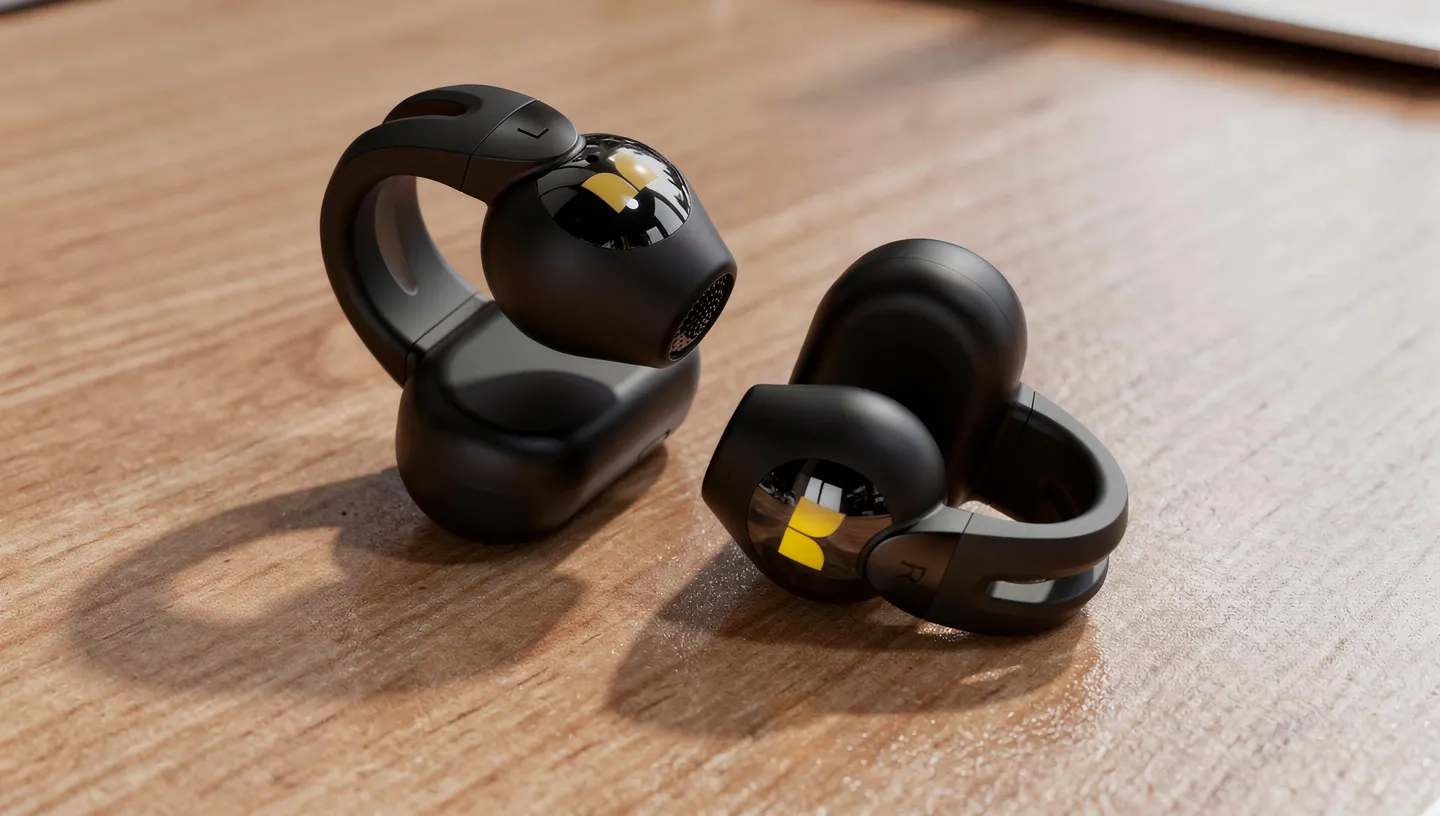
The AC221 is a clip-on earbud with a curved, flexible bridge that wraps around the outer ear. A small speaker unit with a round, mirror-like face sits in front of the ear canal opening, and a second piece rests behind the ear. The finish is matte black plastic with L and R markings and a gold Monster logo on the face. Like other clip-on earbuds, the design leaves the canal free, which means no pressure and no plugged-ear feeling after an hour of listening.
A small opening near the top of the speaker unit looks like a microphone port. The brand does not state a microphone count, so I would not read too much into it.
Comfort and weight
At 4 g per earbud, the Monster Open Ear AC221 is lighter than the Monster AC225 at 5.1 g and the EarFun Clip 2 at 5.5 g. That gap is small on a scale, but clip-ons sit on the cartilage of the outer ear, so every gram counts during long sessions. The bridge is flexible enough to adapt to different ear sizes, though a very small or very large ear will decide whether the grip feels secure or loose.
Glasses wearers have fewer worries here than with ear-hook designs, since the frame sits on the outer ear without fighting the temple arm. Heavy frames can still crowd the area behind the ear, so try them with your own glasses before you decide.
Controls and button layout
The AC221 uses touch control. Touch panels are the weak point of cheap clip-ons because adjusting the earbud on your ear often counts as a tap. The usual result is a paused track, a skipped song or a volume change you did not ask for. Physical buttons avoid this, which is one reason the EarFun Clip 2 gets so much credit for its clicky buttons.
With touch control, set the earbud on your ear first and only then tap, and expect to learn where the sensitive area is.
IPX6 water resistance
IPX6 means protection against powerful water jets, as the IP code overview on Wikipedia explains. Sweat and rain are covered, which suits workouts and walks in bad weather. Immersion is a separate test (IPX7), and an IPX6 rating does not imply it. The marketing mentions swimming among the recommended uses, and I would ignore that. Keep these out of the pool and rinse off heavy sweat after a hard run.
Features and connectivity
Bluetooth 6.0
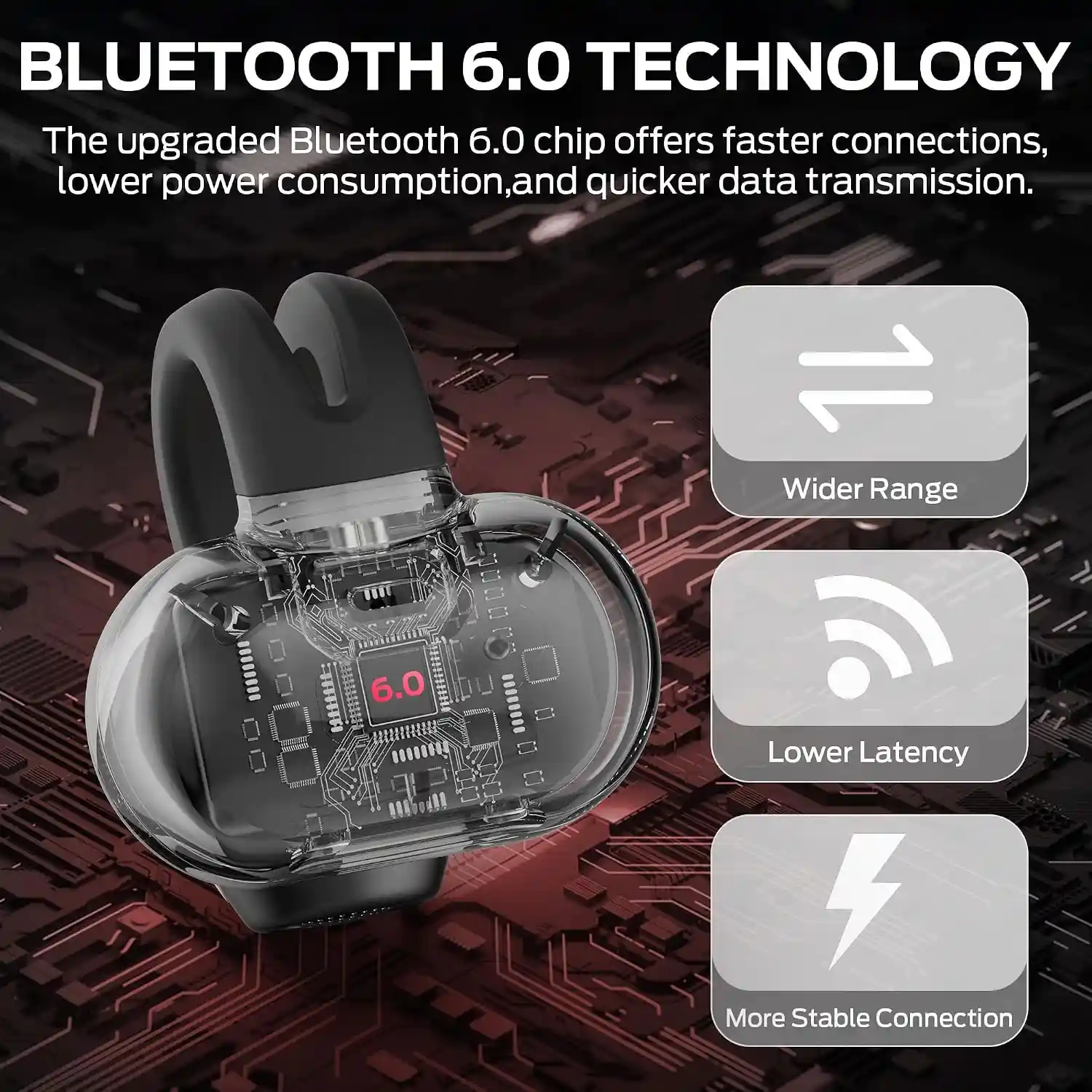
The Monster Open Ear AC221 lists Bluetooth 6.0, and the pitch is a wider range, lower latency and a more stable connection. The Bluetooth SIG describes Channel Sounding, a distance-measuring feature aimed at find-my and digital key products, as the headline feature of Core 6.0. It does not change how music is encoded, so the 6.0 badge says little about sound quality. It does point to a recent chip, which helps with power use and with pairing on a new phone. Our Bluetooth 6.0 explainer covers the version jump in more detail.
Codecs and multipoint
Monster does not name a codec, multipoint or Google Fast Pair for the AC221. Earbuds that skip the codec line usually default to SBC, with AAC on iPhone when the chip supports it. LDAC is not mentioned, so do not expect high-resolution streaming at this price. A low-latency claim appears without a number, so video sync should be fine, while competitive mobile gaming is a gamble.
Charging case and USB-C
The AC221 charges over USB-C in about 2 hours and comes with a charging case that carries the extra hours. No wall adapter is included, so use a charger you already own. Cases on this kind of budget earbud are often bulky, which matters more for a pair this light, because the earbuds are the part you want to forget about in your pocket.
Open-ear earbuds versus in-ear earbuds
Before the sound section, it helps to know what you give up and what you gain. Sealed in-ear earbuds block noise, push bass into the canal and reach higher volumes without much leakage. Open-ear clip-ons trade all of that for awareness and comfort. You hear a car approaching, a colleague speaking or a train announcement, and your ears stay cool and free of pressure.
For that reason, open-ear earbuds work best as a second pair, not a replacement. Keep a sealed pair for flights and loud commutes, and use the clip-on for walks, chores and desk hours. Judged that way, the Monster Open Ear AC221 has a clear job, and its weight and price fit it well.
Monster Open Ear AC221 sound quality
Sound is where open-ear earbuds are won or lost, and where the design sets hard limits. With nothing sealing the ear canal, the earbud works against the room, and low frequencies suffer the most. Judge the AC221 as an open-ear earbud, not against sealed in-ear models.
Driver and tuning
The 13 mm dynamic driver is a normal size for the category. Monster mentions a digital audio processor for lifelike vocals and sharper mids and highs, but there is no named chip, no EQ app and no tuning curve. Treat that as marketing. The same wording shows up across the brand’s open-ear line, which is another reason to expect a tuning aimed at voices and upper mids rather than bass.
Bass and low-end
Open-ear earbuds lose bass because nothing seals the ear canal. That is physics, not a defect. On a $30 clip-on, expect some mid-bass and almost nothing below it. The one Monster clip-on I found a proper independent test for, the AC600 from Scarbir, had missing bass and a thin sound, and the AC221 shares its category and price band.
Mids and highs
This is where a tuning like this one usually does its best work. Vocals, podcasts, audiobooks and acoustic tracks sound clearest, while treble can turn peaky as the volume climbs, and busy tracks lose detail. If you mostly listen to talk, that tradeoff is fine. If you want to hear every layer of a dense mix, an open-ear earbud at this price is the wrong tool.
Soundstage
Open-ear earbuds usually give an airy, natural sense of space because the sound mixes with the room. Imaging is looser than on sealed earbuds, and instruments tend to sound diffuse rather than placed. Do not expect layered separation from the Monster Open Ear AC221. It should sound like music playing nearby, which is the point of the format.
Volume and sound leakage
Volume headroom is the number one weakness of cheap open-ear earbuds. The more noise there is around you, the louder you need to go, and a small driver runs out of room fast. Leakage works the other way. At a low volume in a quiet office, little escapes, but at a high volume on a street, people next to you will hear the track. Some Monster models claim directional audio to reduce this, and the AC221 does not make that claim.
Microphone and call quality
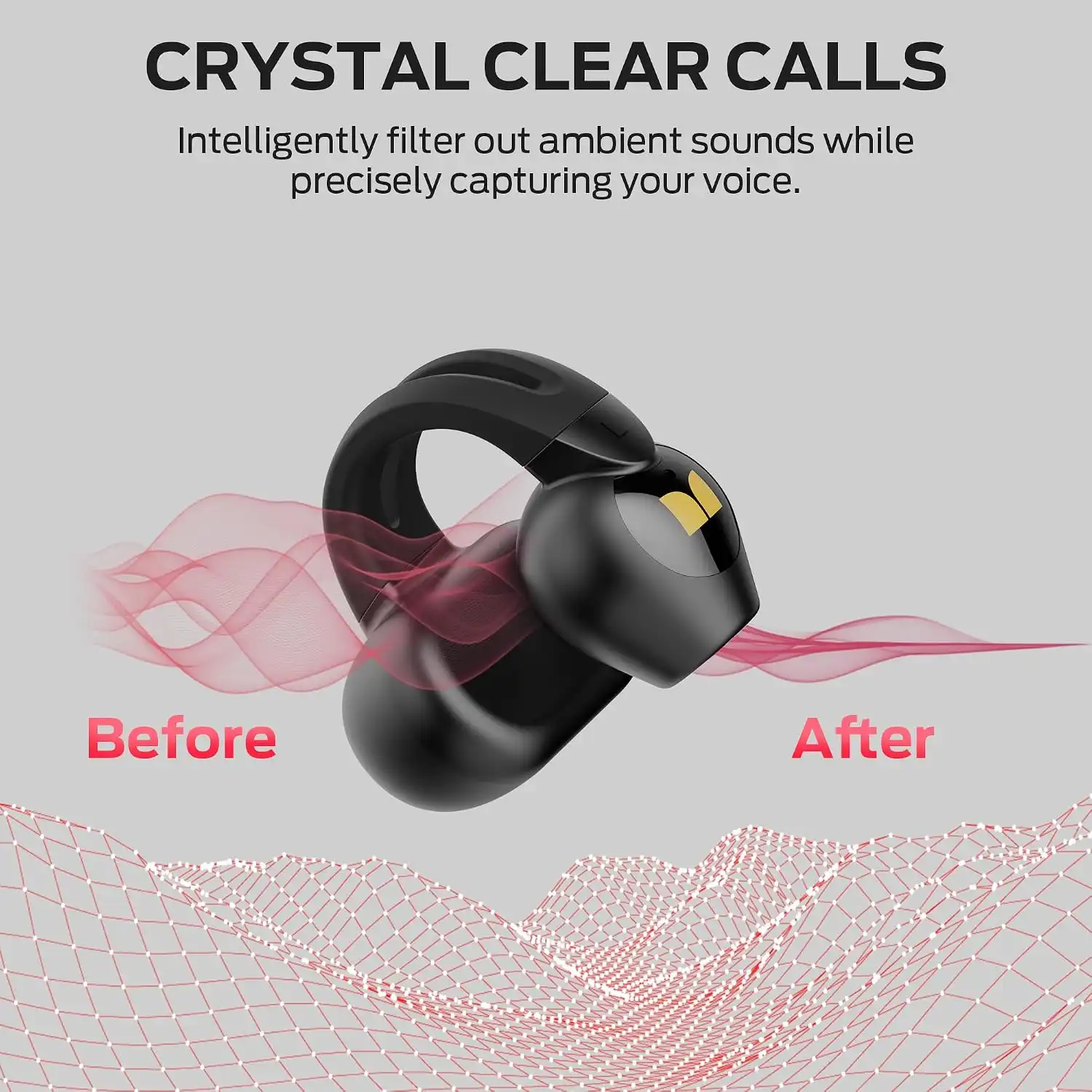
Monster promises clear calls and shows ambient sounds being filtered while your voice is captured. It does not name ENC or give a microphone count, so there is no verified noise reduction here. The AC225, by comparison, names an ENC microphone. The open design adds its own problem, because noise reaches both your ears and the microphones. How much of it gets removed depends on the microphone count and the processing, which we explain in our guide to AI ENC in earbuds and headphones.
The safest way to judge any pair is a voice memo in a quiet room, next to a fan and outside near traffic, played back to compare the level of your voice with the background. After that, make one real call and ask the other person what they hear. For the AC221, I would keep expectations at the level of occasional calls, not daily work meetings.
Monster Open Ear AC221 battery life
Monster lists up to 8 hours per charge, with the case taking the total to 30 hours. Some pages word it as 8 hours plus another 30 from the case, which would be about 38 hours, so the exact total is not clear. Either way, the earbud itself is the number that matters for a workday. Charging takes about 2 hours over USB-C.
Treat 8 hours as a ceiling. High volume and calls cut runtime, and a small battery in a 4 g earbud has little reserve. Sister models show how far the claims can drift: the AC210 advertises 30 hours with the case while its own spec table says 6 hours per charge, and Scarbir measured a solid 7 hours per charge on the AC600. If you need a full workday, plan on topping up from the case.
How the Monster Open Ear AC221 compares to the rest of the Monster open-ear line
| Model | Price | Weight per earbud | Battery per charge | Total with case | Water resistance | Calls |
|---|---|---|---|---|---|---|
| Monster Open Ear AC221 | $29.99 | 4 g | Up to 8 h | 30 h | IPX6 | Clear calls claim, no ENC named |
| Monster Open Ear AC225 | $29.99 | 5.1 g | 8 h | 36 h | IPX6 | ENC microphone |
| Monster Open Ear AC210 | $29.99 (sale) | Not stated | 6 h | 30 h | IPX5 in title | Muffled in owner reports |
| Monster Open Ear AC600 | About $20 | Not stated | 7 h | Not stated | None | Clear but thin in testing |
The AC225 costs the same and adds an ENC microphone, a longer 36-hour claim and a heavier 5.1 g build. The AC210 runs on Bluetooth 5.4 and has the messiest specs of the group. The AC600 is older and cheaper, with no water rating. Within Monster’s open-ear range, the AC225 is the more complete package on paper, while the AC221 wins on weight and on Bluetooth 6.0.
Monster Open Ear AC221 vs the alternatives
Monster Open Ear AC221 vs SoundPEATS Clip1
The SoundPEATS Clip1 sits in the same $30 to $40 range, and it lists AI ENC for calls, which the AC221 does not. It has no LDAC and no wireless charging case, so the two are close on features. The deciding factor is track record: the Clip1 has independent tests and our own SoundPEATS Clip1 review, while the AC221 is a newer, less documented model. At the same price, the Clip1 is the safer pick.
Monster Open Ear AC221 vs EarFun Clip 2
The EarFun Clip 2 costs about 2.7 times as much, and the extra money buys physical buttons, LDAC, a companion app with EQ, a four-mic setup, IP55 and wireless charging. If touch controls, thin sound and call quality worry you, saving up for the Clip 2 is a better move than taking a chance on the cheaper pair. If you only want something light for podcasts and walks, the AC221 does that for a third of the money.
What I like about the Monster Open Ear AC221
- 4 g per earbud, lighter than most clip-ons at any price
- IPX6 rating for sweat, rain and splashes
- Bluetooth 6.0 chip at a very low price
- Up to 8 hours per charge on paper, with a case for top-ups
- USB-C charging
- Open design that keeps you aware of traffic and people
- Clip-on fit with no ear canal pressure
Room for improvement
- Touch controls that can misfire when you adjust the clip
- Thin bass and a limited maximum volume, as with most open-ear earbuds at this price
- No microphone count and no ENC claim
- Battery figures that vary from page to page
- No codec, multipoint or app listed
- A list price that looks inflated against the sale price
Verdict: should you buy the Monster Open Ear AC221
The Monster Open Ear AC221 is a good pick if you want a very light clip-on earbud for walks, chores or desk work, you stream podcasts, audiobooks or background music, and you can get it close to $29.99. It is light, rated IPX6 and has a Bluetooth 6.0 chip at a price where most rivals use older ones. I would not pay more than about $40 for it.
Skip it if you need reliable calls, strong bass or high volume in noisy places, or if the price is $60 or higher. If you want a Monster product with a much stronger sound, our Monster Persona 5th ANC review covers an $80 pair of over-ear headphones with a 70-hour battery. Open-ear earbuds also cannot offer noise isolation, so commuters on loud trains are better off with a sealed design.
Frequently asked questions
Is the Monster Open Ear AC221 worth buying?
At around $29.99, yes, for casual listening, podcasts and walks. At $60 or more, better-documented options such as the SoundPEATS Clip1 or the EarFun Clip 2 make more sense.
Are Monster open ear earbuds good?
They are comfortable, light and cheap, and the fit is the part people like most. The common weak points are low volume, thin bass, touch controls that misfire and muffled calls. Treat them as budget earbuds.
How long does the Monster Open Ear AC221 battery last?
The listing claims up to 8 hours per charge and 30 hours with the case. Charging takes about 2 hours over USB-C. Real runtime is likely lower at high volume and during calls.
Is the Monster AC221 waterproof?
It is rated IPX6, which covers sweat, rain and powerful water jets. It does not cover swimming or submersion, even though the marketing suggests swimming as a use.
Does the Monster Open Ear AC221 have noise cancellation?
No. Open-ear earbuds cannot block outside sound, and no noise-reducing microphone is named for calls either.
Are the Monster AC221 earbuds good for calls?
Monster says clear calls but gives no microphone count or ENC claim. Related Monster models get mixed feedback on calls, so test one in a quiet room before you rely on them for work.
Can you use the Monster AC221 with glasses?
Probably. The clip-on design avoids ear hooks, so it sits on the outer ear without fighting the temple arm. Ear shape and frame thickness still matter, so try them for an hour.
Does the Monster Open Ear AC221 support multipoint or LDAC?
Neither is listed. Expect basic SBC or AAC streaming rather than high-resolution audio.