JBL sent me the Charge 6 for an honest review, and after spending time with it outdoors and at home, I can say this is a genuinely strong upgrade over the Charge 5. Priced at $149, the Charge 6 brings IP68 waterproofing, drop-proof certification from one meter, 45 watts of total output power, and a new USB-C wired connection that supports lossless audio up to 24-bit/96 kHz. Battery life is rated at 24 hours standard and 28 hours with Playtime Boost. Bluetooth 5.4 with Auracast multi-speaker support rounds out a spec sheet that puts this well ahead of what the Charge 5 offered.
I tested the Charge 6 outdoors and at home across several days, running it through music, high-volume sessions, and the wired connection. Based on my experience, it’s looking like tremendous value for money at this price point.
| Spec | Detail |
|---|---|
| Price | $149 / £129 / AU$229 |
| Output power | 45W total (30W woofer + 10W + 5W tweeter) |
| Drivers | 52x90mm racetrack woofer + 20mm tweeter + 2x passive radiators |
| Frequency response | 54Hz – 20kHz |
| Bluetooth | 5.4 |
| IP rating | IP68 + drop-proof from 1 meter |
| Battery | 24h standard / 28h Playtime Boost |
| Wired audio | USB-C, 24-bit/96 kHz lossless |
| Weight | 988g |
| Colors | Black, white, pink, red, blue, purple, squad |
Who the JBL Charge 6 is for
The Charge 6 is built for anyone who takes their speaker outdoors regularly and wants a durable, loud, weatherproof option that doesn’t sacrifice sound quality. It’s not a living room speaker. It’s a speaker you take to the lake, the backyard, a camping trip, or anywhere you’re not worried about keeping it pristine.
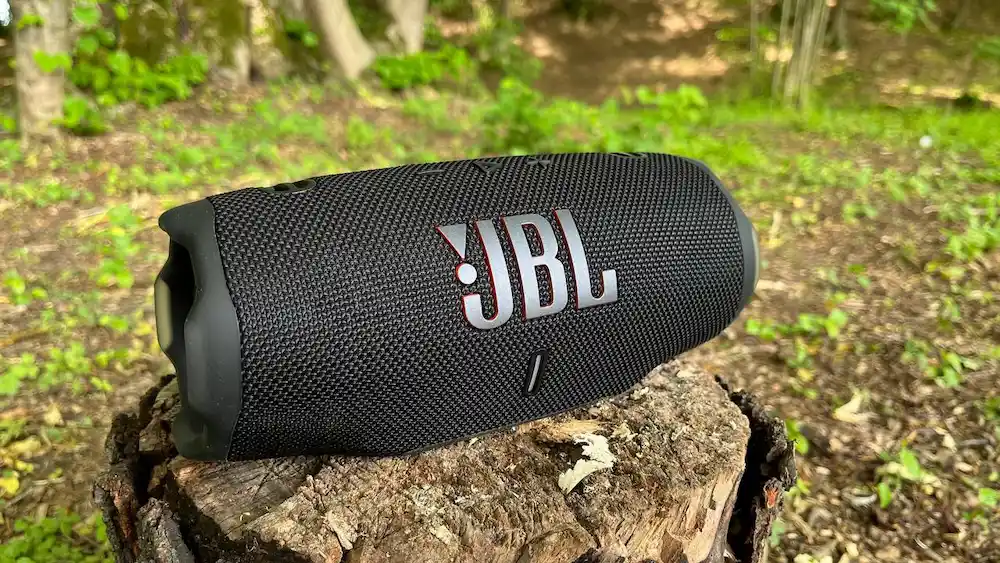
If battery life, volume output, and rugged build matter to you more than 360-degree coverage or smart assistant support, this is the one to get.
Design and build quality
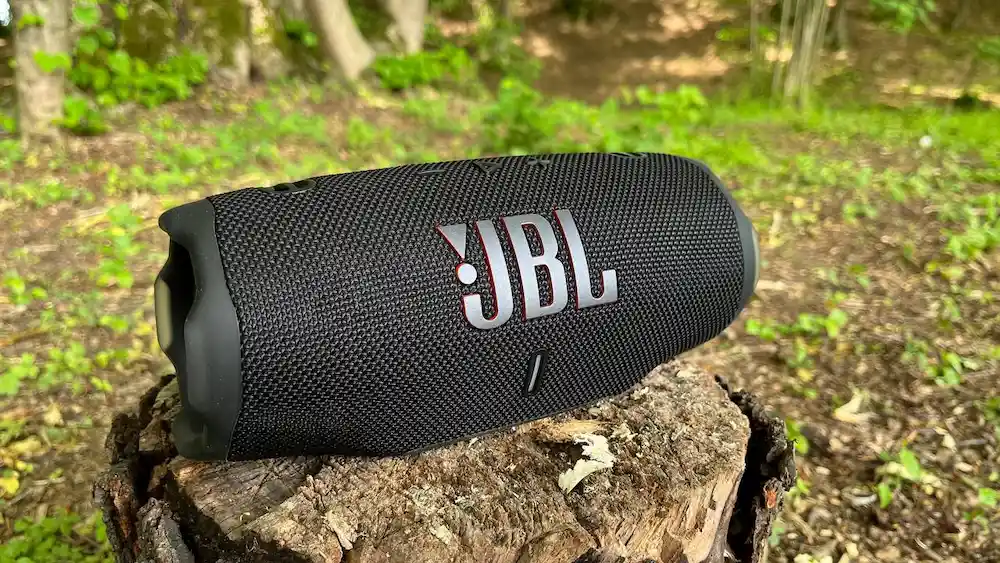
The Charge 6 feels solid and well made. The familiar fabric wrap returns, and it still gives a grippy, confident feel in the hand. JBL hasn’t changed the fundamental shape or size much from the Charge 5, and that’s the right call because the original design works.
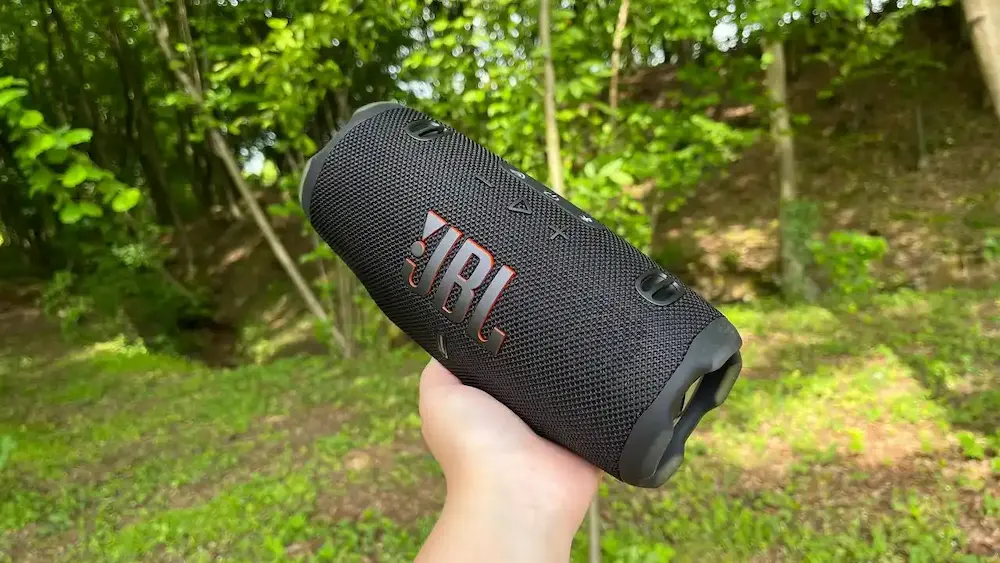
Carry handle, new base and what changed from the Charge 5
The most immediately obvious change is the detachable carry handle. You can configure it two ways: as a traditional handle looped through both eyelets on top, or as a single-point loop through one eyelet. Neither was possible on the Charge 5, and both are genuinely useful. I found the handle more comfortable for carrying than expected given the speaker’s 988g weight.
The base has changed too. JBL ditched the ten thin silicone strips that some Charge 5 owners reported peeling off over time, replacing them with a slightly wider and flatter rubberized base. The speaker sits more stably on flat surfaces and doesn’t rock or roll the way the Charge 5 could on uneven ground. Small change, real improvement.
IP68 rating and drop-proof certification: what they mean in practice
The Charge 5 was IP67. The Charge 6 steps up to IP68, which means it handles submersion down to 1.5 meters for up to 30 minutes. That’s deeper and longer than IP67 covers. On top of that, JBL has certified the Charge 6 as drop-proof from one meter onto concrete. The rubber bumpers protecting the passive radiators on each end are now thicker and longer, and there are four of them instead of the Charge 5’s three. Whether you’re at a pool, a beach, or just clumsy, the Charge 6 is built to handle it.
Controls and button layout
Controls sit on top of the speaker. The play/pause button is flanked by volume up and volume down. Above those is a backlit control strip with three buttons: Bluetooth, power, and Auracast. The Party Boost button from the Charge 5 is gone, replaced by the Auracast button. Each button is tactile and responds cleanly.
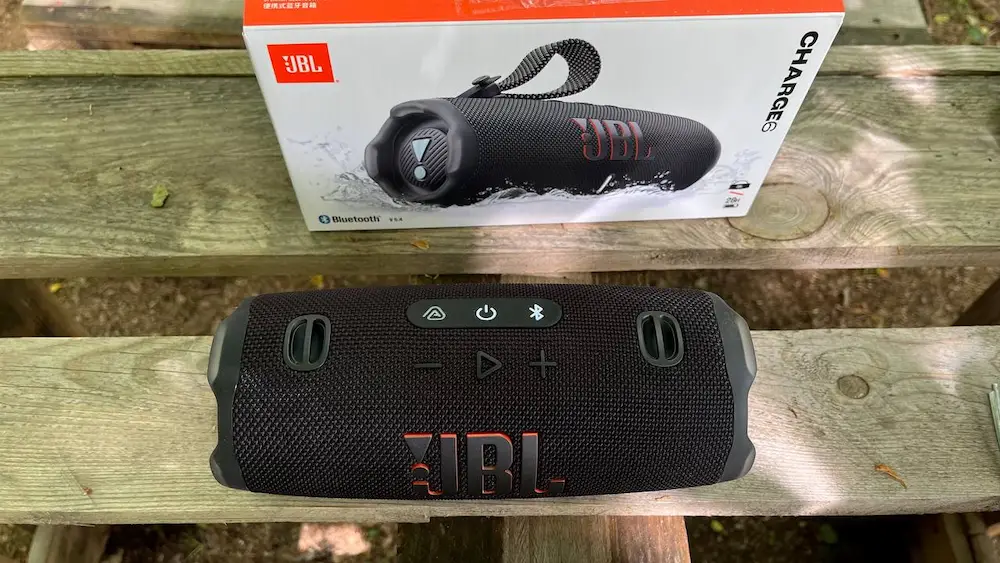
Hold play/pause while plugging in a USB-C cable to activate wired listening mode. A tone confirms when it switches over. The USB-A port from the Charge 5 is gone, with a single USB-C port handling charging, power bank output, and wired audio.
Features and connectivity
This is where the Charge 6 pulls noticeably ahead of its predecessor. The upgrade from Party Boost to Auracast, the addition of USB-C audio, and the jump to Bluetooth 5.4 are all meaningful improvements, not just spec sheet padding.
Bluetooth 5.4 and Auracast: what changed from Party Boost
Bluetooth 5.4 brings better energy efficiency and future support for LE Audio through a firmware update. Auracast replaces the old Party Boost system and expands multi-speaker pairing to up to 100 Auracast-compatible speakers simultaneously. That’s a significant jump from Party Boost’s two-speaker limit.
The catch is backward compatibility. Auracast-enabled JBL speakers are not compatible with older Party Boost models. If you own a Charge 5 and were planning to pair it with a Charge 6, that won’t work. You need two Charge 6 units, or another Auracast-compatible JBL model like the Flip 7, Xtreme 4, or Go 4. For anyone starting fresh, this is a non-issue. For existing Charge 5 owners, it’s worth knowing before buying.
USB-C wired audio and 24-bit/96 kHz lossless playback
This is the most surprising addition on the Charge 6 and one that no competing speaker in this price range offers. Hold down the play/pause button while connecting a USB-C cable from a compatible source, wait for the confirmation tone, and the Bluetooth section shuts off entirely. You get 24-bit/96 kHz lossless audio delivered directly to the speaker’s amplifier.
You need a lossless source to make use of it. Tidal HiFi, Qobuz, or local FLAC and ALAC files are what this is designed for. Spotify at 320 kbps through USB-C gives you no advantage over Bluetooth. But for anyone who uses hi-res audio streaming, the wired option is a genuine upgrade over Bluetooth in ways that are immediately audible. More on that in the sound section.
JBL Portable app and 7-band EQ
Download the JBL Portable app. It’s worth it for the 7-band customizable EQ alone, which is a step up from the 3-band EQ available on the Charge 5. Four EQ presets come built in. I always prefer building my own, and the 7-band gives enough range to dial in the low-end and pull back anything that sounds too sharp at the top.
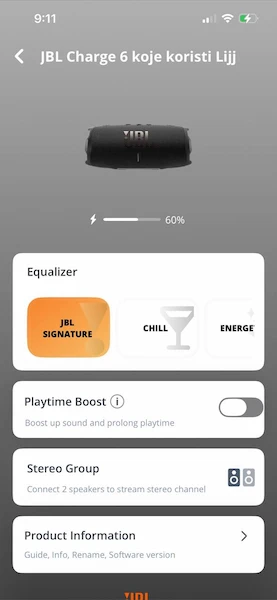
The app also hosts Auracast speaker management under “Party Together,” Playtime Boost toggle, and firmware updates.
AI Sound Boost: how it works and what it does
JBL calls it AI Sound Boost and markets it as a clever audio processing algorithm under the hood. In practice, it is a real-time DSP algorithm that analyzes the audio signal being played and optimizes the 52x90mm racetrack driver’s bass output at its limits with minimal distortion.
The woofer in a speaker this size gets heavily loaded at low frequencies, and without processing, pushing the volume produces audible distortion before the driver physically reaches its limit. AI Sound Boost manages that ceiling in real time so you get more clean output before the driver starts to break up. You can disable it in the app. I left it on for most of my testing because the difference at high volumes is real.
Powerbank function
The same USB-C port that handles charging and wired audio also charges your phone. Connect your device to the Charge 6’s USB-C port and it acts as a powerbank. Useful in a pinch when you’re outdoors and away from a socket. It does eat into the speaker’s own battery, so use it when you need it rather than as a habit.
JBL Charge 6 sound quality
The Charge 6 has a punchy, detailed sound with a tonal balance that holds up across genres and at a wide range of volumes. It’s not a flat or studio-accurate speaker. It’s tuned for fun, for outdoor listening, for music that needs energy and impact. Within that context, it does its job very well.
Bass and low-end response
The 52x90mm racetrack woofer and two passive radiators on each end of the housing produce bass that is deep, controlled, and impactful without becoming bloated. Sub-bass reaches down to 54Hz. The low-end has genuine weight and thump, particularly on hip-hop, electronic, and bass-heavy tracks. It doesn’t rumble the way a much larger speaker would, but for a speaker this size at this price, the bass response is impressive and controlled. The passive radiators are doing meaningful work at the bottom of the frequency range.
Mids and highs
The 20mm tweeter keeps highs clear and present without turning harsh. Vocals sit forward in the mix and come through with detail. Instruments have separation. The midrange is warm but not muddy. On synth-heavy tracks, the Charge 6 handles layered textures without getting congested. Cymbals have texture without splashiness. The tonal balance is even-handed across the frequency range, which makes it work well for a wider variety of genres than a more aggressively V-shaped tuning would.
At high volume
The Charge 6 is built for volume. Pushing past 70 percent, the speaker doesn’t strain or lose composure. The AI Sound Boost keeps the low end clean at high output levels where other speakers at this size start to distort. It’s punchy and detailed at the same time, and the 45 watts of total output are enough to fill outdoor spaces without the speaker sounding like it’s working hard to do it. This thing is made for fun.
At low volume
This is the one area where the Charge 6 is less impressive. At background listening levels, quite a lot of its direct, expansive character disappears. The bass loses its punch, the soundstage narrows, and what’s left sounds comparatively flat and thin. The Charge 6 is not a quiet background speaker. It performs best from moderate to high volumes, and if your primary use case is low-level background music at a desk or during conversation, something with a more room-filling design might serve you better.
Bluetooth vs USB-C wired audio
The difference between Bluetooth and USB-C wired audio is immediately audible and worth the cable. Over USB-C with a lossless source, the Charge 6 gains additional clarity, dynamics, and rhythmic precision that Bluetooth doesn’t deliver. Vocals have more solidity and textural depth. Highs carry more detail without gaining any harshness. The low-end tightens up. It’s not a night-and-day transformation, but it’s a consistent and noticeable step up that justifies the wired option existing in a portable outdoor speaker. For a full breakdown of how Bluetooth codecs affect wireless audio quality, that guide covers every major option.
Battery life: what JBL claims vs what you actually get
Battery life is one of the Charge 6’s headline numbers, but the claimed figures need some context before you plan your next camping trip around them.
Standard mode: 24 hours claimed vs real use
JBL rates the Charge 6 at 24 hours at moderate volume with standard EQ. SoundGuys tested it with a consistent audio source at 80dB from one meter and got 13 hours and 15 minutes. That’s a significant gap from the claim, though 80dB is louder than most people’s average listening volume. Trusted Reviews measured an 11 percent drop after seven hours, which projects closer to JBL’s claim at lower volumes. The honest answer is that real-world battery life sits somewhere between those two results depending on how loud you push it. At moderate outdoor volumes, 18 to 20 hours is a realistic expectation.
Playtime Boost: 28 hours and what you actually lose
Enabling Playtime Boost adds four extra hours by cutting bass response and shifting the frequency balance toward mids and treble. JBL enables this through the app. The result is closer to a podcast listening mode than a music mode. It works, and the audio is still functional, but the bass that makes the Charge 6 what it is gets noticeably curtailed. For music genres that rely on low-end punch, hip-hop, EDM, electronic, Playtime Boost is a poor trade. For podcasts, audiobooks, or voice-heavy content where battery matters more than bass, it makes sense. I’d use it in a pinch but not by default.
Quick charge
Ten minutes on the charger gives 150 minutes of playback. Full charge from flat takes about three hours. Quick charge works well and gives you a useful top-up in the time it takes to eat lunch. If you forget to charge overnight, ten minutes in the morning gets you through most of a day at moderate volumes.
JBL Charge 6 vs JBL Charge 5: what actually changed
The two speakers look nearly identical and use the same driver setup, but the changes underneath are more meaningful than a side-by-side glance suggests.
| Feature | Charge 5 | Charge 6 |
|---|---|---|
| Bluetooth | 5.1 | 5.4 |
| IP rating | IP67 | IP68 |
| Drop-proof | No | Yes, 1 meter |
| Multi-speaker | Party Boost (2 speakers) | Auracast (up to 100) |
| Backward compatible | Yes (with older JBL) | No (Auracast only) |
| Carry handle | No | Yes, detachable |
| EQ in app | 3-band | 7-band |
| Wired audio | No | USB-C, 24-bit/96 kHz |
| AI Sound Boost | No | Yes |
| Base design | 10 silicone strips | Wide rubberized base |
| Passive radiator bumpers | 3 | 4, thicker |
| Weight | ~960g | 988g |
| Drivers | 52x90mm + 20mm | 52x90mm + 20mm |
The driver setup is identical, so the core acoustic character stays the same. The Charge 6 gets there with more processing, better durability, and a more flexible connectivity set. If your Charge 5 is working fine, the upgrade is not urgent. If you’re buying new, the Charge 6 is the clear pick.
How the JBL Charge 6 compares to the competition
JBL Charge 6 vs Bose SoundLink Plus
The Charge 6 is louder and gets more impact on electronic beats and bass-heavy tracks. The Bose SoundLink Plus costs more and is larger, but it pulls ahead on acoustic drums, where it shows finer detail in overtones and more transparency in the midrange. For electronic music and high-volume outdoor listening, the Charge 6 keeps up well and wins on value. For acoustic and classical material where midrange resolution matters more than raw punch, the SoundLink Plus has an edge.
JBL Charge 6 vs Ultimate Ears MEGABOOM 4
The Charge 6 gets louder and delivers more even bass output than the Ultimate Ears MEGABOOM 4. The UE’s 360-degree design means it sounds consistent regardless of listening position, which is an advantage at park gatherings or group settings where people are spread around the speaker. The Charge 6 is directional and works best when you’re positioned in front of it. For a fixed outdoor spot, the Charge 6 wins on volume and bass. For moving around a space, the MEGABOOM 4’s design has the practical edge.
JBL Charge 6 vs JBL Flip 7
The Flip 7 uses the same driver concept as the Charge 6 but in a smaller shell with less power. It is more portable and cheaper, and it shares Auracast compatibility with the Charge 6 for pairing. The Charge 6 gets louder, goes deeper in the bass, and lasts longer on a charge. If portability is the priority and you can give up some volume and low-end, the Flip 7 makes sense. If you want the fuller sound and longer battery that the Charge series is known for, the Charge 6 is worth the extra money and size.
What I like about the JBL Charge 6
- IP68 waterproofing and drop-proof certification from one meter
- Punchy, detailed sound that holds up at high volume
- USB-C wired audio with lossless 24-bit/96 kHz support
- Detachable carry handle in two configurations
- Auracast support for up to 100 speakers
- 7-band EQ in the JBL Portable app
- AI Sound Boost keeps bass clean at the volume ceiling
- Quick charge: 10 minutes gives 150 minutes of playback
- Stable rubberized base that doesn’t roll
- Available in seven colors
Room for improvement
- Not backward compatible with Charge 5 or any Party Boost JBL speaker
- Playtime Boost noticeably reduces bass and overall sound quality
- Sounds flat and thin at low background volumes
- No USB-C cable included in the box
- No voice assistant support
- Real battery life at higher volumes falls well short of the 24-hour claim
- No speakerphone functionality
Verdict: should you buy the JBL Charge 6
The JBL Charge 6 is a strong upgrade over the Charge 5 and one of the best portable Bluetooth speakers at this price. The combination of IP68 waterproofing, drop-proof build, 45 watts of clean output, and USB-C lossless audio is genuinely hard to match for $149. Sound quality is punchy, detailed, and well-balanced at moderate to high volumes. Battery life in real use is solid even if it falls short of JBL’s headline claim.
The Auracast compatibility issue is the one thing to check before buying. If you own older JBL Party Boost speakers and planned to add the Charge 6 to that setup, it will not work. You are starting fresh with Auracast. For anyone buying their first portable speaker or upgrading from something other than a Charge 5, that is a non-issue.
Perfect for outdoor use, camping, beach trips, and backyard sessions. I’d recommend the Charge 6 to anyone who wants a durable, loud, weatherproof speaker that also handles wired lossless audio. It’s looking like tremendous value for money at this price point, and as good as speakers this size at this price get right now.
If you’re also shopping for wireless headphones to go alongside a portable speaker, the best LDAC headphones guide covers top-rated over-ear and on-ear options with hi-res codec support. For a well-rounded budget pick that handles long listening sessions without needing a charge every day, the SoundPEATS Cove Pro review is worth a read.
Frequently asked questions
Is the JBL Charge 6 worth buying?
Yes. At $149, the Charge 6 offers IP68 waterproofing, drop-proof certification, 45 watts of output, USB-C lossless audio, Auracast support, and a 7-band EQ. It is one of the best portable Bluetooth speakers at this price, and the upgrade over the Charge 5 is more meaningful than it first appears.
Can the JBL Charge 6 be used in the shower or pool?
Yes. The IP68 rating covers submersion down to 1.5 meters for up to 30 minutes. It is also certified drop-proof from one meter onto concrete. It handles rain, pool splashes, and accidental drops without issue.
Is the JBL Charge 6 compatible with the JBL Charge 5?
No. The Charge 6 uses Auracast for multi-speaker pairing, which is not backward compatible with the Charge 5’s Party Boost system. You cannot pair a Charge 6 and a Charge 5 together. The Charge 6 works with other Auracast-compatible JBL models like the Flip 7, Xtreme 4, and Go 4.
How long does the JBL Charge 6 battery actually last?
JBL claims 24 hours at moderate volume. SoundGuys measured 13 hours and 15 minutes at a consistent 80dB. At normal outdoor listening volumes, expect somewhere between those two figures, closer to 18 to 20 hours. With Playtime Boost enabled, the claim rises to 28 hours, but bass response is noticeably reduced in that mode.
What is Playtime Boost on the JBL Charge 6?
Playtime Boost is a battery-saving mode accessible through the JBL Portable app that extends playback from 24 to 28 hours by reducing bass output and shifting the sound toward mids and treble. It works but changes the character of the speaker significantly. It is useful for podcasts or voice content but not ideal for music that relies on bass impact.
Does the JBL Charge 6 support lossless audio?
Yes, via USB-C wired connection. Hold down play/pause while connecting a USB-C cable from a compatible device running a lossless audio source like Tidal HiFi or Qobuz. The Charge 6 switches to wired mode and delivers 24-bit/96 kHz audio. Over Bluetooth it uses standard codecs without lossless support.
What is AI Sound Boost on the JBL Charge 6?
AI Sound Boost is a real-time DSP algorithm that analyzes the audio signal and optimizes the racetrack woofer’s output at high volumes to reduce distortion. It allows the driver to produce more clean bass output before breaking up. It can be disabled in the JBL Portable app but is worth keeping on for music listening at high volumes.