The LC3 codec, short for Low Complexity Communication Codec, is the mandatory audio codec for Bluetooth LE Audio. It replaces SBC, which has served as Bluetooth’s baseline audio codec since version 1.0, and it does so by delivering equal or better sound quality at roughly half the bitrate. Every device that carries the LE Audio specification must support it. There are no exceptions and no compatibility gaps between manufacturers.
Bluetooth SIG formally adopted the codec on September 15, 2020, as part of the Bluetooth 5.2 specification. It was jointly developed by Fraunhofer IIS and Ericsson, the same institute behind MP3 and AAC. The full LE Audio specification, incorporating the new codec alongside the new audio profiles, was completed on July 12, 2022. As of 2026, it runs on a growing list of wireless earbuds, flagship smartphones, hearing aids, and Windows 11 computers.
This guide covers how the codec works, how it compares to SBC, AAC, aptX, and LDAC, what LC3plus adds on top, and which devices support it today.
What Is LC3?
LC3 is a royalty-free audio codec standardized by Bluetooth SIG for use in the Bluetooth Low Energy audio protocol. It was introduced with Bluetooth 5.2 and succeeds the SBC codec, which has been the mandatory baseline for Bluetooth Classic audio since the beginning. The codec supports sampling rates from 8 kHz to 48 kHz, bit depths of 16, 24, or 32 bits, and configurable bitrates from 16 kbps to 345 kbps. Frame duration is either 7.5 ms or 10 ms.
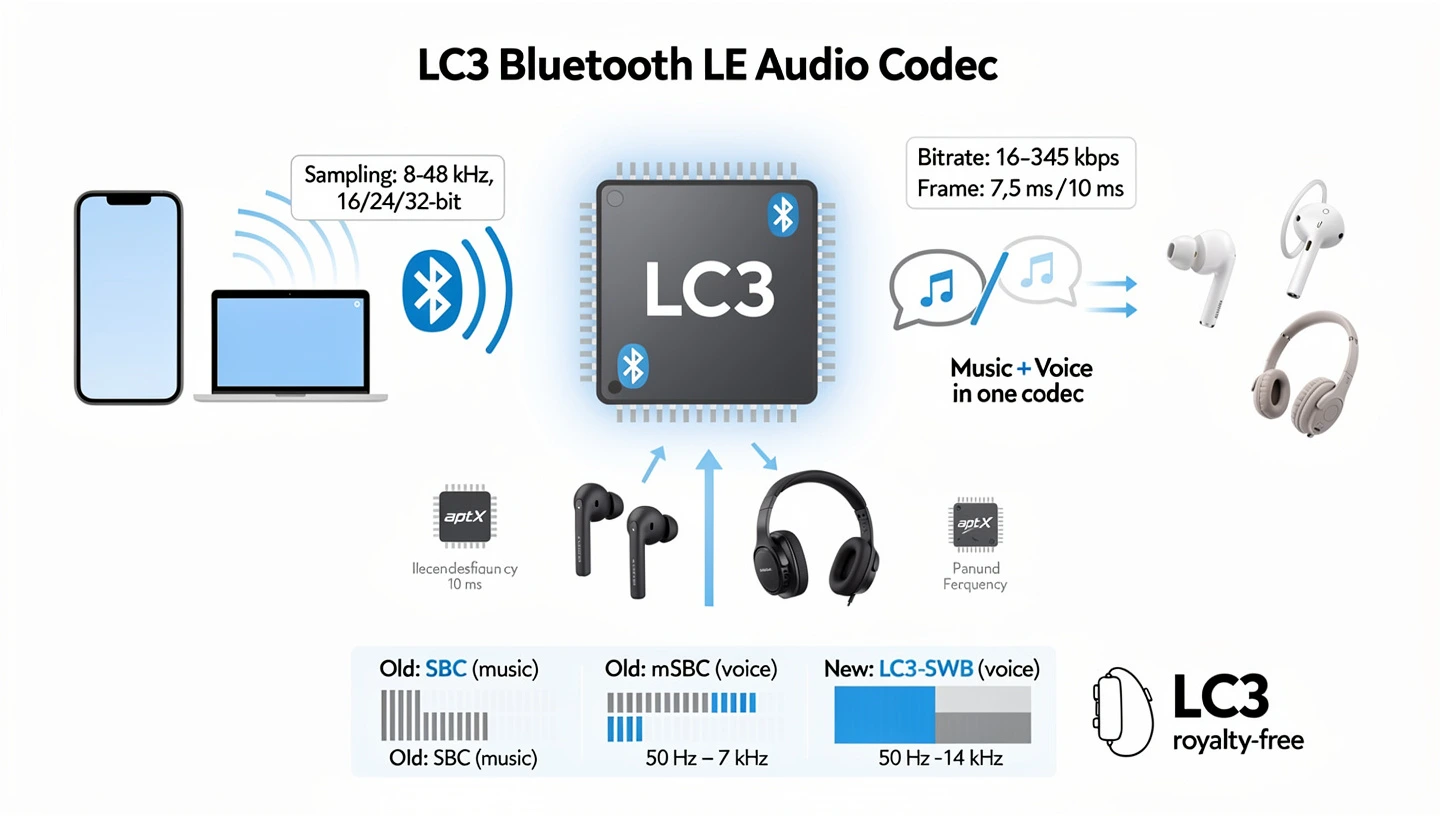
It handles both music and voice within a single, unified architecture. Before this codec, Bluetooth devices used two separate codecs: A2DP with SBC for music and HFP with mSBC for voice calls. The new standard covers both use cases at higher quality than either of its predecessors. For voice calls, LC3-SWB (Super Wideband, mono) is supported over HFP 1.9, succeeding mSBC. That brings Bluetooth voice calls up to a frequency range of 50 Hz to 14 kHz, compared to mSBC’s 50 Hz to 7 kHz ceiling under HFP 1.6.
The codec carries no licensing fee. Manufacturers do not pay per device or per unit to implement it. That is a meaningful difference from codecs like aptX and its variants, which require a Qualcomm license agreement and specific hardware on both the source and the receiver. The royalty-free status means it can appear in budget earbuds and hearing aids just as easily as it can in flagship headphones.
Who Developed LC3?
The codec was jointly developed by Fraunhofer IIS (Fraunhofer Institute for Integrated Circuits) in Erlangen, Germany, and Ericsson, the Swedish telecommunications company. The starting point was not consumer audio: the Bluetooth working group on hearing aids issued a call for a new audio codec that could operate at low bitrates with low power consumption on very small devices. Fraunhofer IIS and Ericsson responded to that call and spent several years supplying the hearing aid industry with preliminary versions before finalizing the specification for Bluetooth SIG.
Fraunhofer IIS has more than 30 years of audio compression research behind it. The institute developed MP3 in 1992 and co-developed AAC, both of which are in virtually every consumer audio device on the planet. Markus Schnell, Fraunhofer’s technical lead of the Low Delay Audio Coding Group, described the codec at launch as essential for hearing aids, communication headsets, wireless speakers, and wireless earbuds. Microsoft licensed the Fraunhofer software implementation for Windows, which is how support arrived in Windows 11.
Bluetooth SIG standardized the codec and made it mandatory for all LE Audio profiles. Because it is built directly into the Bluetooth specification, every LE Audio device must support it regardless of manufacturer, price point, or product category. That is fundamentally different from optional codecs like LDAC or aptX, which only work if both the source device and the receiver support them.
How LC3 Works
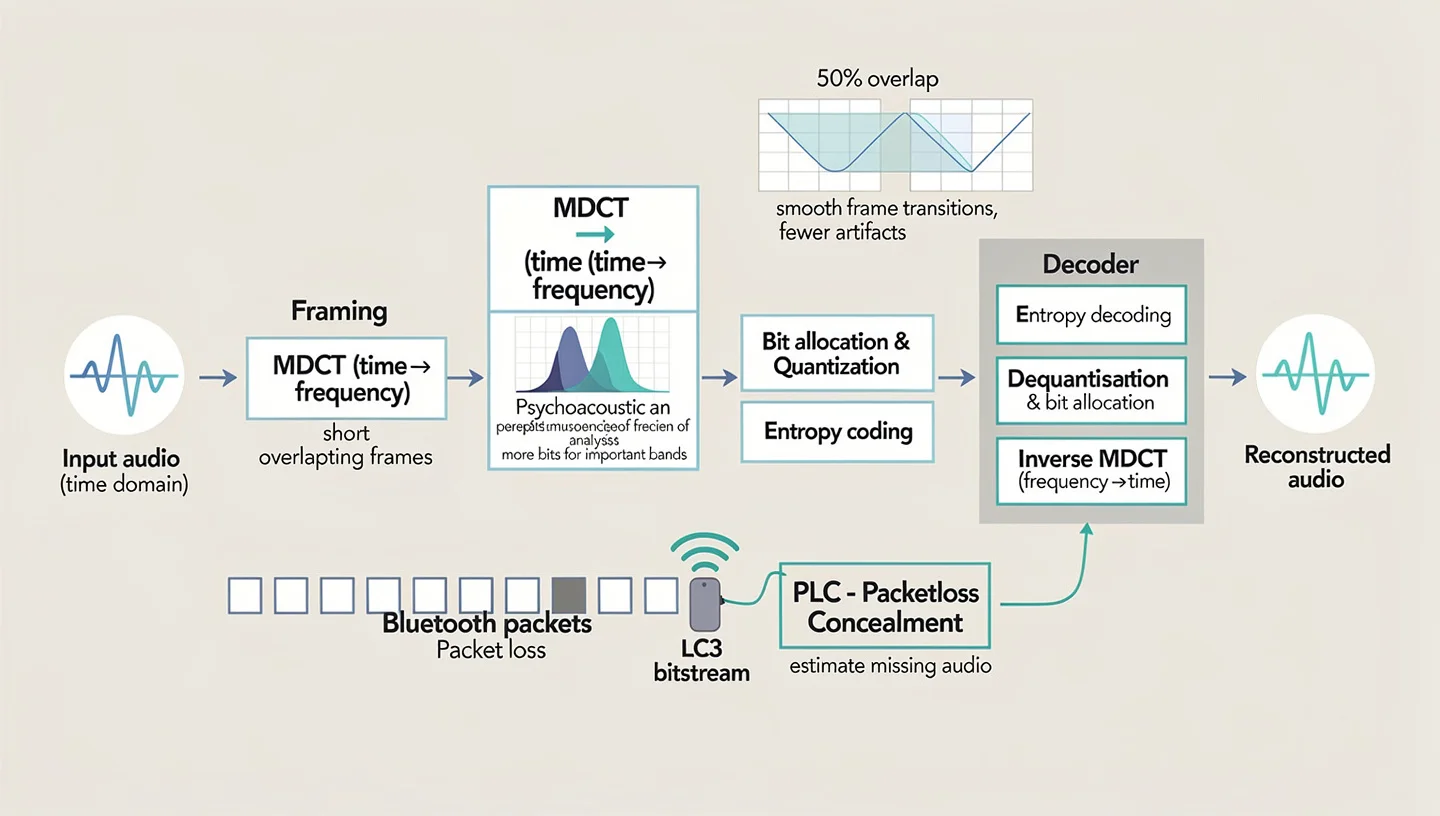
The codec is block-based and transform-based. It processes audio in short frames, encodes each frame using a frequency-domain representation, and transmits the compressed data. The decoder on the receiving device reverses the process and reconstructs the audio signal.
Modified Discrete Cosine Transform (MDCT)
At the heart of the codec is the Modified Discrete Cosine Transform (MDCT). MDCT converts a block of audio samples from the time domain into the frequency domain. Once in the frequency domain, the encoder can identify which frequency components carry the most perceptual weight and allocate more bits to those components, discarding or heavily quantizing the parts the human ear is less sensitive to. This approach is what makes the codec efficient at low bitrates without the audio sounding thin or distorted.
The MDCT operates with a 50 percent overlap between consecutive frames, which reduces blocking artifacts at frame boundaries. The result is smoother audio at the transitions between frames than older codecs like SBC, which use sub-band coding without overlap.
Packet Loss Concealment (PLC)
Packet Loss Concealment (PLC) is one of the most practically important features the codec brings. When a Bluetooth packet is lost in transmission, the decoder does not simply drop that block of audio. Instead, it estimates what the missing audio should have sounded like based on the surrounding frames and fills the gap with a reconstructed signal. The result is a smooth degradation rather than an audible crackle or dropout.
SBC has basic error detection but no real concealment. When SBC packets are lost in a congested radio environment, such as a crowded airport or a subway car, the result is audible crackling or momentary silence. PLC handles those same conditions without the same audible impact. SoundGuys noted that audio quality holds around a perception score of 4.5 even at its lowest quality setting, well above what SBC manages at much higher bitrates under the ITU-R BS.1116-3 standard.
Frame Duration: 7.5 ms and 10 ms
The codec supports two frame durations: 7.5 milliseconds and 10 milliseconds. Frame duration determines how much audio is packed into each compressed block. A shorter frame duration means lower latency, because the decoder does not have to wait as long to fill a frame before it can begin processing and outputting audio. The tradeoff is slightly higher processing overhead per unit time. A longer frame duration is more efficient computationally and handles the same audio in fewer frames, but it adds a few extra milliseconds of delay.
For most music streaming, the 10 ms frame is the standard choice. For low-latency applications like gaming or voice calls, the 7.5 ms frame reduces overall system latency. The codec latency alone with a 7.5 ms frame is approximately 11.5 ms, and with a 10 ms frame approximately 12.5 ms. Total end-to-end latency, including system delays, typically lands in the 20 to 30 ms range for LE Audio devices.
Variable Bitrate (VBR)
The codec supports variable bitrate (VBR) encoding. It adjusts its bitrate based on the complexity of the audio signal at any given moment. Quiet passages and simple tones require fewer bits to encode accurately. Complex passages with dense harmonic content require more. VBR lets the codec allocate bits where they are needed most, which produces better average quality than a fixed bitrate at the same average data rate. It also gives implementations flexibility to trade off between audio quality and power consumption depending on the device’s battery situation or the strength of the radio connection.
LC3 Bitrate and Audio Quality
The codec scales from 16 kbps at the low end, which covers basic voice, to 345 kbps at the high end for full music quality. It hits what Fraunhofer describes as its efficiency sweet spot at around 128 to 160 kbps, where it produces audio quality that equals or exceeds SBC at 345 kbps. At 192 kbps, Fraunhofer’s own testing indicates audio quality equivalent to an uncompressed signal at 1.5 Mbps.
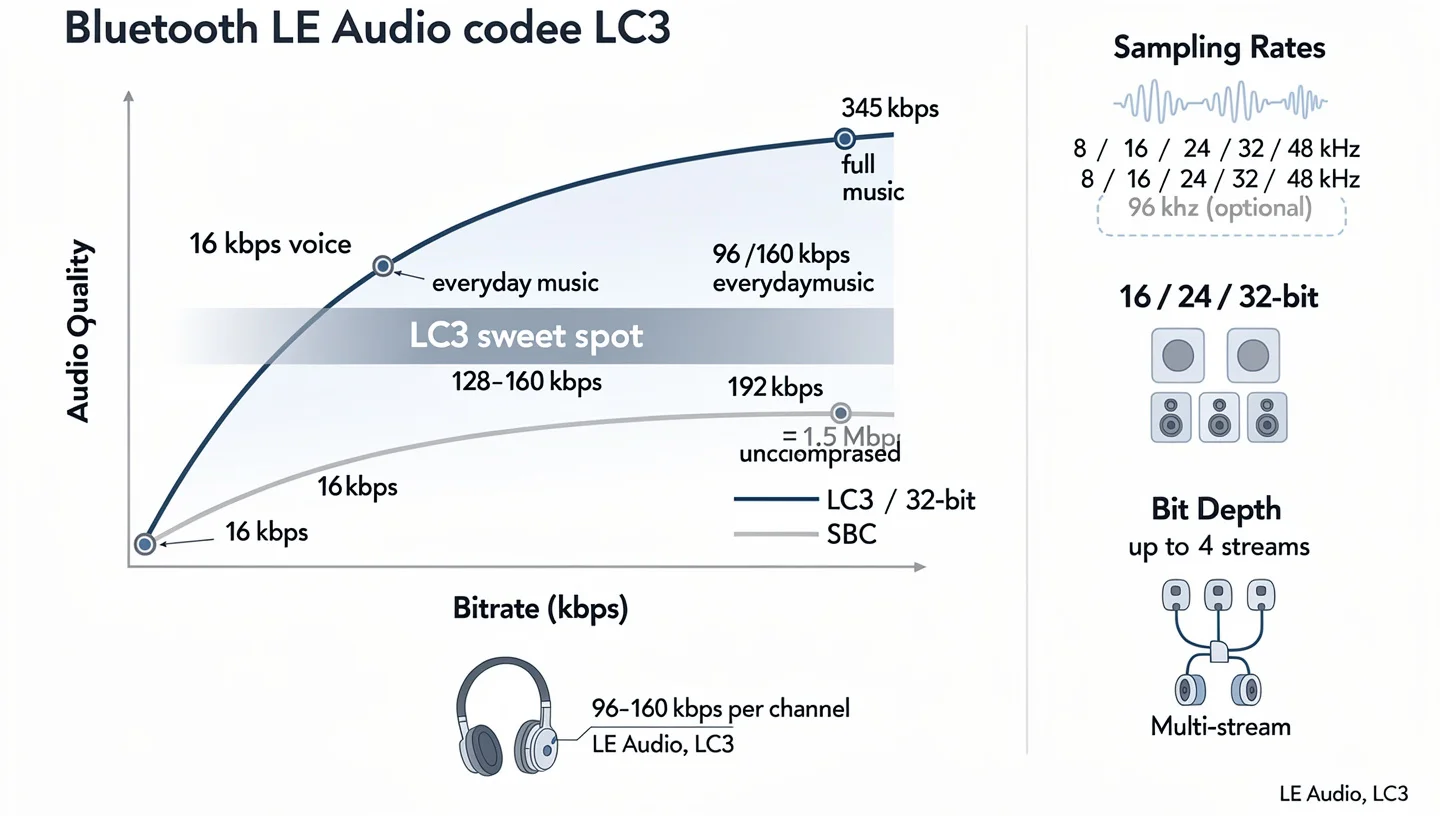
Sampling rate support covers 8 kHz (narrowband voice), 16 kHz (wideband voice), 24 kHz, 32 kHz, and 48 kHz (full music quality). An optional extension to 96 kHz exists but is not part of the mandatory specification for LE Audio devices. Bit depth support covers 16-bit, 24-bit, and 32-bit per sample.
In practice, most LE Audio earbuds run the codec at 96 kbps to 160 kbps per channel for stereo music. That is enough for most listeners to find the quality indistinguishable from the original in everyday listening conditions. Devices can also support up to four simultaneous audio streams per peripheral, which is what enables multi-stream true wireless stereo and multi-channel audio configurations in LE Audio.
ITU-R BS.1116-3 Test Results
Bluetooth SIG tested the codec against SBC and mSBC using the ITU-R BS.1116-3 listening test methodology, which is the standard used to evaluate audio codec quality. The test scores run from 1 (bad) to 5 (imperceptible from the source). A score of 4.0 indicates a perceptible but acceptable quality difference. A score of 3.0 is considered slightly annoying.
In those tests, the codec at 160 kbps scores higher than SBC at 345 kbps. Even at its lowest quality setting, the perception score remains around 4.5, which is better than SBC achieves at its highest bitrate. Those results are from Bluetooth SIG’s own white paper on LC3 characterization, published in July 2023.
There is one disputed comparison. SIG’s tests showed the codec outperforming Opus for speech quality. That conclusion has been questioned because the test used Opus version 1.1.4 at complexity level 0, an older and less optimized configuration, and only included speech audio. The comparison against Opus for music audio and at more typical encoder settings remains contested.
LC3 vs SBC
SBC (Sub-Band Codec) has been the mandatory Bluetooth audio codec since Bluetooth 1.0. It covers bitrates from 240 kbps to 345 kbps for stereo music. At its maximum bitrate, SBC produces acceptable audio quality, but as bitrate drops, quality degrades visibly and quickly. SBC also has no real packet loss concealment, so congested radio environments produce audible crackling or dropouts.

The newer codec outperforms SBC on every measurable axis. It produces equal or better audio quality at half the bitrate. Its packet loss concealment handles poor signal conditions without the audible artifacts SBC produces. Its frame-based MDCT architecture is more efficient than SBC’s sub-band coding approach. And because it operates on the Bluetooth Low Energy radio rather than the Classic BR/EDR radio, it consumes less power from both the source device and the earbuds.
Fraunhofer’s own numbers show that the required bitrate drops by roughly 50 percent compared to SBC while maintaining the same perceived quality. That 50 percent reduction in data over the air translates directly into longer battery life for earbuds and a lower radio duty cycle, which also reduces interference in congested environments. For a detailed look at SBC’s architecture and its role in Bluetooth Classic, see our guide on what is SBC codec.
LC3 vs AAC
AAC (Advanced Audio Coding) is Apple’s preferred Bluetooth codec. It offers significantly better audio quality than SBC at the same bitrates, and on Apple devices it is hardware-optimized to perform at around 256 kbps with consistent quality. The codec was designed originally for general audio encoding and file formats, not specifically for real-time wireless transmission.

The LE Audio codec is more efficient than AAC at low bitrates and produces lower, more consistent latency. AAC latency over Bluetooth varies more depending on the device and operating system. On Android, AAC implementation is inconsistent across manufacturers, and some devices perform poorly with it. The mandatory nature of the new codec eliminates that inconsistency because it is part of the Bluetooth specification itself, not a vendor-negotiated optional codec.
The biggest practical difference is Apple support: iPhones do not support LC3. iOS uses AAC as its highest-quality Bluetooth codec and falls back to SBC if the connected device does not support AAC. As of early 2026, Apple has not announced plans to add LE Audio support. For users inside the Apple ecosystem, AAC remains the best available Bluetooth audio codec. For Android and Windows users, the new standard is now the better choice where supported. Our full breakdown is in the AAC codec guide.
LC3 vs aptX and aptX Adaptive
aptX is Qualcomm’s family of proprietary Bluetooth codecs. Standard aptX runs at 352 kbps and targets CD-quality audio (16-bit/44.1 kHz). aptX HD raises that to 576 kbps with 24-bit support. aptX Adaptive is variable bitrate, running from 279 kbps to 420 kbps depending on connection conditions, and adds low-latency modes targeting around 50 to 80 ms. aptX Lossless goes up to 1.1 to 1.2 Mbps and promises bit-perfect CD-quality reproduction.

All aptX variants require a licensing agreement with Qualcomm and specific hardware support on both the source device and the receiver. If one side of the connection does not support aptX, the connection falls back to SBC. The LE Audio codec carries no licensing fee and is mandatory on all LE Audio hardware, so it is always available when both devices support LE Audio.
In audio quality terms, aptX Adaptive at its highest setting delivers comparable quality to the new codec at typical listening bitrates. aptX Lossless has an advantage for listeners who want bit-perfect audio. The LE Audio standard has an advantage over all aptX variants in power efficiency and packet loss behavior. For a full codec comparison across all major Bluetooth codecs, see our guide on LDAC, LC3, aptX, and SBC.
LC3 vs LDAC
LDAC is Sony’s high-resolution Bluetooth codec. It operates at three adaptive bitrate modes: 330 kbps, 660 kbps, and 990 kbps. At 990 kbps, LDAC carries enough data to qualify for Hi-Res Audio Wireless certification and to preserve high-frequency content from 24-bit/96 kHz source files. It has been part of Android since Android 8 (Oreo) and runs on most modern Android phones.

LDAC and the LE Audio codec approach quality differently. LDAC chases high bitrates to preserve maximum audio detail. The newer codec focuses on getting more quality out of fewer bits. At 990 kbps, LDAC sounds better than the LE Audio codec at 160 kbps in ideal conditions on capable hardware. But LDAC at 990 kbps also consumes significantly more power, requires a strong and stable radio connection, and is not supported on iPhones. When the connection weakens, phones often drop LDAC to 330 kbps, where the LE Audio standard at 160 kbps becomes competitive.
The LE Audio codec has lower latency than LDAC. LDAC’s heavier encoding and higher bitrates push latency above what the new standard achieves on the LE transport. For gaming and video, that difference matters. It also works over Auracast broadcast audio, which LDAC does not support at all. Full technical comparison: LE Audio vs LDAC.
LC3plus vs LC3
LC3plus is the extended version of the codec, also developed by Fraunhofer IIS. It shares the same core architecture but adds features that make it suitable for a broader range of applications. LC3plus is standardized by ETSI as TS 103 634 and is part of the 2019 DECT standard. It is not the same thing as the mandatory LE Audio codec and is not part of the Bluetooth LE Audio specification.
What LC3plus Adds
LC3plus extends the base codec with higher robustness against packet loss and transmission errors, even lower encoding delay, and support for high-resolution audio at high sampling rates. Where the standard version limits audio bandwidth to approximately 20 kHz, LC3plus High-Resolution (HR) mode supports up to 24-bit/96 kHz audio at 125 to 250 kbps per channel. Fraunhofer states that other codecs require at least two to three times that bitrate for comparable performance at the same resolution.
Frame Duration Differences
The base codec supports frame durations of 7.5 ms and 10 ms. LC3plus adds shorter frame durations of 2.5 ms and 5 ms, which reduce codec latency further. With a 2.5 ms frame, total codec delay comes down to approximately 5 ms. That is below the base codec’s minimum of 11.5 ms and significantly faster than any other open-standard audio codec currently available. The 10 ms frames of both versions are compatible with each other at the decoder level, but LC3plus HR mode is fully incompatible with both the standard codec and non-HR LC3plus.
LC3plus Hi-Res Audio Wireless Certification
On November 9, 2022, the Japan Audio Society (JAS) awarded LC3plus the Hi-Res Audio Wireless certification. It is the fourth codec to receive this certification, joining LDAC, LHDC, and MQair. The certification confirms that LC3plus meets the objective and subjective quality standards required for Hi-Res Audio playback over a wireless connection. The base LC3 codec itself does not carry this certification; only LC3plus High-Resolution mode qualifies.
LC3plus for Gaming
Fraunhofer positions LC3plus as the codec of choice for wireless gaming headsets that need both low latency and high audio quality. At its 2.5 ms frame duration, LC3plus reduces total system latency to levels that approach wired connections. For competitive gaming, where even a few milliseconds of audio delay can affect awareness of positional audio cues, that matters. LC3plus is the only open-standard audio codec currently certified for wireless high-resolution and high-quality gaming headsets, according to Fraunhofer IIS.
LC3plus and DECT
LC3plus was integrated into the 2019 DECT (Digital Enhanced Cordless Telecommunications) standard, which covers cordless phones and professional wireless communication systems. In DECT applications, it provides super-wideband call quality and maintains stable connections even when the handset is far from the base station, thanks to its forward error correction and redundant packet transmission for voice data.
Is LC3plus Royalty-Free?
LC3plus is an open standard, but it is not entirely royalty-free in the same way the base codec is. The ETSI implementation is source-available software, subject to ETSI Intellectual Property Rights Policy and standard patent restrictions. Manufacturers using LC3plus may still need to navigate patent licensing, depending on their implementation. Bang and Olufsen uses LC3plus in its Beolab 28 and Beosound Balance speakers and the Beosound series of headphones. Fraunhofer is also developing a specification to enable LC3plus as a vendor-specific codec in LE Audio, though that work was not finalized as of early 2026.
LC3 for Gaming and Latency
One of the most practical advantages of the codec is its latency. Bluetooth Classic audio with SBC typically runs 100 to 200 ms end-to-end. At 150 ms, the delay between a gunshot on screen and the sound reaching your ears is noticeable and disruptive in any game that relies on positional audio. Many gaming headsets bypassed Bluetooth entirely and used proprietary 2.4 GHz wireless protocols to get latency below 40 ms.
The LE Audio codec targets 20 to 30 ms end-to-end. That range is below the 40 to 50 ms threshold where the brain perceives audio and video as out of sync. At 20 to 30 ms, footsteps, gunshots, and environment audio all arrive with the timing needed for positional accuracy. For mobile gaming, where a 2.4 GHz dongle is not possible, LE Audio earbuds are now a practical alternative to proprietary gaming audio solutions.
Bi-directional audio for gaming, which includes simultaneous microphone input and audio output, is also handled within LE Audio profiles. The codec’s lower computational complexity compared to its quality output means it processes faster and imposes less CPU load on the earbuds’ chip, which helps keep latency consistent even during extended gaming sessions. For current options in gaming audio, our best gaming headphones guide covers Bluetooth, 2.4 GHz, and wired picks with latency data.
LC3 for Phone Calls
Before the new standard, Bluetooth voice calls used the Hands-Free Profile (HFP) with mSBC, which covered frequencies from 50 Hz to 7 kHz. That frequency ceiling, set by the HFP 1.6 wideband specification, is why Bluetooth calls have always sounded noticeably thinner and more distant than wired calls. The human voice extends to around 14 kHz for full natural clarity, and the 7 kHz ceiling cuts off a significant portion of the upper frequency range that gives voices their clarity and presence.
LC3-SWB over HFP 1.9 extends that ceiling to 14 kHz, covering 50 Hz to 14 kHz and falling just short of full-band reproduction at 20 kHz. All LE Audio devices mandate Super Wideband (SWB) quality and are compatible with HD Voice+. In practical terms, voice calls over LE Audio earbuds sound significantly more natural and closer to face-to-face conversation quality than any previous Bluetooth voice standard. The difference is particularly noticeable in conference calls and VoIP calls, where the frequency improvement makes speech more intelligible and less fatiguing over long durations.
Stereo microphone input is also supported in LE Audio, which allows earbuds with two microphones to capture spatial audio input for calls and content creation, something that Bluetooth Classic profiles did not support in a standardized way.
LC3 for Hearing Aids
The codec’s origin is in hearing aid research, and that history is visible in how well it fits hearing aid requirements. Low bitrate efficiency, low power consumption, low latency, and robust packet loss handling are exactly what a hearing aid needs. The device is tiny, the battery is small, and the audio must stay synchronized with lip movements and environmental sound at all times.
The Hearing Aid Profile (HAP) in LE Audio uses the codec as its audio standard. Before LE Audio, hearing aid manufacturers each used their own proprietary Bluetooth protocols, which tied users to specific phone brands and operating system versions. HAP standardizes the connection across all manufacturers and devices. A hearing aid user can connect to any LE Audio compatible smartphone or computer without worrying about brand compatibility.
Latency of 20 to 30 ms keeps audio and lip movements aligned at the threshold where users no longer notice the delay. PLC maintains audio continuity in environments where packet loss would otherwise cause disruptive gaps. And the low bitrate efficiency means a hearing aid’s small battery lasts longer per charge than it would powering a Classic Bluetooth connection with SBC.
Auracast extends these benefits into public spaces. Hearing aid users can tune directly into a cinema’s audio stream, an airport gate announcement, a sermon, or a museum tour guide through their own hearing aids, without any external receiver or assistive listening hardware. The ReSound Nexia, ReSound Vivia, Signia IX, and Jabra Enhance Select already support this. GN Group, the parent company of ReSound, delivered the world’s first Auracast-capable hearing aid.
LC3 and Auracast Broadcast Audio
The codec is the only audio standard that works over Auracast broadcast audio. Auracast uses Broadcast Isochronous Streams (BIS) to send audio from one transmitter to an unlimited number of receivers simultaneously, without pairing. The receiver picks up the Bluetooth LE advertising packet, selects the stream, synchronizes to the broadcast, and decodes the audio. The transmitter has no knowledge of how many devices are listening.
Auracast latency is under 40 ms, which keeps audio in sync with video and live performance. Range is roughly 30 meters indoors and up to 100 meters outdoors under good conditions. Multiple simultaneous streams are possible from the same transmitter, each carrying a separate audio channel. A cinema can broadcast the main film audio on one stream and an audio description track on another. An airport can broadcast gate announcements in multiple languages. A church can broadcast in two languages simultaneously.
ABI Research projected that by 2029, 1.5 million public venues will have Auracast transmitters installed. Early adopters include the Sydney Opera House, Oslo Central Theater, and Frankfurt Airport. Every Auracast transmitter and receiver uses the codec. There is no Auracast without LC3.
LC3 Supported Devices in 2026
The codec requires Bluetooth 5.2 or newer hardware plus firmware and OS-level support for LE Audio. Having Bluetooth 5.2 does not guarantee support. Budget chipsets sometimes carry the radio but omit the LE Audio stack entirely. Look for explicit LC3, LE Audio, or Auracast mention in the device specifications.
Phones and Computers
Samsung Galaxy S23, S24, and S25 series, Galaxy Z Fold 5, Fold 6, and Fold 7 all support LE Audio and Auracast. Google Pixel 8 and newer received Auracast support in a 2025 update. Xiaomi 14T, 14, and 15, OnePlus 11, 12, and 13, and Sony Xperia 5 V are on the confirmed list. Windows 11 version 22H2 and later supports the codec on compatible hardware after Microsoft licensed the Fraunhofer software implementation. Apple iPhones do not support LE Audio or the new standard as of early 2026.
Earbuds and Headphones
LC3 Supported earbuds and headphones include the Samsung Galaxy Buds 2 Pro and Buds 3 Pro, EarFun Air Pro 3 and Air Pro 4, OnePlus Buds Pro 2, Sony WF-1000XM5, Sony WH-1000XM6, and a broad range of earbuds based on Qualcomm QCC30xx-series chips, including models from SoundPEATS, TOZO, and Anker. Bang and Olufsen uses LC3plus (not the standard LE Audio codec) in its Beolab and Beosound product lines. Hearing aids with support include the ReSound Nexia, ReSound Vivia, Signia IX, and Jabra Enhance Select.
Pros and Cons of LC3
Pros: Royalty-free, mandatory on all LE Audio hardware with no compatibility gaps between manufacturers. Equal or better audio quality compared to SBC at half the bitrate. Packet Loss Concealment maintains audio quality in congested radio environments where SBC produces crackling. Latency of 20 to 30 ms, usable for gaming and video without noticeable desync. Handles both music (A2DP) and voice calls (HFP 1.9 Super Wideband) in a single codec. Works over Auracast broadcast audio for one-to-many streaming without pairing. Standardized Hearing Aid Profile (HAP) connects hearing aids to any LE Audio device from any manufacturer.
Cons: Requires Bluetooth 5.2 hardware minimum, older devices cannot be updated. No Apple support as of early 2026. Does not reach LDAC’s 990 kbps peak bitrate for audiophile-level high-resolution listening. Not all Bluetooth 5.2 devices support LE Audio since budget chipsets often omit the feature. LC3plus, which adds Hi-Res Audio Wireless capability and lower latency gaming modes, is not part of the mandatory LE Audio specification and requires separate hardware support.
FAQ: LC3 Codec
What is LC3 codec?
LC3, or Low Complexity Communication Codec, is the mandatory audio codec for Bluetooth LE Audio. It was developed by Fraunhofer IIS and Ericsson, standardized by Bluetooth SIG in 2020, and introduced with Bluetooth 5.2. It replaces SBC for music and mSBC for voice calls, delivering better quality at lower bitrates with royalty-free licensing.
Is LC3 better than SBC?
Yes. The codec produces equal or better audio quality compared to SBC at roughly half the bitrate. It also includes Packet Loss Concealment, which handles poor signal conditions without the crackling or dropout SBC produces. Bluetooth SIG’s ITU-R BS.1116-3 tests show it at 160 kbps scoring higher than SBC at 345 kbps.
Does LC3 support Hi-Res Audio?
The standard LE Audio codec itself does not carry the Hi-Res Audio Wireless certification. It supports up to 48 kHz sampling rate and 32-bit depth, but the mandatory Bluetooth LE Audio profiles run at 48 kHz with bitrates below the Hi-Res threshold. LC3plus High-Resolution mode, a separate and more capable codec, supports up to 24-bit/96 kHz and carries the Hi-Res Audio Wireless certification from the Japan Audio Society.
What is the difference between LC3 and LC3plus?
LC3 is the mandatory codec for Bluetooth LE Audio. LC3plus is an extended version developed by Fraunhofer IIS that adds shorter frame durations (2.5 ms and 5 ms), higher robustness against packet loss, and a High-Resolution mode supporting 24-bit/96 kHz audio. LC3plus is standardized by ETSI for DECT and A2DP but is not part of the mandatory LE Audio specification. Bang and Olufsen uses LC3plus in its high-end wireless speakers and headphones.
Does Apple support LC3?
No. As of early 2026, Apple iPhones and iPads do not support LE Audio or the new codec. iOS uses AAC as its highest Bluetooth audio codec. Apple has not announced plans to add support.
What bitrate does LC3 run at?
It scales from 16 kbps up to 345 kbps. Most LE Audio earbuds run at 96 kbps to 160 kbps per channel for stereo music, which is Fraunhofer’s described efficiency range where quality equals or exceeds SBC at 345 kbps. Higher bitrates up to 345 kbps are available for situations where bandwidth and power are not constraints.
Can LC3 be used for gaming?
Yes. The codec targets 20 to 30 ms end-to-end latency, which is below the 40 to 50 ms threshold where most people notice audio-video desync. For mobile gaming, LE Audio earbuds now offer latency that Bluetooth Classic with SBC could never approach. For the lowest possible latency in wireless gaming, LC3plus with its 2.5 ms frame duration goes further, though that requires specific hardware support.
Which phones support LC3 in 2026?
Samsung Galaxy S23 and newer, Google Pixel 8 and newer, Xiaomi 14T, 14 and 15, OnePlus 11, 12 and 13, and Sony Xperia 5 V. Windows 11 version 22H2 and later also supports it on compatible hardware. Apple iPhones do not.
Is LC3 royalty-free?
Yes. Manufacturers do not pay a per-device or per-unit licensing fee to implement it, unlike aptX and its variants, which require a Qualcomm license. LC3plus carries ETSI Intellectual Property Rights Policy restrictions, so the royalty situation is less straightforward for that extended version.
What is LC3-SWB?
LC3-SWB (Super Wideband) is the mono configuration used for voice calls over HFP 1.9. It covers frequencies from 50 Hz to 14 kHz, compared to the 50 Hz to 7 kHz ceiling of mSBC under HFP 1.6. All LE Audio devices mandate SWB quality for voice calls, which makes Bluetooth headset call quality noticeably more natural compared to older Bluetooth Classic devices.
Final Verdict: Is LC3 the Codec to Look For?
For anyone buying earbuds, headphones, or hearing aids in 2026, LC3 support should be on the checklist. The improvement over SBC is real and consistent: better audio quality at lower bitrates, cleaner behavior under poor signal conditions, lower latency for gaming and video, and better voice call quality through HFP 1.9. Because it is mandatory for all LE Audio hardware and carries no licensing fee, it is available across all price ranges without the brand or ecosystem restrictions that come with aptX or LDAC.
For audiophiles who want maximum resolution over Bluetooth, LDAC still has the bitrate advantage at 990 kbps in good conditions. The new codec does not replace LDAC for that specific use case. But for everyday listening, gaming, calls, and future compatibility with Auracast broadcast audio in public venues, it is the more practical and broadly compatible choice.
The only significant gap is Apple. Until iPhones support LE Audio, iPhone users are limited to AAC. If Apple adds support, the transition from Bluetooth Classic to LE Audio will accelerate sharply across the entire consumer market. Until then, the codec is the standard for Android, Windows, and hearing aid users, and it is the foundation that every Auracast installation in airports, cinemas, churches, and stadiums runs on.
For our full comparison of how the codec sits within the broader Bluetooth version history, see our guide on Bluetooth 5.4. For how Snapdragon Sound builds on top of LE Audio with Qualcomm’s chipset ecosystem, see our guide on Snapdragon Sound.