Bluetooth audio eliminated troublesome cables from earphones and headphones while adding convenient features like noise canceling (ANC) and voice calls. Wired connections still deliver superior sound quality and stability, especially where dropouts become noticeable. Yet technological innovation continues yearly, slowly narrowing the gap between wired and wireless audio.
One topic gaining attention in 2026 is Qualcomm’s Snapdragon Sound Technology Suite alongside Qualcomm Expanded Personal Area Network Technology (XPAN).
Qualcomm XPAN moves beyond conventional Bluetooth audio by combining it with Wi-Fi. This technology has appeared several times on this site, with compatible products reaching the market this year. Available products remain limited, making everyday testing opportunities relatively rare.
At BestTechRadar, we track these wireless audio developments closely, particularly as XPAN emerges in consumer products.
Event Overview
The event gathered diverse participants.
Nigel Burgess, Director of Product Management, and Carrie Zhang, Product Manager at Qualcomm Technologies International, Ltd., presented the company’s latest technologies. A listening comparison used high-end audio equipment to demonstrate differences between Qualcomm XPAN and conventional Bluetooth. Technical explanations came with support from Tsutomu Oshima of Qualcomm Japan.
What Are Snapdragon Sound and Qualcomm XPAN?
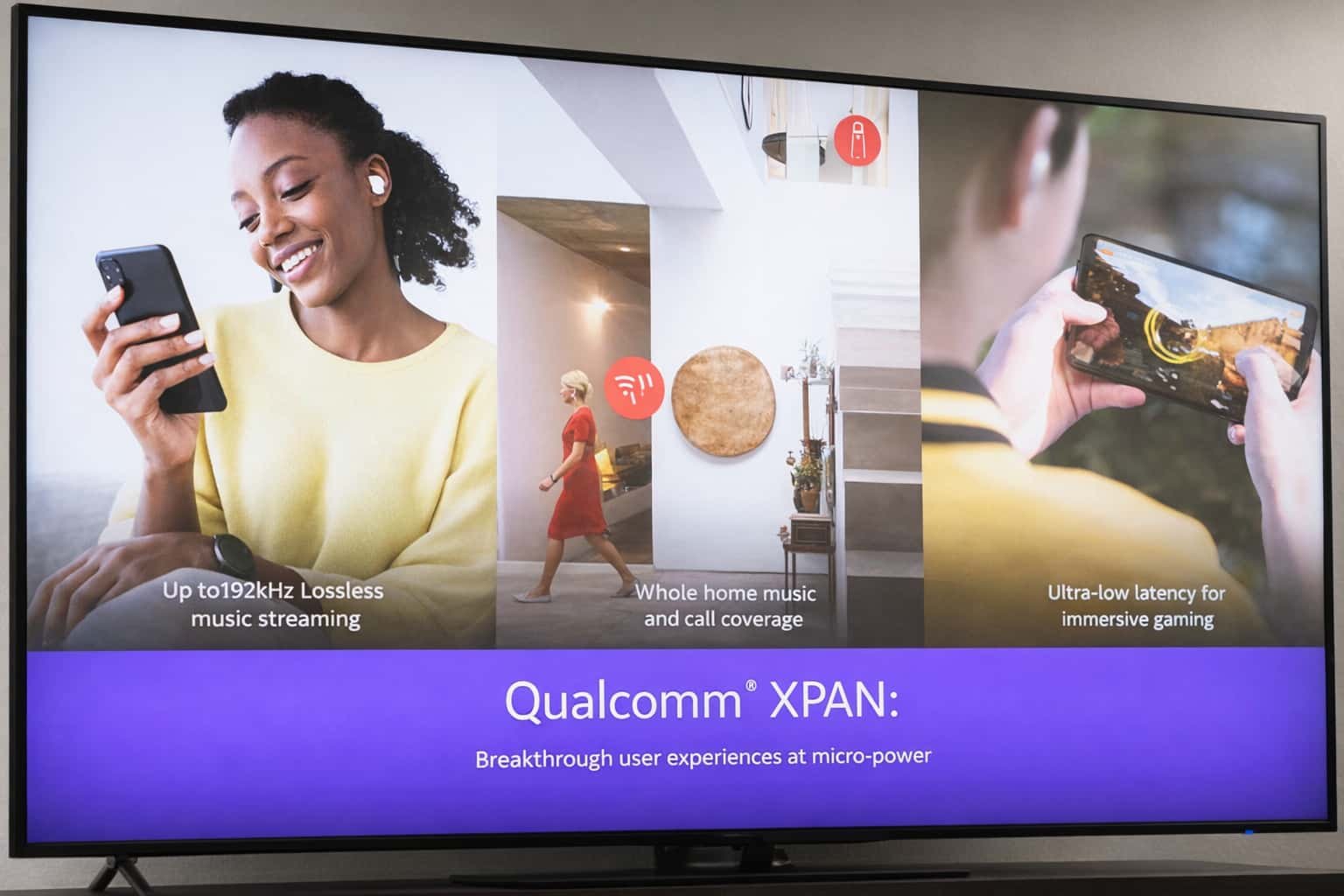
Qualcomm XPAN stands for Expanded Personal Area Network Technology. Simply put, it’s an audio transmission technology combining Bluetooth and Wi-Fi, using Qualcomm’s low-power Wi-Fi implementation to carry audio signals.
Qualcomm representatives explained the main advantage of combining Bluetooth and Wi-Fi lies in leveraging Wi-Fi’s much wider bandwidth. Compared to Bluetooth, Wi-Fi offers significantly broader frequency range. The low-power Wi-Fi technology in Qualcomm XPAN operates across 2.4GHz, 5GHz, and 6GHz bands.
This bandwidth supports lossless transmission of high-resolution audio up to 96kHz/24-bit. Dropout resistance clearly surpasses conventional Bluetooth audio. Current implementations limit to 96kHz/24-bit, but 192kHz/24-bit lossless transmission is technically possible, with surround audio transmission research ongoing. The Wi-Fi used by Qualcomm XPAN operates with low power consumption, so battery life shouldn’t shorten drastically.
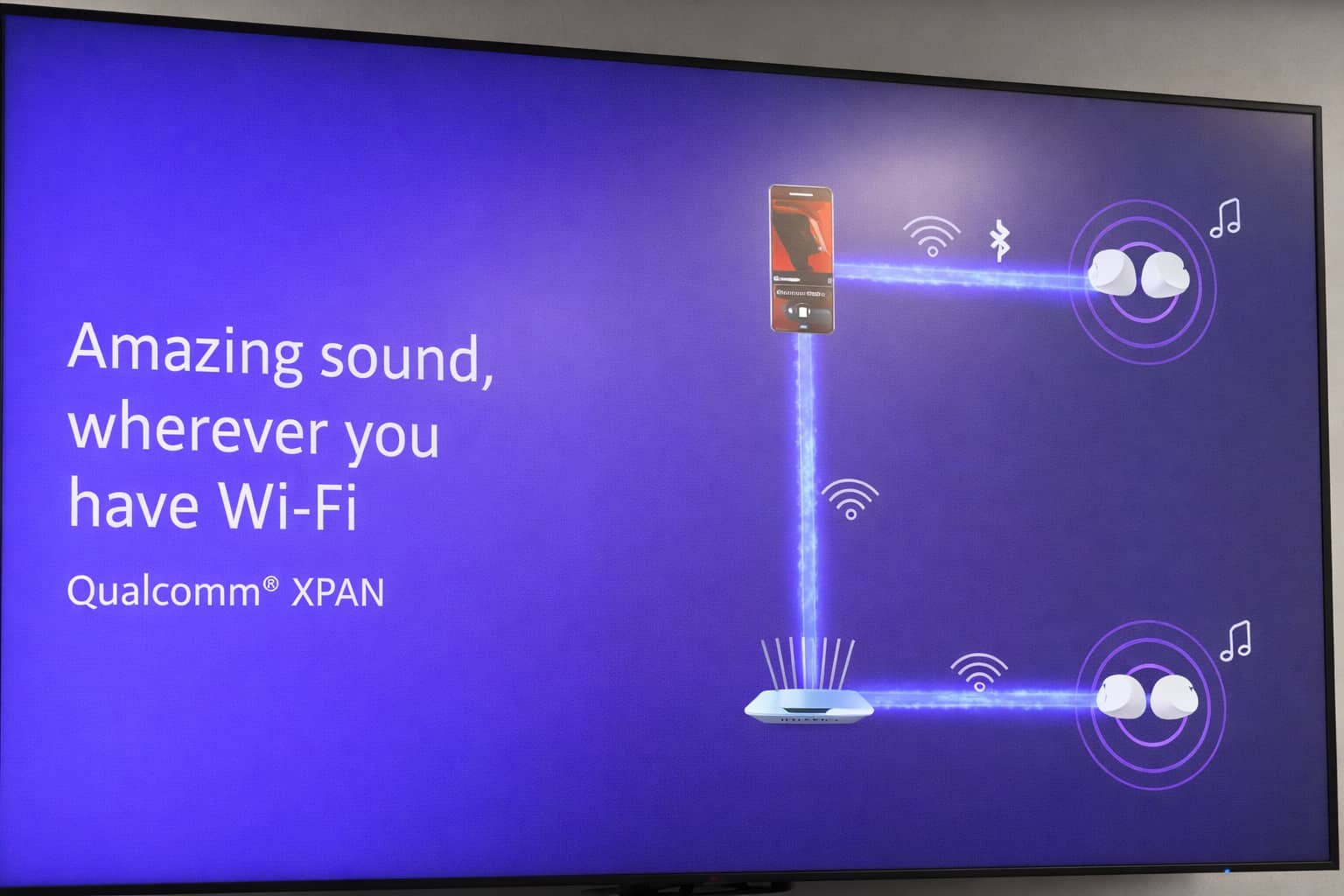
Qualcomm XPAN supports different connection methods. Beyond direct peer-to-peer connections between player and earphones, it can operate through standard home Wi-Fi routers.
If this approach becomes common, users could listen without interruptions when moving farther from playback devices or when communication conditions change. Connections could switch from peer-to-peer links to home network connections during playback.
Snapdragon Sound as XPAN’s Foundation
Qualcomm XPAN’s foundation is Snapdragon Sound.

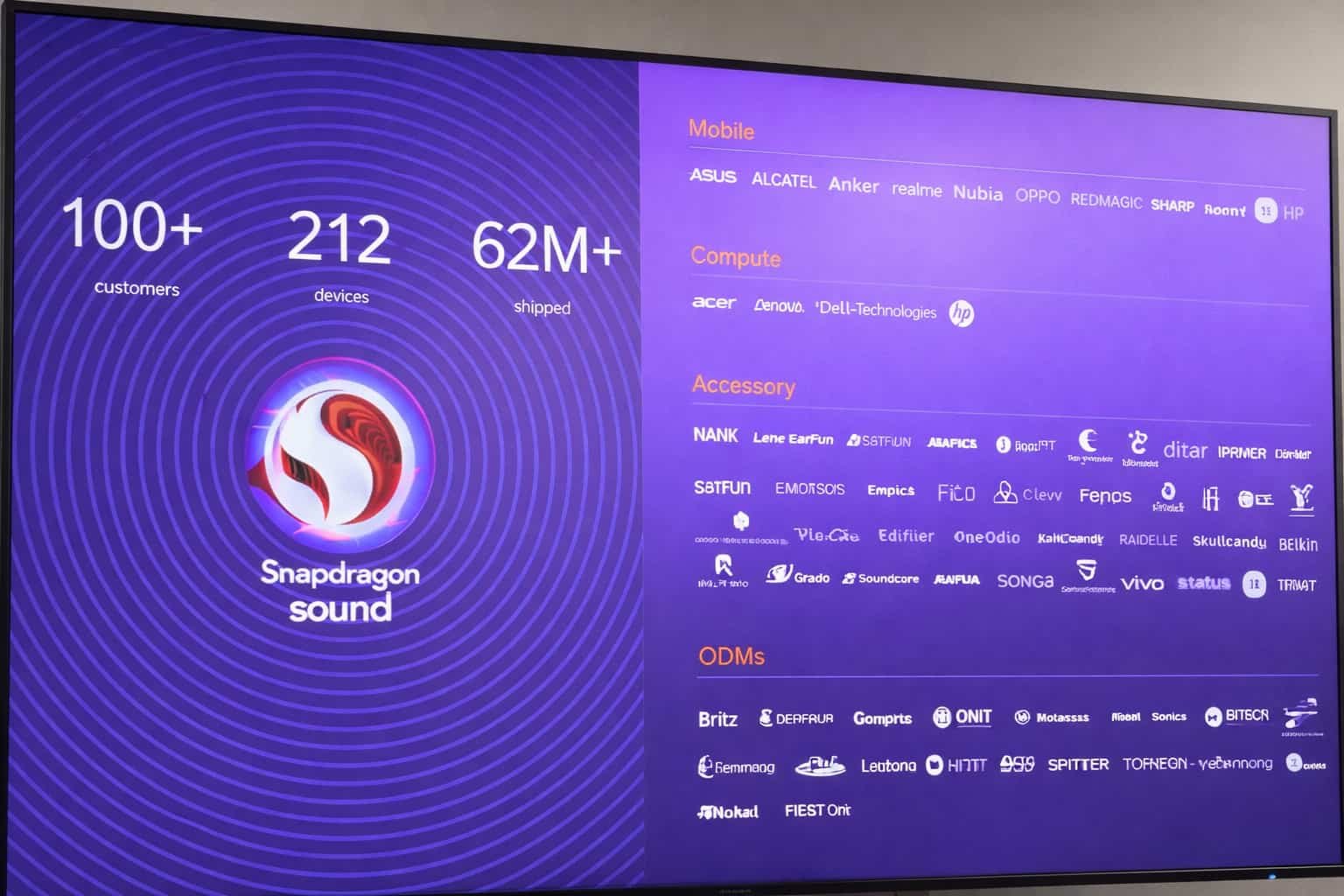
Snapdragon Sound is a wireless audio platform integrating Qualcomm technologies like high-performance processors, on-device AI, premium audio processing, and low-power wireless communication. It aims to balance sound quality, robustness, and low latency. Within this framework, Qualcomm XPAN positions as one supported technology.
A key topic within Snapdragon Sound is the Qualcomm aptX Lossless codec. This codec extends Qualcomm aptX Adaptive, which automatically adjusts between sound quality and stability depending on radio conditions. aptX Lossless enables near-lossless transmission of CD-quality audio at 44.1kHz/16-bit.
Earphones and Bluetooth amplifiers compatible with aptX Lossless continue increasing, with USB Bluetooth transmitters released by several manufacturers. This makes it one of the most accessible Qualcomm audio technologies available today.
Listening Comparison and Measurements
After the Qualcomm XPAN overview, the event moved to its main segment: the listening comparison.
The listening system used a Qualcomm XPAN evaluation board, shown publicly in Japan for the first time. This board receives audio from a smartphone via Qualcomm XPAN or conventional Bluetooth using aptX Lossless or SBC, outputting the signal digitally. Designed for true wireless earphones, separate boards handled left and right channels, combined for stereo playback.
Digital output connected to an Accuphase E-800S integrated amplifier with optional DAC board, playing through Bowers & Wilkins 803 D3 speakers. The system represented a high-end audio setup valued at several million yen.
Audio critic Kenzo Konoe guided the listening session, with additional technical explanations from Yoshitaka Murayama of Cear Co., Ltd. Cear worked closely with Qualcomm over ten years, certified as an Extension Partner. The company performs acoustic measurements based on Snapdragon Sound standards and provides technical consulting.
Measurement data showed multi-tone signals transmitted using Qualcomm XPAN at 96kHz/24-bit, aptX Lossless at 44.1kHz/16-bit, and SBC. Measurements illustrated clear differences in frequency response and dynamic range.
SBC transmission produced waveforms significantly differing from original signals, with dynamic range limited around 25dB. aptX Lossless preserved waveforms more accurately, achieving dynamic range approximately 75dB. Qualcomm XPAN came closest to original signals, with dynamic range around 135dB, exceeding human hearing limits.
Listening impressions reflected these results. SBC transmission introduced noticeable background roughness, particularly in reverberation and spatial details. As transmission quality improved, artifacts diminished, making characteristics like vocal extension, spatial openness, and clarity more noticeable.
Two tracks served comparison. In a male singer-songwriter recording, low-frequency richness and resonance increased with improved transmission method. In a female vocal track, improvements appeared most in vocal extension, transparency, and spatial presentation.
Products on Display
The venue featured demonstration booths with commercially available products supporting Qualcomm XPAN and Snapdragon Sound.

Currently, only Xiaomi’s 15 Ultra smartphone and Xiaomi Buds 5 Pro Wi-Fi true wireless earphones support Qualcomm XPAN. This combination lets users experience XPAN directly and compare it with aptX Lossless and Bluetooth LE Audio through simple settings.
The Xiaomi Buds 5 Pro Wi-Fi feature a driver configuration combining dynamic driver, planar driver, and piezoelectric ceramic tweeter arranged coaxially and driven by dual amplifiers. They include ANC, Harman-tuned sound modes, head-tracking audio, and other features.
Snapdragon Sound demonstration devices included Sharp’s AQUOS R10 and AQUOS R9 smartphones, Audio-Technica’s ATH-TWX9 MKII true wireless earphones, several Bose QuietComfort Ultra models, and Cear’s Snapdragon Sound-compatible Bluetooth speaker Pave CP-4000.
Closing Remarks
Qualcomm representatives discussed listening experiences the company aims to deliver through technologies like XPAN.
They explained Qualcomm XPAN should let users enjoy high-quality sound more freely in everyday situations without fixed listening positions. Future efforts will integrate AI more closely with music streaming services to ease content discovery.
Qualcomm will continue contributing not only through product development but also broader industry initiatives, including support for Bluetooth High Data Throughput.