LE Audio is the next generation of Bluetooth audio technology. It runs on the Bluetooth Low Energy radio instead of the older Bluetooth Classic (BR/EDR) radio, which has been the backbone of wireless audio since Bluetooth 1.0. That single change opens the door to lower power consumption, a brand new codec, true stereo streaming for wireless earbuds, and a broadcast system that can send audio to an unlimited number of listeners at once without pairing.
The Bluetooth Special Interest Group (SIG) announced Bluetooth LE Audio at CES 2020 alongside the release of Bluetooth 5.2. The full specification was completed on July 12, 2022, making it the largest specification development project in the history of Bluetooth SIG. As of 2026, a growing number of wireless earbuds, smartphones, hearing aids, and public venues already support it.
This guide covers how LE Audio works, what the LC3 codec brings to the table, how Auracast broadcast audio changes public listening, which devices support it today, and whether upgrading is worth it.
History of LE Audio
Bluetooth audio has always run on the Classic Bluetooth radio, also called BR/EDR (Basic Rate/Enhanced Data Rate). This radio has been part of Bluetooth since version 1.0, and it was never designed with power efficiency in mind. It works well for continuous streaming but burns through battery, and its architecture puts hard limits on what is possible with true wireless stereo earbuds.
Bluetooth Low Energy was introduced in Bluetooth 4.0 in June 2010. For years it was strictly a data radio used in fitness trackers, sensors, and IoT devices. It was never meant for audio. The problem was that audio requires isochronous data transfer, meaning packets must arrive at fixed, predictable time intervals. Bluetooth LE had no mechanism for that until 2020.
On December 31, 2019, Bluetooth SIG published Bluetooth Core Specification version 5.2. The key addition was Isochronous Channels (ISOC), a new feature that gives Bluetooth LE the ability to carry time-bound, synchronized data. That was the technical foundation LE Audio needed. Bluetooth SIG made the formal announcement at CES on January 7, 2020, presenting LE Audio as the next generation of wireless audio built entirely on Bluetooth Low Energy.
It took two more years to finalize all the profiles and specifications. On July 12, 2022, Bluetooth SIG announced the full completion of the LE Audio specification set. That release included the Generic Audio Framework, the LC3 codec, the Hearing Aid Profile, and the specifications that power Auracast broadcast audio. Device support started growing in late 2022 and has accelerated sharply since 2023.
For a broader look at how Bluetooth versions have evolved, see our guide on Bluetooth 5.4.
How LE Audio Works
The core difference between LE Audio and Classic Audio is the radio. Classic Audio uses the BR/EDR Bluetooth radio. LE Audio uses the Bluetooth Low Energy radio. These two radios are not compatible with each other, which is why smartphones carry both radios to maintain backward compatibility with older Bluetooth devices.
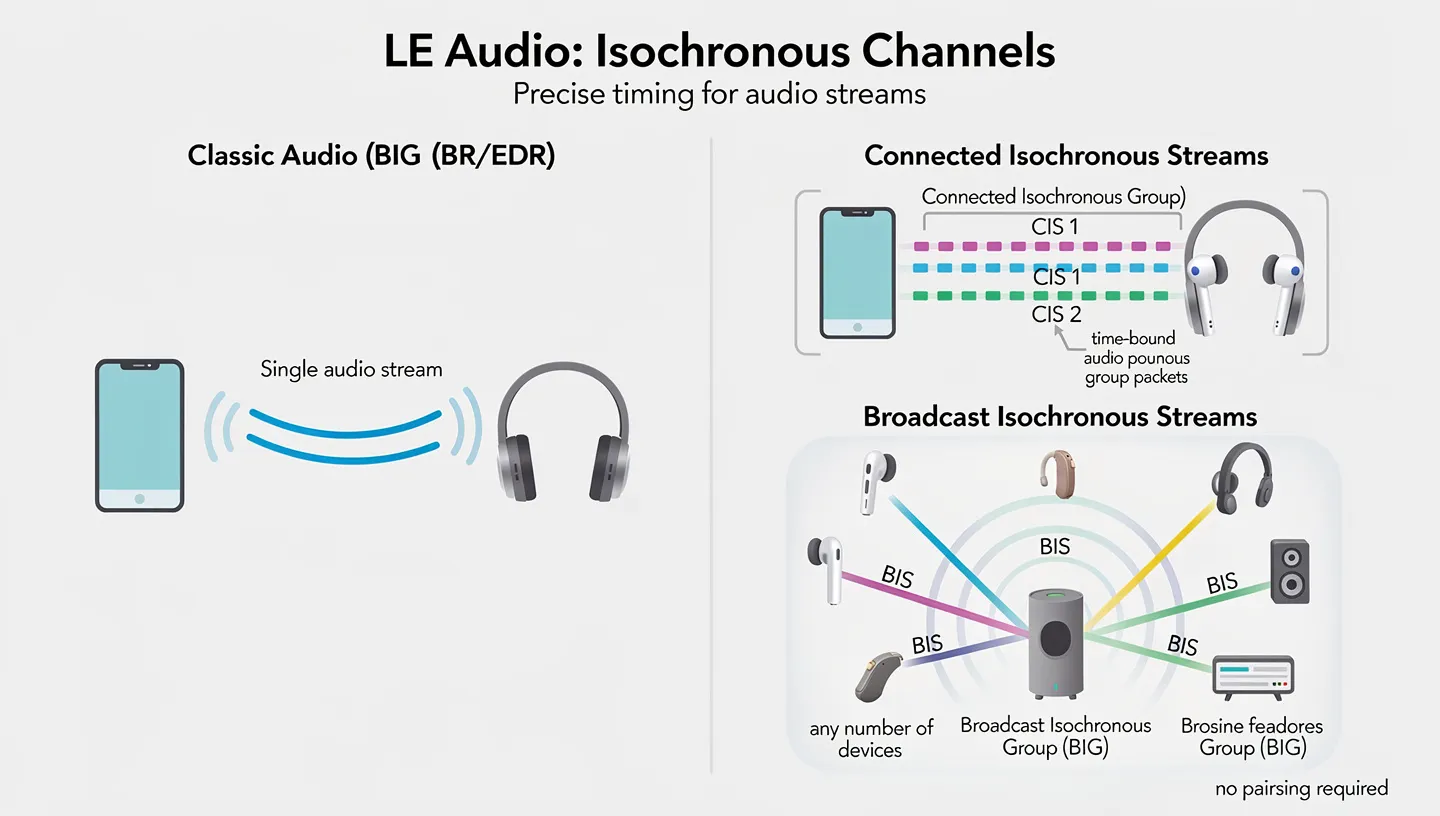
The key enabling feature is Isochronous Channels. The word isochronous comes from Greek, meaning “occurring at the same time.” In Bluetooth, it refers to data that is time-bound and must be processed at precise intervals. Audio is exactly that kind of data: a stream of packets that must arrive at fixed times or there is a gap in playback. Without isochronous channels, Bluetooth LE had no way to guarantee that timing.
LE Audio uses two types of isochronous streams. Connected Isochronous Streams (CIS) are point-to-point connections between two paired devices, like a smartphone and a pair of earbuds. Each CIS carries one audio stream, and multiple CIS streams can be grouped into a Connected Isochronous Group (CIG) to keep the left and right earbud channels synchronized. This is what powers multi-stream audio. Broadcast Isochronous Streams (BIS) work without any pairing. One device broadcasts audio to any number of receivers within range. Multiple BIS streams are grouped into a Broadcast Isochronous Group (BIG). This is the mechanism behind Auracast broadcast audio.
All audio compressed and decompressed over these channels uses the LC3 codec, which was designed specifically for LE Audio. Classic Audio relied on SBC as its mandatory codec, with optional codecs like AAC and aptX sitting on top. LE Audio replaces that entire stack with LC3 as the new standard.
LC3 Codec: The New Bluetooth Audio Standard
The LC3 codec, short for Low Complexity Communication Codec, is the mandatory audio codec for LE Audio. Bluetooth SIG developed it specifically for transmission over Bluetooth Low Energy, and it works differently from every codec that came before it in the Bluetooth ecosystem.
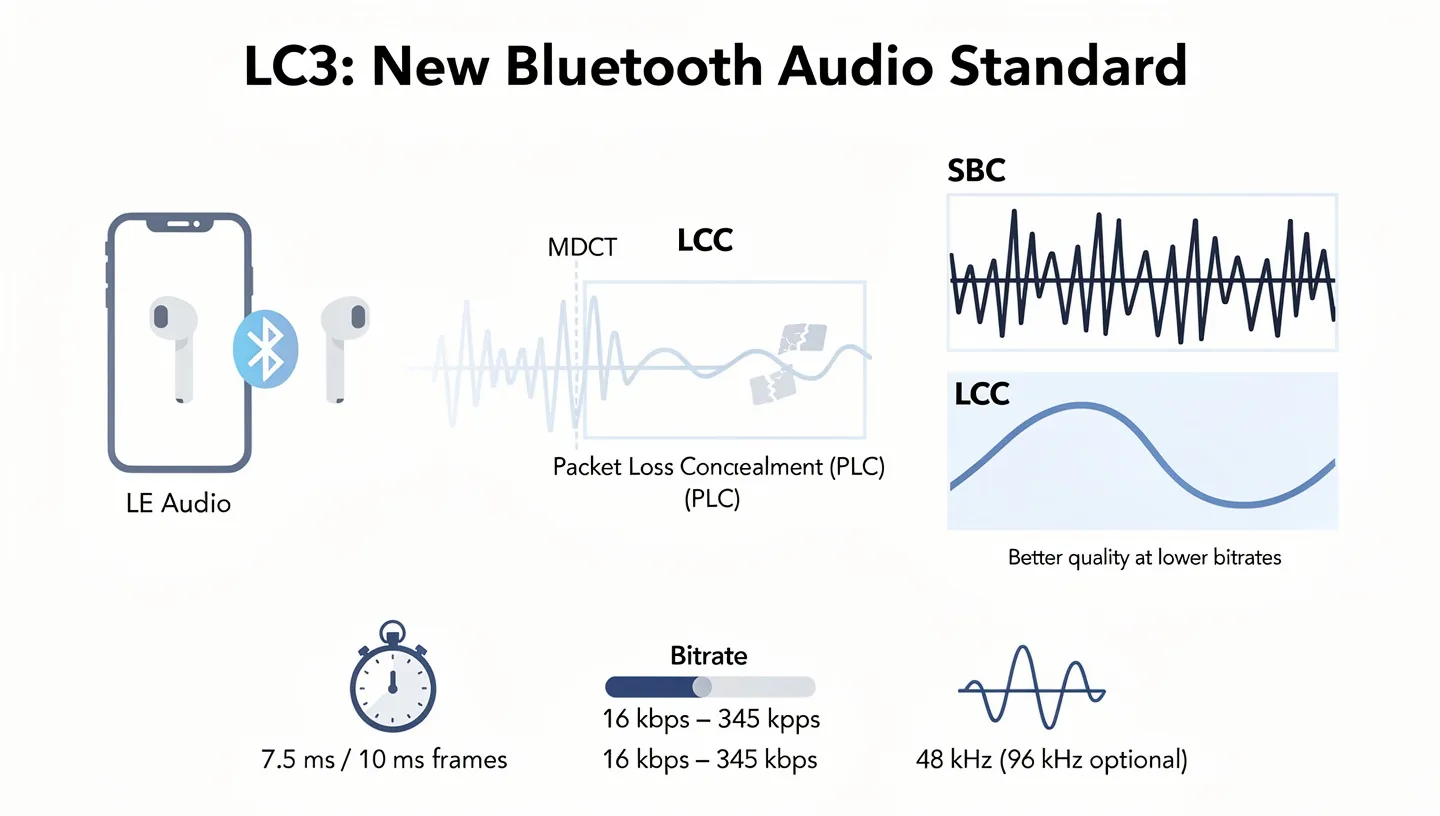
LC3 uses a technique called Modified Discrete Cosine Transform (MDCT) to analyze and compress audio. It also includes Packet Loss Concealment (PLC), which smooths out audio when packets are lost instead of producing the crackle or dropout you hear with SBC under bad signal conditions. Frame duration is either 7.5 ms or 10 ms, giving implementations flexibility based on their latency requirements.
LC3 scales from as low as 16 kbps up to 345 kbps with a sampling rate of 48 kHz (96 kHz is supported as an optional extension). The codec maintains good audio quality at much lower bitrates than SBC can manage, which is the key to its efficiency gains.
LC3 vs SBC
SBC (Sub-Band Codec) is the mandatory codec for Bluetooth Classic. It ranges from 240 kbps to 345 kbps. As bitrate drops, SBC audio quality degrades noticeably. LC3 produces equal or better sound quality at around 160 kbps, roughly half of what SBC needs.

That lower bitrate means less data over the air, which translates directly into lower power consumption and longer battery life. According to Bluetooth SIG’s own perception tests using the ITU-R BS.1116-3 standard, LC3 at 160 kbps scores higher than SBC at 345 kbps. For a detailed breakdown of SBC, our dedicated guide covers the codec’s strengths and limitations in full.
LC3 vs AAC
AAC is Apple’s preferred Bluetooth codec. It offers comparable listening quality to LC3 on paper, but AAC was designed for general audio encoding and not specifically for the constraints of Bluetooth LE.

LC3 has lower and more consistent latency, better packet loss behavior under congested radio conditions, and carries no licensing cost for device manufacturers. Note that Apple iPhones do not support LC3. iOS devices use AAC as their highest-quality Bluetooth codec. If an accessory does not support AAC, an iPhone falls back to SBC. Read our AAC codec guide for a full comparison of how AAC works and where it still has an edge.
LC3 vs aptX and LDAC
aptX and its variants (aptX HD, aptX Adaptive) are Qualcomm codecs that require licensing and specific hardware on both the source and the receiver. LDAC, developed by Sony, pushes up to 990 kbps and is the closest thing to Hi-Res Audio available over Bluetooth.

LC3 does not reach LDAC’s peak bitrate, so LDAC still has an advantage for listeners who prioritize maximum audio resolution on hardware that supports it. LC3 has one advantage none of these codecs can match: it is built into the Bluetooth specification itself. Every LE Audio device must support LC3 with no compatibility mismatches. For a full codec comparison, see our guide on Bluetooth codecs: LDAC, LC3, aptX, and SBC.
LC3 Bitrate and Audio Quality
In practice, most LE Audio earbuds run LC3 at 96 kbps to 160 kbps per channel for stereo listening. That gives a comfortable margin above the perceptual threshold where most listeners cannot tell the difference from the original. Higher bitrates up to 345 kbps are available for situations where bandwidth and power are not constraints. Latency with LC3 sits at 20 to 30 milliseconds. Bluetooth Classic audio typically runs 100 to 200 ms. The 20-30 ms range is below the threshold where the human brain perceives audio and video as out of sync, which is roughly 40 to 50 ms.
Multi-Stream Audio
Multi-stream audio is one of the most significant practical improvements LE Audio brings to true wireless earbuds. With Bluetooth Classic and the A2DP profile, a smartphone sent a single audio stream to one earbud, typically the right one. That primary earbud then forwarded a mono signal to the secondary earbud via its own wireless link. This relay method introduced extra latency, higher power consumption on the primary earbud, and more opportunities for dropout.
LE Audio replaces that relay method entirely. Using Connected Isochronous Streams (CIS), the smartphone sends separate, synchronized audio streams directly to each earbud. The left earbud receives the left channel directly. The right earbud receives the right channel directly. Both streams are time-synchronized to within approximately 10 to 15 microseconds, which produces a clean stereo image without either earbud needing to know the other exists.
Battery drain becomes more even between the two earbuds. Dropout on one side does not affect the other. Switching between audio sources is faster and cleaner. Multi-stream also enables a phone to connect two separate pairs of earbuds simultaneously, each receiving the same audio stream, so two people can listen to the same content without sharing a single earbud.
Auracast Broadcast Audio
Auracast broadcast audio lets a single audio source broadcast to an unlimited number of receivers simultaneously, with no pairing required. Anyone with a compatible device can tune in, the same way you scan for a Wi-Fi network. Auracast is the brand name Bluetooth SIG uses for this broadcast capability.
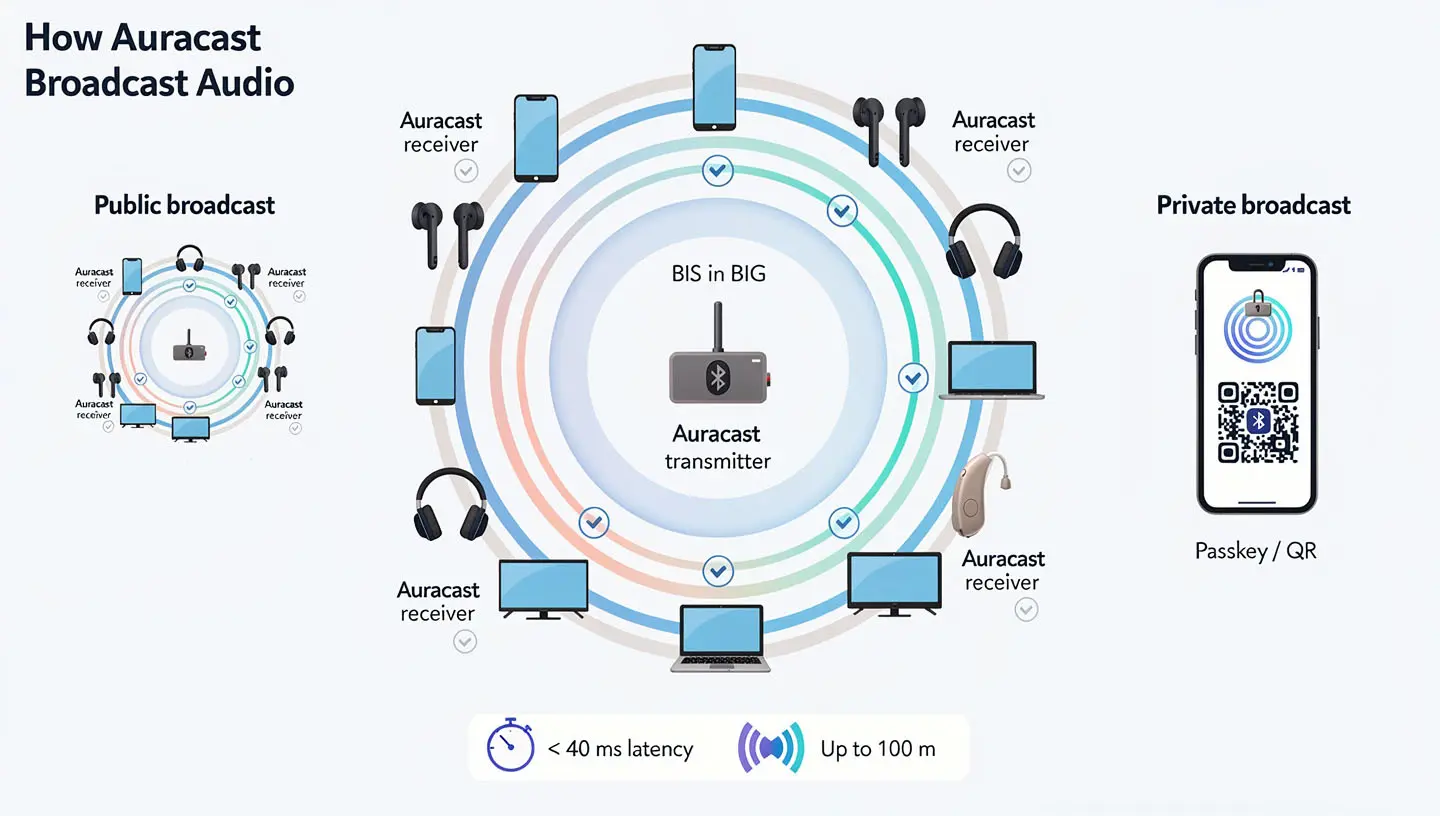
The underlying mechanism is the Broadcast Isochronous Stream (BIS). The source device creates a Broadcast Isochronous Group (BIG) and transmits audio streams inside it. Receivers synchronize to the broadcast and decode the audio. The source has no knowledge of who is listening, and there is no limit to the number of receivers. Broadcasts can be public or private. A private stream requires a passkey or a QR code scan to join.
How Auracast Works
When an Auracast transmitter is active, it advertises available streams using Bluetooth LE advertising packets. A receiver picks up that advertisement and shows the available audio channels. The user selects the one they want, the receiver synchronizes to the BIS, and audio begins. The whole process takes a few seconds and requires no pairing. Auracast latency is under 40 milliseconds. Range is roughly 30 meters indoors and up to 100 meters outdoors under good conditions. Multiple simultaneous streams are possible from the same source: a cinema could broadcast the main film on one stream and an audio description track on another, while an airport broadcasts gate announcements in multiple languages at the same time.
Auracast Use Cases
The applications for Auracast split into personal sharing and public venue access. For personal use: two people listening to the same music from one phone on separate headphones, a group joining a private broadcast from one device, or a parent watching a film at night with audio going directly to their headphones. For public venues: airports and train stations broadcasting gate announcements directly to passengers’ earbuds and hearing aids, cinemas and theaters sending film audio with no ambient room noise, museums offering guided tours in multiple languages on separate channels, gyms with muted TVs that visitors can tune into directly, churches providing services in multiple languages simultaneously, and hospitals offering TV audio to patients without disturbing others nearby.
ABI Research projected that by 2029, 1.5 million public venues will become Auracast locations. Early adopters already include the Sydney Opera House, Oslo Central Theater, St. Paul’s Cathedral, and Frankfurt Airport, which tested Auracast gate announcements in 2025. For more on Auracast specifically, see our dedicated guide: Auracast Bluetooth explained.
LE Audio vs Bluetooth Classic
The core differences between LE Audio and Bluetooth Classic come down to radio, codec, latency, and broadcast capability. Classic Audio uses the BR/EDR radio with SBC as its mandatory codec, typical latency of 100 to 200 ms, and a relay method for true wireless stereo where one earbud forwards audio to the other. It has no broadcast capability and no standardized hearing aid profile.
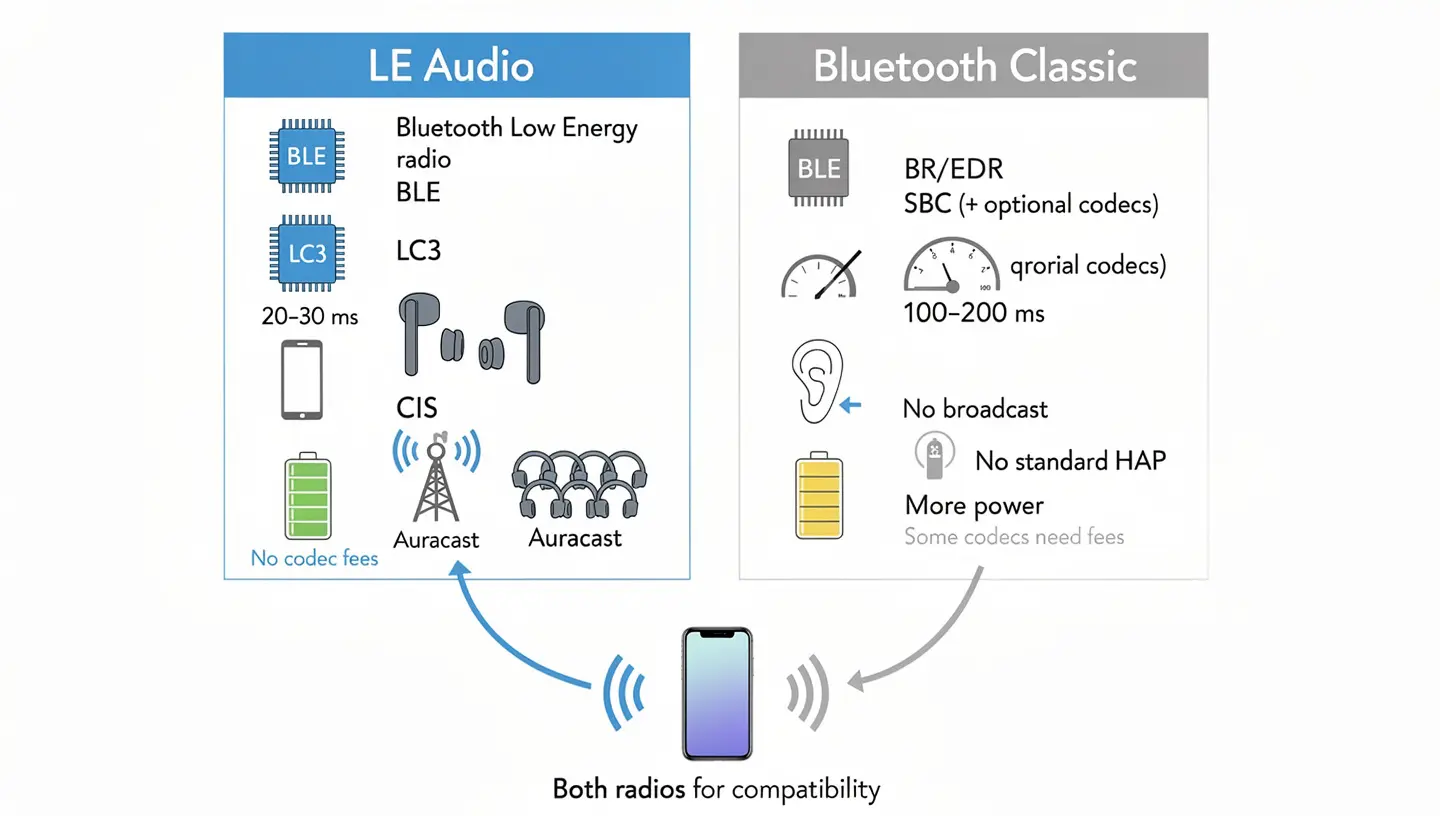
LE Audio uses the Bluetooth Low Energy radio with LC3 as its mandatory codec, latency of 20 to 30 ms, direct independent streams to each earbud via CIS, Auracast broadcast audio via BIS, the standardized Hearing Aid Profile (HAP), and lower power consumption across all devices. LC3 carries no licensing fee. SBC is also royalty-free, but optional Classic codecs like aptX require licensing.
LE Audio does not replace Classic Audio overnight. Billions of devices still use Bluetooth Classic, and smartphones carry both radios for backward compatibility. For a full breakdown across more use cases, see our guide: LE Audio vs Bluetooth Classic.
LE Audio Features and Benefits
Lower Power Consumption
Bluetooth Low Energy was built from the ground up for battery efficiency. Running audio over the LE radio reduces power draw on both the source device and the earbuds. Users of LE Audio earbuds report 20 to 30 percent longer playback times compared to equivalent Classic Bluetooth models. For hearing aids, where battery life is critical and device size limits battery capacity, the difference is even more pronounced. Lower power draw also gives manufacturers room to fit smaller batteries into smaller enclosures without sacrificing listening time.
Lower Latency
LE Audio targets 20 to 30 ms end-to-end latency, well below the 40 to 50 ms threshold where the brain starts to perceive audio and video as out of sync. Bluetooth Classic typically runs 100 to 200 ms, which is noticeable during video playback and a significant problem for gaming. At 20 to 30 ms, LE Audio is fast enough for gaming, video calls, and live monitoring.
Better Audio Quality at Lower Bitrates
LC3 delivers equal or better perceived audio quality compared to SBC at roughly half the bitrate. That efficiency lets LE Audio devices spend less power on transmission while maintaining sound quality. The audio holds together better in congested radio environments, such as crowded airports or stadiums, where packet loss would previously cause crackling or dropout with SBC.
Hearing Aid Support
LE Audio includes a standardized Hearing Aid Profile (HAP). Before LE Audio, hearing aids connected to smartphones using manufacturer-specific protocols, which limited compatibility to specific phone brands and OS versions. HAP changes that with a single open standard any device can implement. Lower latency is critical for hearing aid users because many rely on lip synchronization when following speech. At 100 to 200 ms, Bluetooth Classic introduces enough delay that lips and audio fall out of sync. At 20 to 30 ms, LE Audio keeps them aligned.
Auracast broadcast audio extends these benefits into public spaces. Hearing aid users can tune directly into a cinema’s audio feed, a gate announcement at an airport, a sermon, or a museum audio guide, all through their own hearing aids, without borrowing any external receiver. The ReSound Nexia, ReSound Vivia, Signia IX, and Jabra hearing aids already support Auracast. GN Group, the parent company of ReSound, delivered the world’s first Auracast-capable hearing aid. ABI Research projects that by 2029, 1.5 million public venues will have Auracast transmitters installed, making this the most significant upgrade to assistive listening infrastructure in decades.
Gaming and Latency with LE Audio
Gaming over Bluetooth has always been compromised by latency. With Bluetooth Classic, a 100 to 200 ms delay between a gunshot sound and the trigger pull is not acceptable in any competitive game. Many gaming headsets avoided Bluetooth entirely and used proprietary 2.4 GHz wireless to get below 40 ms. LE Audio changes that calculation. At 20 to 30 ms, footsteps, gunshots, environmental cues, and dialogue all arrive with timing fast enough for gaming to feel natural. This matters most for mobile gaming, where a 2.4 GHz dongle is not an option. With LE Audio earbuds and a compatible phone, mobile gamers get latency that Classic Bluetooth could never approach.
Device Support and Compatibility
To use LE Audio, a device needs Bluetooth 5.2 or newer hardware plus specific firmware and software support. Having Bluetooth 5.2 does not guarantee LE Audio works on a device. Manufacturers must implement the feature set, and some budget chipsets carry the radio but omit the LE Audio stack to reduce costs. On the smartphone side, support is now widespread among flagships. Samsung Galaxy S23, S24, and S25, the Galaxy Z Fold 5, Fold 6, and Fold 7 all support LE Audio with Auracast. Google Pixel 8 and newer received Auracast support in a 2025 software update. Xiaomi 14T, 14, and 15, OnePlus 11, 12, and 13, and Sony Xperia 5 V are also on the confirmed list. Windows 11 version 22H2 and later supports LE Audio on compatible hardware. Apple iPhones do not currently support LE Audio or Auracast.
On the earbud and headphone side, supported devices include the Samsung Galaxy Buds 2 Pro, EarFun Air Pro 3 and Air Pro 4, OnePlus Buds Pro 2, Sony WF-1000XM5, Sony WH-1000XM6, and a growing range of earbuds based on Qualcomm QCC30xx-series chips, including models from SoundPEATS, TOZO, and Anker.
LE Audio Devices in 2026
In 2026, LE Audio support is standard on flagship smartphones from Samsung, Google, and Xiaomi. The mid-range is catching up quickly, and earbud support has expanded from a short list of premium models in 2022 to dozens of options across all price ranges. Bluetooth SIG’s 2024 Bluetooth Market Update projected that by the end of the decade, LE Audio will be the dominant Bluetooth audio standard.
Phones with confirmed LE Audio support in 2026 include the Samsung Galaxy S25 series, Google Pixel 9 series, Xiaomi 15 and 15 Ultra, OnePlus 13, and Sony Xperia 1 VII. Earbuds and headphones with support include the Samsung Galaxy Buds 3 Pro, EarFun Air Pro 4, Sony WF-1000XM5, Sony WH-1000XM6, OnePlus Buds Pro 2, SoundPEATS Air5 Pro, and a broad range of Qualcomm QCC30xx-based models. Hearing aids with Auracast support include the ReSound Nexia, ReSound Vivia, Signia IX, and Jabra Enhance Select. Public venues with Auracast transmitters installed include the Sydney Opera House, Oslo Central Theater, Frankfurt Airport, Marriott Theatre, and hundreds of houses of worship and cultural venues across the US, UK, and Europe.
LE Audio vs LDAC: Which Is Better?
LDAC is Sony’s high-resolution Bluetooth codec, pushing up to 990 kbps, well above LC3’s 345 kbps ceiling. At its highest bitrate, LDAC delivers audio that is perceptually very close to lossless, and it is the preferred codec for audiophiles on hardware that supports it. LC3 does not match LDAC at the top of the bitrate range. If maximum audio resolution is the priority and both devices support LDAC, LDAC is the better codec for that specific goal.
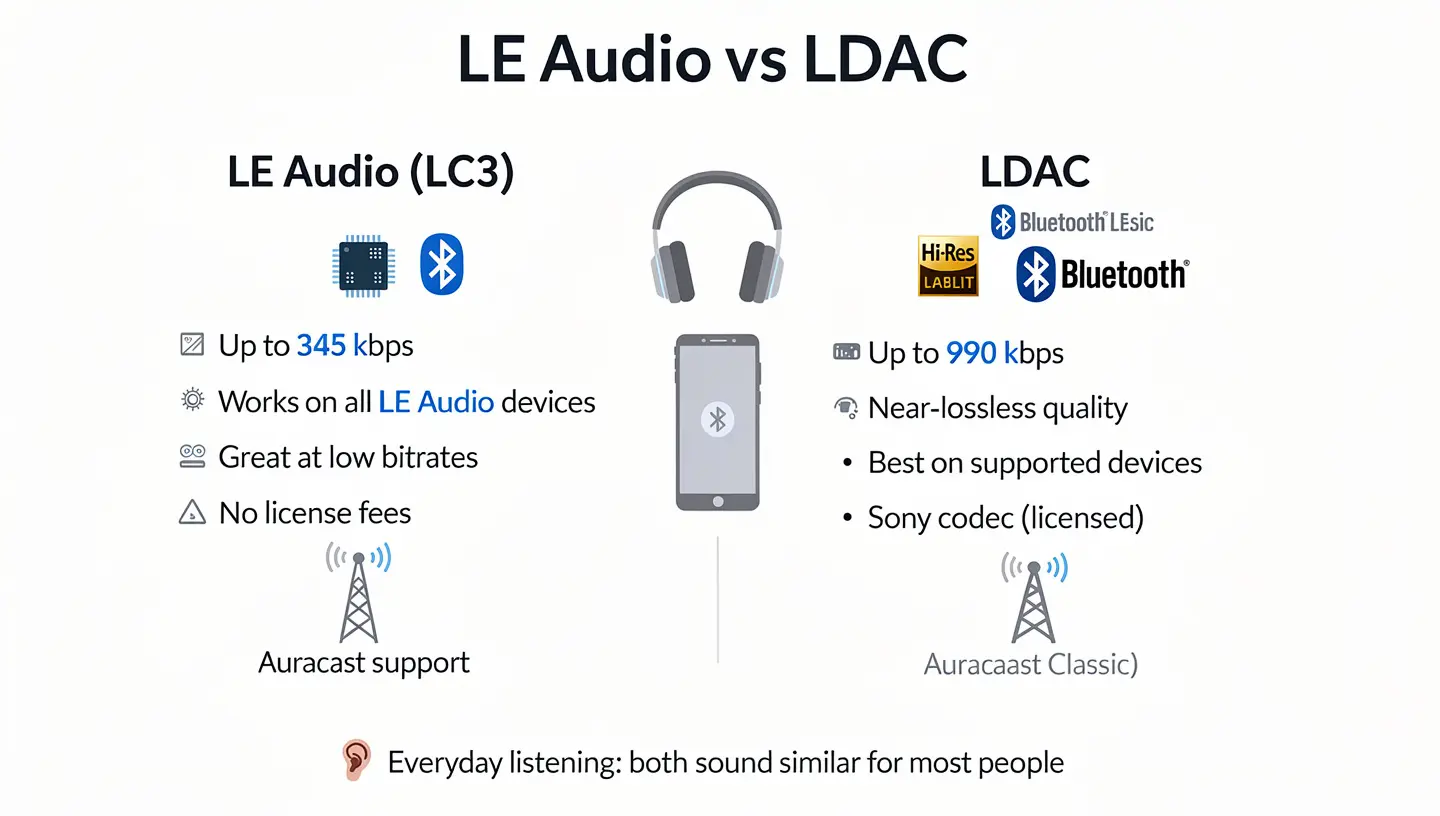
LC3 has advantages LDAC does not. It runs on any LE Audio hardware regardless of manufacturer, carries no licensing fee, works well at much lower bitrates without quality collapse, and is the only codec that works over Auracast broadcast audio. For everyday listening, the difference between LC3 at 160 kbps and LDAC at 990 kbps is inaudible to most people on most headphones in most environments. Full comparison: LE Audio vs LDAC.
Pros and Cons of LE Audio
Pros: Lower power consumption with 20-30% longer battery life in practice. LC3 delivers equal or better quality than SBC at half the bitrate, royalty-free. Latency of 20 to 30 ms, usable for gaming and video without noticeable desync. True stereo streaming to each earbud independently with no relay method. Auracast broadcast audio enables one-to-many listening without pairing. Hearing Aid Profile (HAP) standardizes hearing aid connectivity across all brands. Built into the Bluetooth specification itself, no manufacturer-specific implementation required.
Cons: Requires Bluetooth 5.2 minimum hardware. Older devices cannot be updated to support it. No Apple support as of early 2026. LC3 does not match LDAC at peak bitrate for high-resolution listening. Auracast venue adoption is still early, with most public spaces yet to install transmitters. Not all Bluetooth 5.2 devices support LE Audio since budget chipsets often omit the feature.
Final Verdict: Is LE Audio Worth It?
If you use an Android smartphone from Samsung, Google, or Xiaomi released in 2023 or later, LE Audio is already on your device. The question is whether your earbuds support it. For anyone buying new earbuds in 2026, LE Audio should be on the checklist. The combination of lower power consumption, better codec efficiency, cleaner stereo separation, and real gaming latency makes it a genuine improvement over Bluetooth Classic in every category that matters for everyday use.
Auracast is the feature that will take longer to reach its potential because it depends on venue adoption. That adoption is accelerating, particularly in hearing aid communities, cinemas, and airports, but most public spaces have not installed transmitters yet. That is a timing issue, not a technical one. The technology works today anywhere it has been deployed.
The only group for whom LE Audio is not immediately relevant is Apple users. iPhones do not support LC3 or Auracast. If that changes, Apple’s enormous installed base would accelerate adoption sharply. Until then, LE Audio is largely an Android and Windows story. For our current picks with LE Audio support, the best wireless earbuds guide is regularly updated. If you want to understand how Snapdragon Sound fits alongside LE Audio and LC3 in the broader chipset picture, our guide on Snapdragon Sound covers how Qualcomm’s ecosystem builds on top of these Bluetooth specs.